The regulatory mechanism and detection application of interleukin-3 in multiple sclerosis


Interleukin-3 (IL-3), as a critical hematopoietic growth factor and inflammatory regulator, plays a pivotal role in the pathogenesis of multiple sclerosis (MS) and its animal model, experimental autoimmune encephalomyelitis (EAE).
- Recent Advances
- Product Information
1. What is the core role of IL-3 in multiple sclerosis?
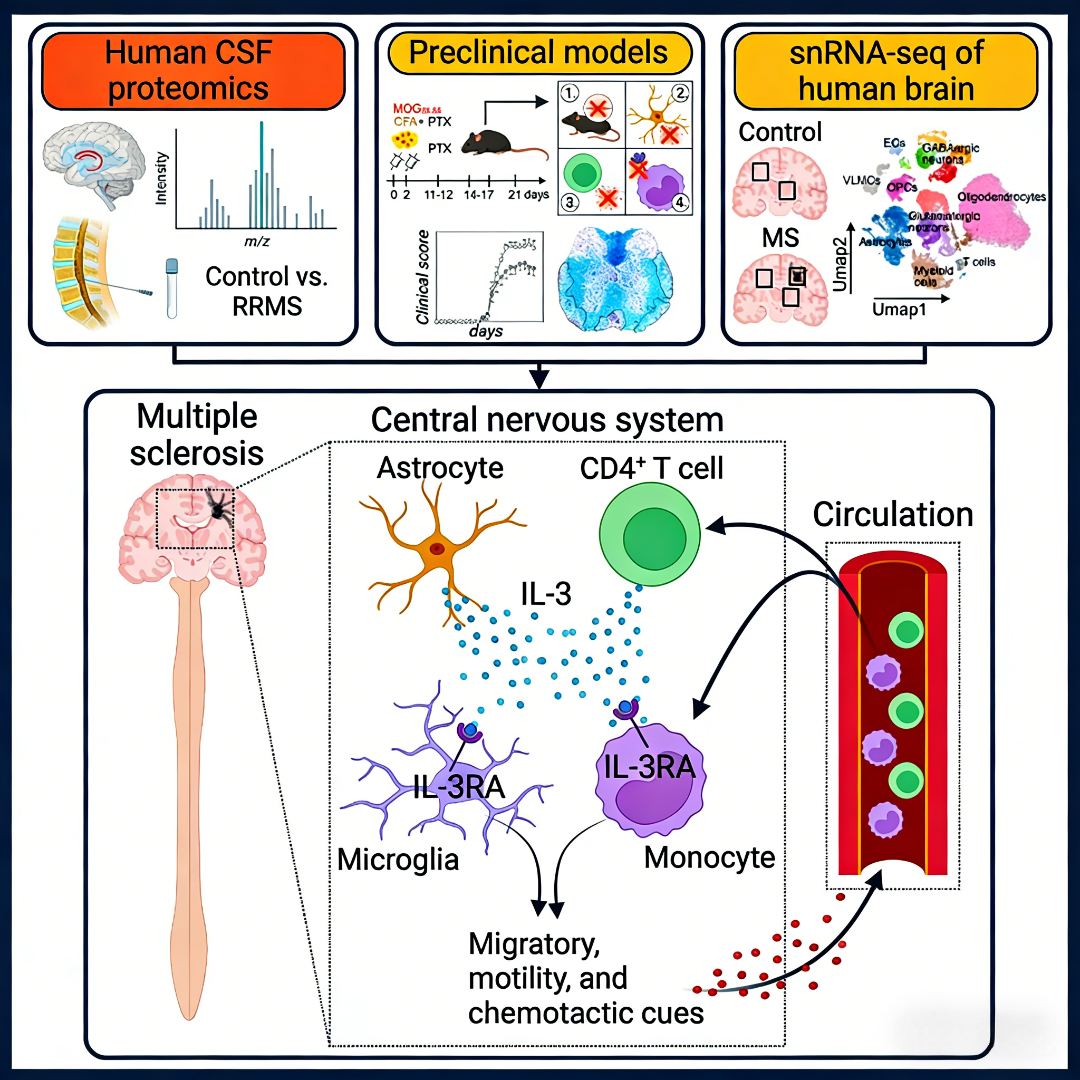
Interleukin-3 (IL-3), as a critical hematopoietic growth factor and inflammatory regulator, plays a vital role in the pathogenesis of multiple sclerosis (MS) and its animal model (experimental autoimmune encephalomyelitis, EAE). Clinical studies show that the cerebrospinal fluid (CSF) levels of IL-3 are significantly elevated in relapsing-remitting multiple sclerosis (RRMS) patients and correlate with disease activity. In EAE models, IL-3 knockout mice exhibit markedly reduced clinical symptoms, spinal cord inflammation, and demyelination, directly confirming the key role of IL-3 in promoting central nervous system (CNS) inflammation and autoimmune responses.
2. What are the cellular sources of IL-3 in the central nervous system?
In the inflammatory environment of the CNS, IL-3 is primarily produced by two types of cells: astrocytes and activated CD4⁺ T cells (particularly the CD44hi subset). Immunofluorescence and flow cytometry analyses reveal that astrocytes continuously produce IL-3, while infiltrating CD4⁺ T cells begin producing IL-3 in peripheral immune organs during the early stages of the disease and migrate to the CNS to further secrete it as the disease progresses. Cell-specific knockout experiments confirm that the absence of IL-3 from either astrocytes or T cells significantly alleviates EAE severity, reduces spinal cord immune cell infiltration, and lowers chemokine expression, indicating that IL-3 from both cellular sources collectively regulates disease progression.
3. How does IL-3 regulate myeloid cell function through its receptor?
IL-3 initiates downstream signaling by binding to the IL-3 receptor α chain (IL-3Rα) on target cell surfaces. In the CNS, IL-3Rα is primarily expressed on microglia, monocyte-derived dendritic cells, MHC II⁺ macrophages, and other myeloid cells. IL-3Rα knockout mice exhibit significantly milder disease phenotypes in EAE models, confirming that this receptor is a key mediator of IL-3's pro-inflammatory effects. Mechanistic studies demonstrate that IL-3 induces the differentiation of these myeloid cells into antigen-presenting cells and significantly upregulates the expression of chemokines such as CCL2, CCL5, and CCL12, thereby enhancing immune cell recruitment and infiltration into the CNS and forming an inflammatory amplification loop.
4. What clinical evidence supports the role of the IL-3/IL-3R pathway in human multiple sclerosis?
Single-cell transcriptome sequencing provides direct evidence for the role of the IL-3/IL-3R pathway in human MS. Myeloid cells in the brain tissue of MS patients exhibit significant heterogeneity, with subsets highly expressing IL-3Rα showing distinct migration- and adhesion-related gene signatures. These cells not only increase in number but also display chemokine expression profiles correlated with disease severity. Importantly, IL-3 levels in the CSF of MS patients are significantly positively correlated with the degree of myeloid cell and T cell infiltration in the CNS, further supporting the central role of the IL-3/IL-3R axis in mediating neuroimmune crosstalk and driving chronic neuroinflammation.
5. What are the key applications of IL-3/IL-3R detection kits?
Given the critical role of the IL-3/IL-3R pathway in neuroinflammatory diseases, high-sensitivity, high-specificity detection kits have significant applications in the following areas:
1. Disease diagnosis and stratification: Measuring IL-3 levels in CSF or peripheral blood can serve as potential biomarkers for neuroimmune diseases like MS, aiding clinical diagnosis and disease activity assessment.
2. Treatment response monitoring: In the development and application of IL-3/IL-3R-targeted therapies (e.g., monoclonal antibodies), dynamic monitoring of IL-3 and its receptor expression levels can provide objective indicators for efficacy evaluation.
3. Pathogenesis research: In basic and translational research, precise quantification of IL-3 production and response helps elucidate the cellular and molecular mechanisms of neuroimmune interactions.
4. Drug screening and development: In drug development for MS and related diseases, IL-3/IL-3R detection kits can be used for high-throughput screening of IL-3 signaling pathway inhibitors or modulators.
6. Which manufacturers provide IL-3/IL-3R detection kits?
Nanjing U-Protein自主研发的 "Human IL3/IL3R Binding Kit" is a high-performance in vitro detection tool specifically designed for studying hematopoietic regulation, immune cell differentiation, and inflammatory signaling pathways. This kit is dedicated to accurately and efficiently quantifying the binding activity between interleukin-3 (IL-3) and its specific receptor IL-3R, providing a stable, sensitive, and standardized analysis platform for mechanism research, drug screening, and functional evaluation in fields such as hematologic diseases, immune regulation, tumor microenvironments, and therapeutic antibody/drug development.
| Core Advantages of the Product |
|---|
| High bioactivity and correct conformation: The kit provides rigorously quality-controlled, high-purity, high-activity human IL-3 protein and its receptor IL-3R. The proteins maintain native conformation and full biological function, accurately simulating the high-affinity binding of the IL-3/IL-3R signaling pathway under physiological conditions, ensuring experimental accuracy and physiological relevance. |
| Exceptional stability and batch-to-batch consistency: Utilizing advanced recombinant expression systems and precise purification processes, combined with stringent quality control throughout production, ensures high purity, excellent long-term stability, and outstanding batch-to-batch consistency, supporting long-term, continuous experimental research and data comparison. |
| Ready-to-use flexible detection platform: Based on mature enzyme-linked immunosorbent assay (ELISA) technology, the kit provides pre-coated strips, detection antibodies, standards, and a complete optimized buffer system. The operation is simple and fast, with high sensitivity and specificity, suitable for various applications such as antibody screening, affinity determination, competitive binding assays, and signaling pathway mechanism research. |
| Comprehensive solutions and professional support: The kit includes detailed standard operating procedures, typical data curves, and result analysis guidelines to help quickly establish reliable detection workflows. A professional technical team provides full consultation and support for research design, experimental optimization, and data interpretation. |
Nanjing U-Protein is committed to providing high-quality, high-performance key reagents and tools for immunology, hematology, and biopharmaceutical research. For detailed technical information, validation data, or specific application support regarding the "Human IL3/IL3R Binding Kit" (Catalog No.: UA086011), please feel free to contact us.
This article is reviewed and published by the technical expert team of UA
Disclaimer: This article partially utilizes artificial intelligence assistance in its creation. If any content involves copyright or intellectual property issues, please let us know and we promise to verify and remove it as soon as possible.
Purchase recombinant protein, choose 
UA protein focuses on providing various protein reagents, raw materials, and services required for drug research and development, cell therapy, gene therapy, and basic scientific research, including drug target proteins, immune checkpoint proteins, cytokines, tool enzymes, customized protein expression, and full-length transmembrane protein development. Nanjing Univ is committed to providing customers with high-quality products and professional services, and building a High-tech Biological Enterprise with International Competitiveness.







 Business license (three certificates in one)