

Interleukin-2 (IL-2) Regulatory Mechanisms and Detection Applications in Autoimmune Diseases


Interleukin-2 (IL-2) is a four α-helix bundle cytokine primarily produced by CD4⁺ T cells, playing a central role in the regulation of adaptive immunity.
- Recent Advances
- Product Information
1. What is the Key Role of IL-2 in the Immune System?
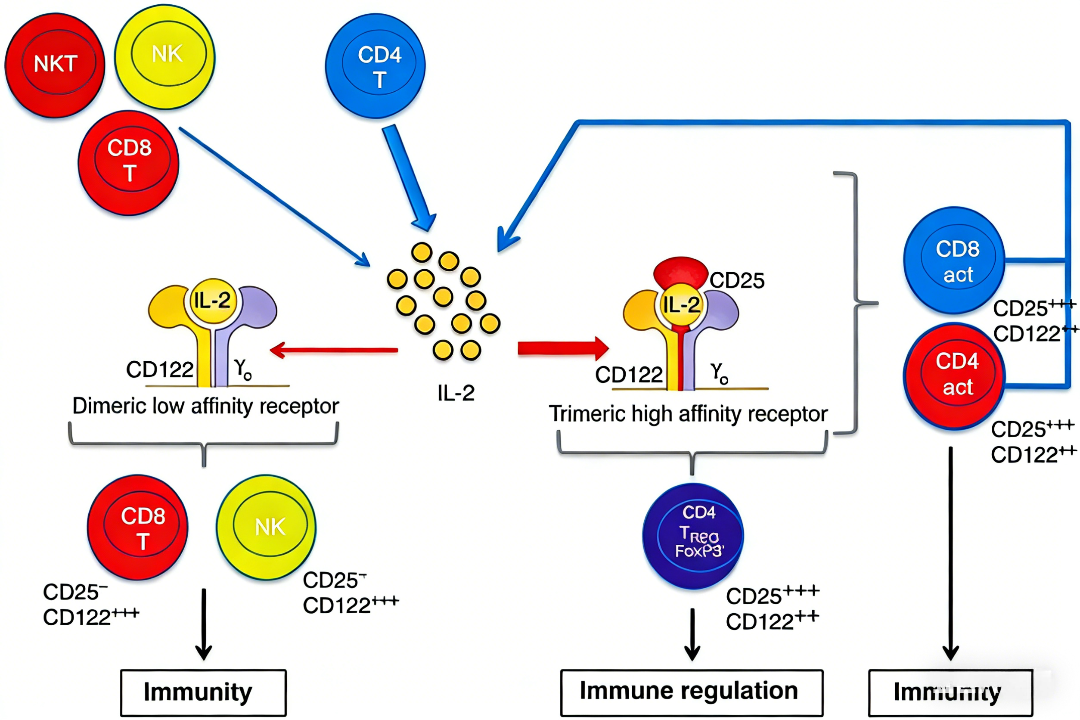
Interleukin-2 (IL-2), a four α-helix bundle cytokine primarily produced by CD4⁺ T cells, plays a central role in adaptive immune regulation. Traditionally recognized as a T-cell growth factor promoting effector T-cell proliferation and differentiation, deeper research has revealed that IL-2 is equally critical for the survival, stability, and functional maintenance of regulatory T cells (Treg). Treg cells highly express the IL-2 receptor α-chain (CD25), granting them higher affinity for IL-2. This allows low-dose IL-2 to preferentially stimulate Treg cells over effector T cells, forming the theoretical basis for its application in autoimmune disease treatment.
2. How Does IL-2 Transmit Signals Through Its Receptor System?
IL-2 functions via a receptor complex composed of the α-chain (CD25), β-chain (CD122), and γ-chain (CD132). These subunits form receptors with varying affinities: low-affinity monomeric CD25 (Kd ≈ 10⁻⁸ M), medium-affinity βγ dimer (Kd ≈ 10⁻⁹ M), and high-affinity αβγ trimer (Kd ≈ 10⁻¹¹ M). Upon binding to the high-affinity receptor, IL-2 activates JAK1 and JAK3 kinases associated with the β and γ chains, primarily through the STAT5 signaling pathway (accounting for ~90% of signal transduction), while also activating the PI3K-AKT-mTOR and MAPK pathways. This regulates downstream gene expression, mediating cell proliferation, differentiation, and functional modulation.
3. How Does IL-2 Regulate the Balance Between Treg and Th17 Cells?
IL-2 exhibits dual regulatory roles in maintaining immune homeostasis: promoting Treg cell development, survival, and function while inhibiting Th17 cell differentiation. Treg cells do not produce IL-2 themselves and rely entirely on exogenous IL-2 to maintain FOXP3 expression and immunosuppressive function. Conversely, IL-2 suppresses the key Th17 differentiation transcription factor RORγt via STAT5 activation, thereby limiting Th17 cell development. This balancing mechanism is vital for preventing autoimmune reactions. Dysregulation of IL-2 signaling in many autoimmune diseases leads to impaired Treg function and enhanced Th17 responses, exacerbating disease progression.
4. What Are the Clinical Application Strategies for IL-2?
The clinical use of IL-2 has evolved significantly from high-dose cancer immunotherapy to low-dose autoimmune disease treatment. Since its first report in 1984, high-dose IL-2—capable of activating effector T cells and NK cells—has been FDA-approved for metastatic renal cell carcinoma and melanoma. However, the discovery of the "IL-2 paradox"—where IL-2-deficient mice exhibit severe autoimmunity rather than immunodeficiency—revealed IL-2's essential role for Treg cells. Based on this, low-dose IL-2 strategies (daily 300,000–3 million IU) were developed to selectively expand Treg cells without activating effector T cells. Early clinical trials in systemic lupus erythematosus, rheumatoid arthritis, and other autoimmune diseases have shown promising efficacy and tolerability.
5. What Are the Clinical Applications of IL-2/IL-2R Detection Kits?
Accurate detection of IL-2 and its receptor levels holds multifaceted clinical value:
1. Disease Diagnosis and Assessment: Measuring soluble IL-2 receptor (sIL-2R) levels in serum or plasma aids in evaluating the activity and severity of autoimmune diseases like systemic lupus erythematosus and rheumatoid arthritis. Elevated sIL-2R typically reflects T-cell activation.
2. Immune Status Monitoring: Quantifying peripheral Treg cell counts and CD25 expression alongside IL-2 levels assesses immune regulatory status, providing diagnostic insights for immune imbalance-related disorders.
3. Treatment Guidance and Monitoring: During low-dose IL-2 therapy, dynamic tracking of Treg expansion, CD25 expression changes, and IL-2 levels optimizes treatment regimens for personalized precision medicine.
4. Prognostic Evaluation: Studies indicate that peripheral sIL-2R levels in autoimmune patients correlate with disease activity, organ damage, and treatment response, serving as a potential prognostic biomarker.
6. Which Manufacturers Provide IL-2/IL-2R Detection Kits?
Nanjing U-Protein's independently developed TR-FRET Human IL-2/IL-2R Binding Kit (Catalog #: UA086010) is a high-performance detection platform based on advanced time-resolved fluorescence energy transfer (TR-FRET) technology. Designed for precise, efficient quantification of interleukin-2 (IL-2) binding kinetics with its specific receptor IL-2R, this kit is ideal for mechanistic studies, drug screening, and affinity evaluation in T-cell immunoregulation, autoimmune diseases, cancer immunotherapy, and antibody drug development. It offers a sensitive, rapid, and homogeneous in vitro detection solution.
| Core Product Advantages |
|---|
| High Sensitivity and Broad Dynamic Range: The TR-FRET-based system minimizes background noise and maximizes sensitivity, enabling accurate quantification across wide concentration ranges—especially suited for low-abundance or weak-interaction analyses. |
| Native Conformation and High Bioactivity: The kit provides rigorously validated, high-purity human IL-2 protein and IL-2R with intact spatial conformation and full biological activity, ensuring binding experiments reflect physiological interactions. |
| Homogeneous Detection and User-Friendly Operation: Featuring a "mix-and-read" homogeneous format without washing steps, it reduces processing time and errors while supporting high-throughput screening and automation. |
| Exceptional Stability and Batch Consistency: Advanced recombinant expression and strict quality control ensure superior stability and inter-batch consistency, guaranteeing long-term reproducibility and data reliability. |
| Comprehensive Support: We provide optimized protocols, standard curve examples, data analysis guides, and tailored assistance for experimental design, optimization, and interpretation. |
Nanjing U-Protein is committed to delivering cutting-edge, high-quality core reagents and tools for immunology, cell therapy, and drug discovery. For detailed technical specifications, validation data, or application inquiries regarding the TR-FRET Human IL-2/IL-2R Binding Kit (Catalog #: UA086010), please contact us anytime.
This article is reviewed and published by the technical expert team of UA
Disclaimer: This article partially utilizes artificial intelligence assistance in its creation. If any content involves copyright or intellectual property issues, please let us know and we promise to verify and remove it as soon as possible.
Purchase recombinant protein, choose 
UA protein focuses on providing various protein reagents, raw materials, and services required for drug research and development, cell therapy, gene therapy, and basic scientific research, including drug target proteins, immune checkpoint proteins, cytokines, tool enzymes, customized protein expression, and full-length transmembrane protein development. Nanjing Univ is committed to providing customers with high-quality products and professional services, and building a High-tech Biological Enterprise with International Competitiveness.







 Business license (three certificates in one)