

Epigenetic regulator BRD4: from basic functions to targeted degradation strategies


BRD4 (Bromodomain-containing protein 4) is a key member of the BET protein family, functioning as a critical transcriptional regulator involved in multi-level gene expression regulation.
- Recent Advances
- Product Information
I. What are the core functions of BRD4 in normal physiological processes?
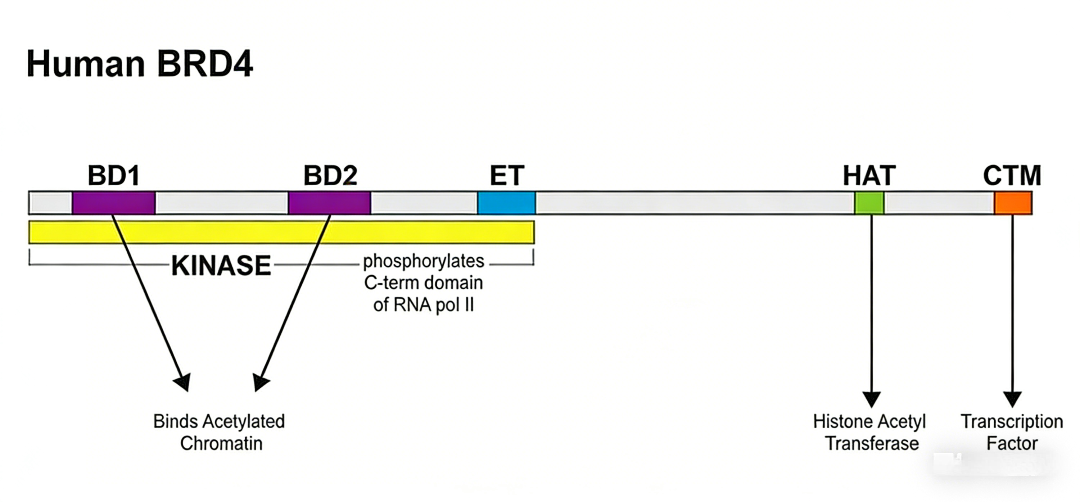
BRD4 (Bromodomain-containing protein 4) is a key member of the BET protein family, serving as a crucial transcriptional regulator involved in multi-level gene expression control. This protein contains two highly conserved N-terminal bromodomains (BD1 and BD2), enabling it to specifically recognize and bind acetylated histones, thereby maintaining epigenetic memory during cell division—a process known as "transcriptional bookmarking." Additionally, BRD4 possesses histone acetyltransferase (HAT) activity, serine kinase activity (primarily targeting RNA polymerase II), and functions as a transcription factor nucleation platform through its C-terminal domain (including the extraterminal domain ET), interacting with key transcriptional regulators such as P-TEFb, MYC, and NF-κB. These functions make BRD4 indispensable in cell cycle regulation, stem cell differentiation (including hematopoietic stem cell differentiation into B/T cells), and tissue development processes.
II. What role does BRD4 play in cancer development?
Dysregulation of BRD4 expression is closely associated with the development of various malignancies. In hematological tumors, BRD4 drives abnormal proliferation of tumor cells by sustaining the expression of oncogenes like MYC. Clinical studies have found abnormal expression patterns of BRD4 in solid tumors such as breast cancer, colon cancer, and prostate cancer. Notably, the discovery of BRD4-NUT fusion proteins in certain aggressive midline carcinomas directly demonstrates the pathogenic role of BRD4 in cancer. These findings establish BRD4 as an important potential therapeutic target, and the development of inhibitors targeting this protein has become a hotspot in cancer targeted therapy.
III. What are the limitations of traditional BRD4 inhibitors?
Most bromodomain inhibitors currently in clinical development can simultaneously target multiple members of the BET family (including BRD2, BRD3, BRD4, and BRDT). While this broad-spectrum inhibition can block BRD4's binding to acetylated chromatin and suppress transcription of key oncogenes like MYC, it may also lead to unpredictable off-target effects and clinical toxicity. Furthermore, traditional inhibitors typically only temporarily block BRD4 function without achieving complete elimination of the target protein, making them prone to drug resistance. These limitations have prompted researchers to develop more selective and efficient targeting strategies.
IV. How does PROTAC technology revolutionize BRD4-targeted therapy?
Proteolysis-targeting chimera (PROTAC) technology has brought revolutionary breakthroughs to BRD4-targeted therapy. BRD4/CRBN degraders based on PROTAC form ternary complexes by linking BRD4 ligands with CRBN E3 ubiquitin ligase-recruiting molecules, thereby inducing ubiquitination and proteasomal degradation of BRD4. Compared to traditional inhibitors, PROTAC degraders offer unique advantages: they achieve complete elimination of the target protein rather than temporary inhibition; they exhibit sub-stoichiometric catalytic activity, enabling more sustained pharmacological effects; they may overcome certain resistance mechanisms; and through rational design, they can improve selectivity for BRD4 while minimizing effects on other BET family members.
V. What are the applications of BRD4/CRBN PROTAC detection kits?
Specialized detection kits for BRD4/CRBN PROTAC degradation systems have multiple important applications in drug development and mechanistic research:
1. Degradation efficiency evaluation: Quantitatively detect changes in intracellular BRD4 protein levels after PROTAC treatment, accurately assessing the efficacy and optimal concentration of different degraders.
2. Kinetic studies: Dynamically monitor the entire process of BRD4 degradation and resynthesis, providing data support for optimizing dosing regimens.
3. Specificity validation: Simultaneously detect protein levels of other BET family members (BRD2, BRD3) to evaluate the selectivity of PROTAC degraders.
4. Mechanistic exploration: Investigate the specific molecular mechanisms of PROTAC-induced protein degradation by detecting ubiquitination levels, proteasome activity, and other indicators.
5. Combination therapy research: Evaluate the synergistic effects of PROTAC degraders with traditional chemotherapy drugs and targeted therapies, providing experimental basis for combination treatment development.
VI. Which manufacturers provide BRD4/CRBN PROTAC detection kits?
Nanjing U-Protein自主研发的 "TR-FRET Human BRD4/CRBN PROTAC Binding Kit" (Product No.: UA086009) is an innovative high-throughput screening platform designed specifically for PROTAC (proteolysis-targeting chimera) drug development, based on advanced Time-Resolved Fluorescence Resonance Energy Transfer (TR-FRET) technology. This kit aims to precisely and efficiently detect the formation of ternary complexes where PROTAC molecules simultaneously bind to the target protein BRD4 and the E3 ubiquitin ligase CRBN, providing a sensitive, rapid, and homogeneous standard solution for molecular design, potency evaluation, mechanism research, and lead compound optimization in the field of targeted protein degradation.
| Core Product Advantages |
|---|
| Designed specifically for PROTAC mechanisms: Directly simulates the "target protein-E3 ligase" ternary complex formation process induced by PROTAC, truly reflecting the bifunctional binding efficiency and induced proximity effects of PROTAC molecules, enabling early assessment from simple binding to functional degradation potential. |
| High sensitivity and low background interference: Utilizes TR-FRET detection technology with time-resolved and dual-wavelength detection advantages, effectively eliminating compound fluorescence interference with low background signals and high sensitivity, particularly suitable for high-throughput screening of complex compound libraries. |
| Ready-to-use homogeneous detection system: The experimental process follows a "mix-incubate-detect" homogeneous mode, requiring no washing or separation steps, with simple and fast operation compatible with automated workstations, significantly improving screening throughput and data consistency. |
| Strictly validated high-quality proteins: The kit provides high-purity, high-activity human recombinant BRD4 protein with specific tags and CRBN protein (containing key components of the CRL4^CRBN complex). Both maintain native conformations and complete functional domains, ensuring physiological relevance and data reliability in interaction detection. |
| Excellent stability and batch-to-batch consistency: Produced using advanced expression systems and precise processes with strict quality control throughout, ensuring protein products exhibit outstanding stability and exceptional batch-to-batch consistency, supporting long-term and continuous drug development projects. |
| Complete solutions and professional support: We provide detailed optimized experimental protocols, standard curve examples, and data analysis guidelines, along with professional technical consultation and customized support for special requirements in PROTAC development (such as linker length optimization, degradation activity correlation analysis, etc.). |
Nanjing U-Protein remains committed to providing cutting-edge, high-performance tools and solutions for targeted protein degradation, epigenetics, and innovative drug development. For detailed technical parameters, validation data, or specific application solutions regarding the TR-FRET Human BRD4/CRBN PROTAC Binding Kit (Product No.: UA086009), please feel free to contact us.
This article is reviewed and published by the technical expert team of UA
Disclaimer: This article partially utilizes artificial intelligence assistance in its creation. If any content involves copyright or intellectual property issues, please let us know and we promise to verify and remove it as soon as possible.
Purchase recombinant protein, choose 
UA protein focuses on providing various protein reagents, raw materials, and services required for drug research and development, cell therapy, gene therapy, and basic scientific research, including drug target proteins, immune checkpoint proteins, cytokines, tool enzymes, customized protein expression, and full-length transmembrane protein development. Nanjing Univ is committed to providing customers with high-quality products and professional services, and building a High-tech Biological Enterprise with International Competitiveness.







 Business license (three certificates in one)