

Study on the role and mechanism of DDB1 in transcriptional regulation during adipocyte differentiation


Adipocyte differentiation is a complex biological process in which preadipocytes transform into mature adipocytes, involving the precise regulation of a series of transcription factors and closely associated with the development of metabolic diseases such as obesity.
- Recent Advances
- Product Information
1. What are the key scientific questions regarding transcriptional regulation mechanisms in adipocyte differentiation?
Adipocyte differentiation is a complex biological process where preadipocytes transform into mature adipocytes, involving precise regulation by a series of transcription factors closely related to the development of metabolic diseases such as obesity. Although several key transcription factors have been identified, the specific mechanisms by which preadipocytes perceive and integrate external signals to initiate transcriptional cascades remain incompletely understood. Transcriptional initiation, as a critical stage of adipocyte differentiation, holds significant scientific importance for elucidating obesity mechanisms through the analysis of its molecular regulatory network.
2. What are the molecular characteristics and biological functions of DDB1 protein?
DDB1 (Damage-specific DNA-binding protein 1) was initially discovered as a component of the UV-induced DNA damage repair complex. Currently, DDB1 is known to be the core scaffold protein of the Cullin 4 (CUL4) ubiquitin ligase complex, recognizing specific substrates through its WD40 domain to participate in protein ubiquitination and degradation processes, thereby regulating various cellular physiological activities. Notably, recent studies have found that the anti-obesity factor WDTC1 inhibits adipocyte differentiation via the CUL4 complex, yet the specific substrates of this complex remain to be elucidated, suggesting that DDB1 may play roles in metabolic regulation beyond traditional ubiquitination functions.
3. How does DDB1 regulate transcriptional initiation in adipocyte differentiation independently of CUL4?
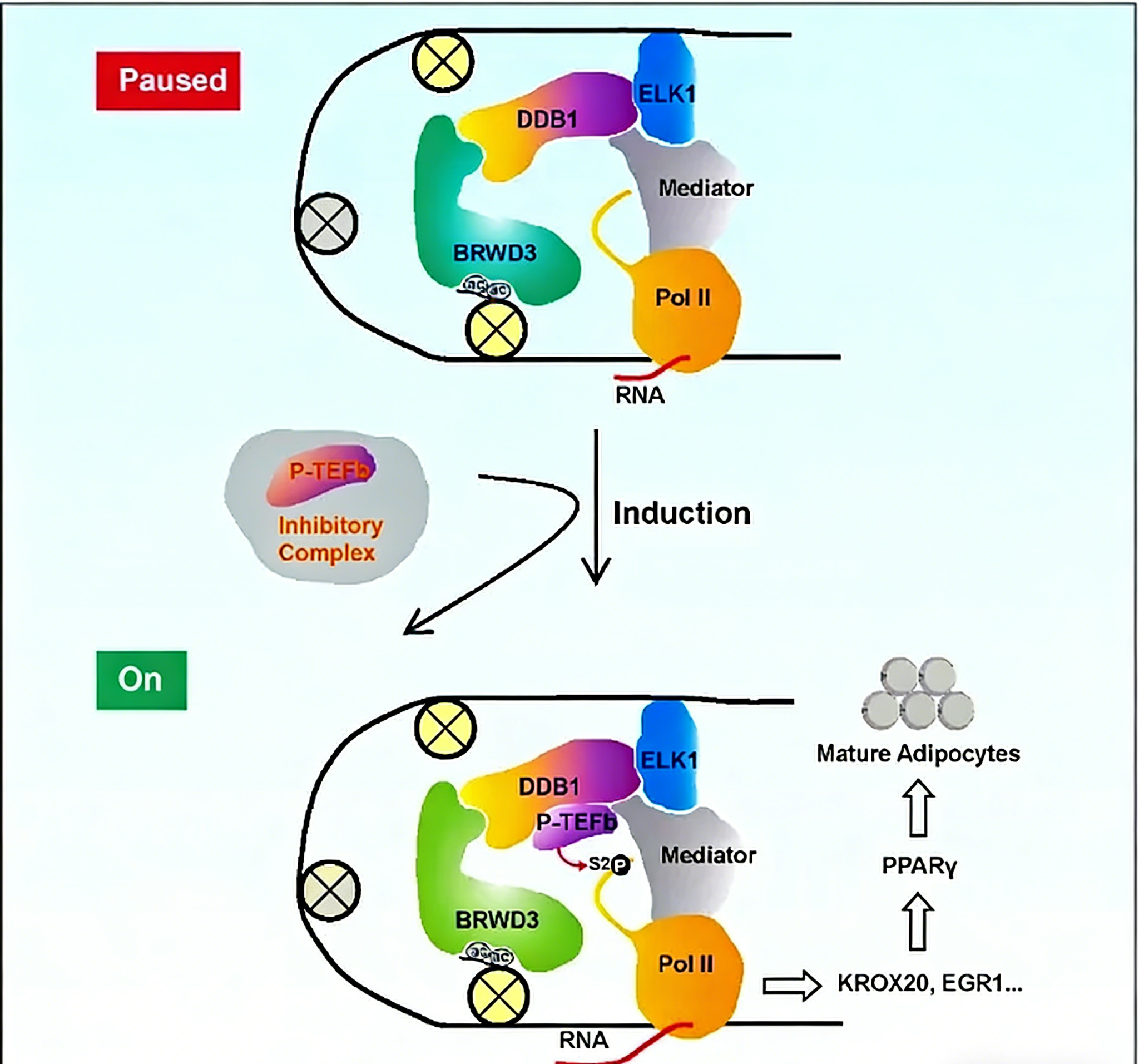
Recent research has revealed that DDB1 can directly regulate transcriptional initiation events during adipocyte differentiation in a manner independent of CUL4 ubiquitin ligase activity. In preadipocytes, DDB1 binds to the histone reader protein BRWD3 to form a pre-initiation complex at the promoter regions of the earliest adipogenic genes. In the absence of differentiation signals, RNA polymerase II (Pol II) completes the assembly of the transcription initiation complex but enters a paused state, halting transcription at the early stage. Upon receiving differentiation signals, DDB1 recruits the positive transcription elongation factor b (P-TEFb) from inhibitory complexes to gene promoter regions, phosphorylating and releasing paused Pol II, thereby initiating the first wave of transcriptional events. This mechanism elucidates DDB1's novel function in activating the adipocyte differentiation transcriptional cascade by regulating Pol II pause-release.
4. What is the special significance of Pol II pause-release in adipocyte differentiation?
The Pol II pause-release mechanism serves as a critical regulatory node in gene transcription, playing essential roles in developmental processes and stress response gene expression. In adipocyte differentiation, this mechanism has been proven to be the key regulatory switch for initiating differentiation-related gene expression. High-throughput analyses such as ChIP-Seq and RNA-Seq have confirmed that DDB1-regulated Pol II pause-release directly determines the transcriptional activity of the earliest adipogenic genes, constituting the initiating switch of the adipocyte differentiation transcriptional regulatory network. This discovery not only reveals a new mechanism of transcriptional regulation in adipocyte differentiation but also provides fresh perspectives for understanding transcriptional regulation in other cell differentiation processes.
5. What are the application values of the DDB1-CRBN&GSPT1 PROTAC Detection Kit?
Given DDB1's pivotal role in transcriptional regulation, specialized detection kits targeting DDB1-related protein degradation systems hold significant application value in metabolic disease research and drug development:
| Application Value | Specific Description |
|---|---|
| Mechanistic Research Tool | Can be used to study DDB1's transcriptional regulatory functions in adipocyte differentiation and other physiological processes, particularly its CUL4-independent mechanisms. |
| Drug Screening Platform | In developing innovative drugs for obesity and related metabolic diseases, this kit serves as a detection tool for evaluating drug effects on DDB1-related signaling pathways. |
| Protein Degradation Efficiency Assessment | For PROTAC-based DDB1 degraders, the expression changes of key components like CRBN and GSPT1 can be accurately measured to assess protein degradation efficiency. |
| Metabolic Regulation Research | In fields such as adipocyte differentiation and energy metabolism regulation, this kit can evaluate the activity states of DDB1-related transcriptional regulatory networks. |
| Combination Therapy Evaluation | When assessing the combined effects of PROTAC degraders with traditional anti-obesity drugs, this detection system provides objective pharmacodynamic data support. |
6. Which manufacturers provide the DDB1-CRBN&GSPT1 PROTAC Detection Kit?
Nanjing U-Protein's independently developed TR-FRET Human DDB1-CRBN&GSPT1 PROTAC Binding Kit (Catalog No.: UA086006) is a high-performance detection platform based on Time-Resolved Fluorescence Resonance Energy Transfer (TR-FRET) technology, specifically designed for studying CRBN-class PROTAC molecules targeting GSPT1. This kit enables precise detection and quantification of the ternary complex formed when PROTAC molecules simultaneously bridge the E3 ubiquitin ligase complex DDB1-CRBN and the substrate protein GSPT1, providing a sensitive, rapid, and homogeneous standard solution for molecular glue and PROTAC drug development, protein degradation mechanism research, and efficient lead compound screening.
| Core Product Advantages |
|---|
| Designed specifically for CRBN-class GSPT1 degraders: Directly simulates the DDB1-CRBN -- GSPT1 ternary complex assembly process induced by PROTAC/molecular glues, accurately reflecting the binding and proximity effects mediated by compounds between target proteins and E3 ligases, suitable for early-stage degrader screening and potency evaluation. |
| High sensitivity and low background interference: Utilizes a TR-FRET detection system with time-resolved and dual-wavelength advantages, significantly reducing compound autofluorescence and matrix interference to achieve high signal-to-noise homogeneous detection, particularly suited for high-throughput screening scenarios. |
| Ready-to-use homogeneous workflow: Features a "mix-incubate-detect" homogeneous operation mode without washing or separation steps, offering simple operation compatible with automated workstations, greatly improving experimental efficiency and data consistency. |
| Rigorously validated functional protein complexes: The kit provides high-purity, high-activity human recombinant DDB1-CRBN complex and GSPT1 protein, both retaining intact domains and functional activity to ensure biological relevance and data reliability in ternary complex formation. |
| Excellent stability and batch consistency: Employs advanced expression and purification processes with stringent quality control throughout, ensuring high purity, long-term stability, and exceptional batch-to-batch consistency to support continuity in long-term research projects. |
| Comprehensive solutions and professional support: We provide detailed optimized protocols, representative data curves, result analysis guidelines, and professional technical support and customized solutions for specific needs in PROTAC drug development (e.g., linker optimization, degradation activity correlation analysis). |
Nanjing U-Protein remains committed to providing cutting-edge and reliable tools and solutions for targeted protein degradation, molecular glue drug development, and innovative drug research. For detailed technical specifications, validation data, or application inquiries regarding the TR-FRET Human DDB1-CRBN&GSPT1 PROTAC Binding Kit (Catalog No.: UA086006), please feel free to contact us.
This article is reviewed and published by the technical expert team of UA
Disclaimer: This article partially utilizes artificial intelligence assistance in its creation. If any content involves copyright or intellectual property issues, please let us know and we promise to verify and remove it as soon as possible.
Purchase recombinant protein, choose 
UA protein focuses on providing various protein reagents, raw materials, and services required for drug research and development, cell therapy, gene therapy, and basic scientific research, including drug target proteins, immune checkpoint proteins, cytokines, tool enzymes, customized protein expression, and full-length transmembrane protein development. Nanjing Univ is committed to providing customers with high-quality products and professional services, and building a High-tech Biological Enterprise with International Competitiveness.







 Business license (three certificates in one)