The Critical Role of IRAK4 in Innate Immune Signaling Pathways and Targeted Degradation Strategies


Interleukin-1 receptor-associated kinase 4 (IRAK4) is a core member of the IRAKs kinase family and plays a crucial signaling transduction role in innate immune responses.
- Recent Advances
- Product Information
1. What is the key role of IRAK4 in innate immune signal transduction?
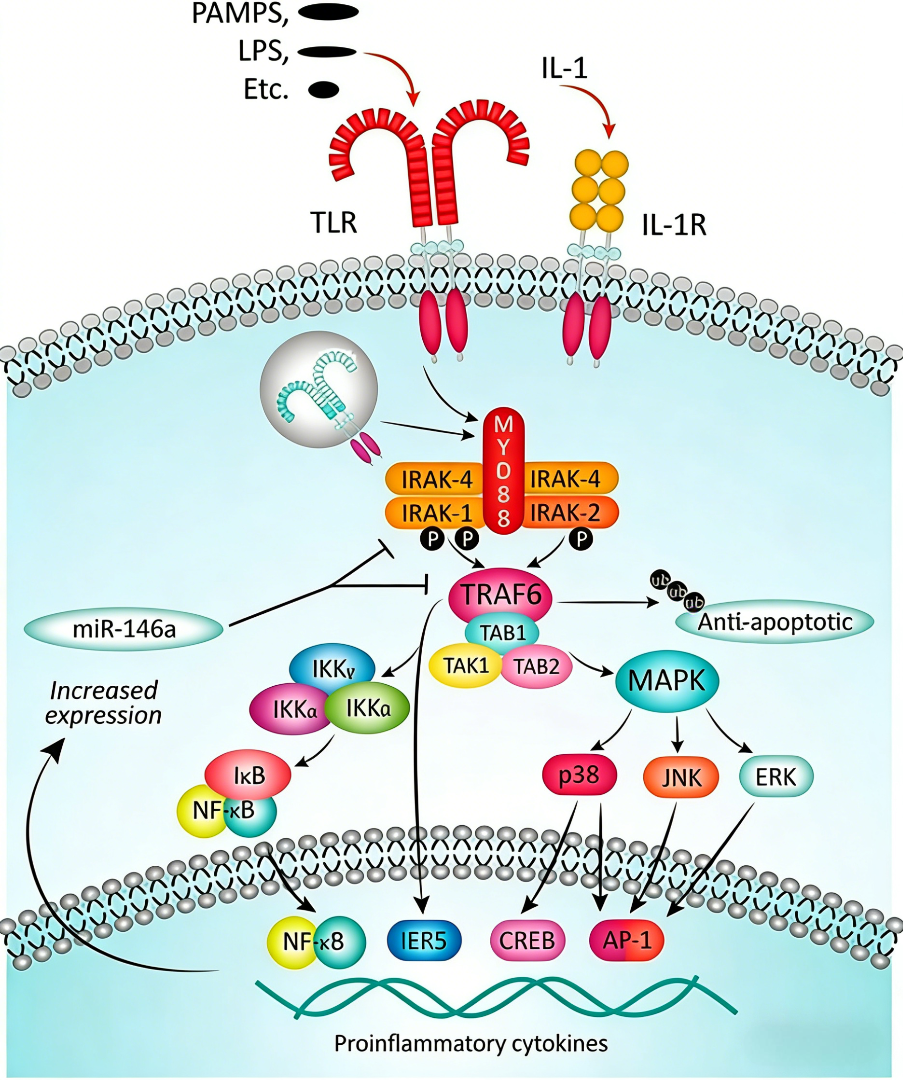
Interleukin-1 receptor-associated kinase 4 (IRAK4) is a core member of the IRAKs kinase family and plays a crucial signaling role in innate immune responses. As a key nodal molecule in the Toll-like receptor (TLR) and interleukin-1 receptor (IL-1R) signaling pathways, IRAK4 serves as a pivotal "bridge" connecting upstream receptor activation with downstream inflammatory signal transduction. When TLR or IL-1R is activated by their respective ligands, the adaptor protein MyD88 is recruited to the receptor complex, which then recruits IRAK4 to form a signaling complex known as the "Myddosome." During this process, IRAK4 is activated and phosphorylates downstream signaling molecules IRAK1/2, initiating subsequent cascade reactions.
2. How does IRAK4 activation trigger downstream inflammatory signaling pathways?
Activated IRAK4 transmits inflammatory signals through a precisely regulated cascade mechanism. After phosphorylating IRAK1/2, these kinases dissociate from the Myddosome complex and bind to tumor necrosis factor receptor-associated factor 6 (TRAF6). The activated TRAF6 complex then initiates multiple downstream signaling pathways, ultimately leading to the activation of key transcription factors, including nuclear factor-κB (NF-κB), cAMP response element-binding protein (CREB), activator protein-1 (AP-1), and interferon regulatory factors (IRFs). The activation of these transcription factors promotes the production and release of various pro-inflammatory cytokines and chemokines, initiating and amplifying inflammatory responses. Due to IRAK4's central role in inflammatory signaling pathways, its abnormal activation is closely associated with the pathogenesis and progression of various inflammatory diseases, making it a potential therapeutic target.
3. What are the unique advantages of PROTAC strategies targeting IRAK4?
Traditional IRAK4 inhibitors primarily function by competitively binding to the kinase active site to suppress its activity, but no such drugs have been approved for clinical use yet. In contrast, proteolysis-targeting chimera (PROTAC) technology offers an innovative solution for targeting IRAK4. The PROTAC-based IRAK4 degradation strategy involves designing bifunctional molecules that specifically bind to IRAK4 at one end and recruit E3 ubiquitin ligases (e.g., CRBN) at the other, forming a ternary complex that induces IRAK4 ubiquitination and proteasomal degradation. Compared to traditional inhibitors, PROTAC degraders offer the following advantages: complete removal of the target protein rather than temporary inhibition; sub-stoichiometric catalytic activity for longer-lasting effects; potential to overcome certain resistance mechanisms; and the possibility of achieving highly selective IRAK4 degradation through rational design.
4. What are the applications of the DDB1-CRBN&IRAK4 PROTAC Detection Kit?
The specialized detection kit developed for IRAK4 degradation systems has multiple important applications in drug development and mechanistic research:
| Application Value | Specific Description |
|---|---|
| Precise Assessment of Degradation Efficiency | By quantitatively measuring dynamic changes in IRAK4 protein levels after PROTAC treatment, the efficacy of different degraders can be accurately evaluated to determine optimal concentrations and time points. |
| In-Depth Mechanistic Studies | Detecting IRAK4 ubiquitination levels, proteasome activity, and changes in related signaling pathway molecules helps elucidate the specific molecular mechanisms of PROTAC-induced IRAK4 degradation. |
| Selectivity Validation Analysis | Simultaneously measuring protein levels of other IRAK family members (e.g., IRAK1, IRAK2) assesses the selectivity of PROTAC degraders for IRAK4, reducing the risk of off-target effects. |
| Functional Validation of Signaling Pathways | By detecting activity changes in downstream NF-κB, MAPK, and other signaling pathways, the biological effects of IRAK4 degradation can be validated, providing a basis for drug functional evaluation. |
| Combination Therapy Research | Evaluating the synergistic effects of IRAK4 degraders with traditional anti-inflammatory drugs or immunomodulators to explore potential combination therapy strategies. |
5. Which manufacturers provide the DDB1-CRBN&IRAK4 PROTAC Detection Kit?
Nanjing U-Protein's self-developed TR-FRET Human DDB1-CRBN&IRAK4 PROTAC Binding Kit (Catalog No.: UA086005) is a high-sensitivity detection platform based on time-resolved fluorescence energy transfer (TR-FRET) technology, specifically designed for the research and development of CRBN-based PROTAC molecules targeting IRAK4 protein. This kit enables precise detection and quantification of the ternary complex formation between the E3 ubiquitin ligase complex DDB1-CRBN and the substrate protein IRAK4 mediated by PROTAC molecules. It provides an efficient, homogeneous standardized detection solution for drug development in innate immune signaling pathways, PROTAC molecule screening and optimization, and degradation mechanism studies.
| Core Product Advantages |
|---|
| Specialized Design for IRAK4 Degradation: Directly simulates the assembly process of the DDB1-CRBN -- IRAK4 ternary complex induced by PROTAC molecules, accurately reflecting the compound's ability to bridge IRAK4 protein with the CRBN E3 ligase. Suitable for early-stage discovery and activity evaluation of IRAK4-targeting drugs. |
| High Sensitivity and Low Background Interference: Utilizes TR-FRET detection technology, combining time-resolved and dual-wavelength detection advantages to significantly reduce compound autofluorescence and matrix interference, enabling high signal-to-noise ratio homogeneous detection. Ideal for high-throughput screening and low-abundance complex detection. |
| Ready-to-Use Homogeneous Workflow: Features a "mix-incubate-detect" homogeneous operation mode without washing or separation steps, simplifying procedures and improving efficiency. Compatible with automated workstations for enhanced experimental consistency. |
| Functionally Validated Protein Complexes: Provides high-purity, high-activity human recombinant DDB1-CRBN complex and IRAK4 protein, both retaining intact domains and biological functions to ensure physiological relevance and data reliability in ternary complex formation. |
| Exceptional Stability and Batch Consistency: Advanced expression systems and purification processes, combined with rigorous quality control, ensure high purity, long-term stability, and excellent batch-to-batch consistency, supporting long-term and continuous drug development projects. |
| Comprehensive Solutions and Professional Support: Includes detailed optimized protocols, standard curve examples, and data analysis guidelines. Offers specialized technical support and customized services for specific needs in PROTAC drug development, such as linker optimization and degradation efficiency correlation analysis. |
Nanjing U-Protein is committed to providing cutting-edge, high-performance research tools and solutions for proteolysis-targeting chimeras (PROTAC), innate immune regulation, and innovative drug development. For detailed technical parameters, validation data, or application inquiries regarding the TR-FRET Human DDB1-CRBN&IRAK4 PROTAC Binding Kit (Catalog No.: UA086005), please feel free to contact us.
This article is reviewed and published by the technical expert team of UA
Disclaimer: This article partially utilizes artificial intelligence assistance in its creation. If any content involves copyright or intellectual property issues, please let us know and we promise to verify and remove it as soon as possible.
Purchase recombinant protein, choose 
UA protein focuses on providing various protein reagents, raw materials, and services required for drug research and development, cell therapy, gene therapy, and basic scientific research, including drug target proteins, immune checkpoint proteins, cytokines, tool enzymes, customized protein expression, and full-length transmembrane protein development. Nanjing Univ is committed to providing customers with high-quality products and professional services, and building a High-tech Biological Enterprise with International Competitiveness.







 Business license (three certificates in one)