
Biological characteristics and targeted degradation strategies of KRAS[G12C] mutant


The RAS gene family is one of the most commonly mutated gene families in human malignant tumors.
- Recent Advances
1. What is the important role of the RAS gene family in cancer development?
The RAS gene family is one of the most frequently mutated gene families in human malignancies. In 1982, Robert Weinberg's research team first identified the RAS oncogene in human cancer, marking a new era in molecular oncology research. Among the three major RAS subtypes, Kirsten-RAS (KRAS) mutations are the most common, accounting for approximately 86% of all RAS mutations, followed by neuroblastoma-RAS (NRAS, 11%) and Harvey-RAS (HRAS, 3%). KRAS mutations are widespread in various solid tumors, with particularly high detection rates in pancreatic cancer (~90%), colorectal cancer (~45%), and non-small cell lung cancer (~35%). Due to KRAS's central role in tumorigenesis and progression, it has remained a crucial target in cancer therapy research.
2. What are the molecular characteristics of KRAS[G12C] mutation?
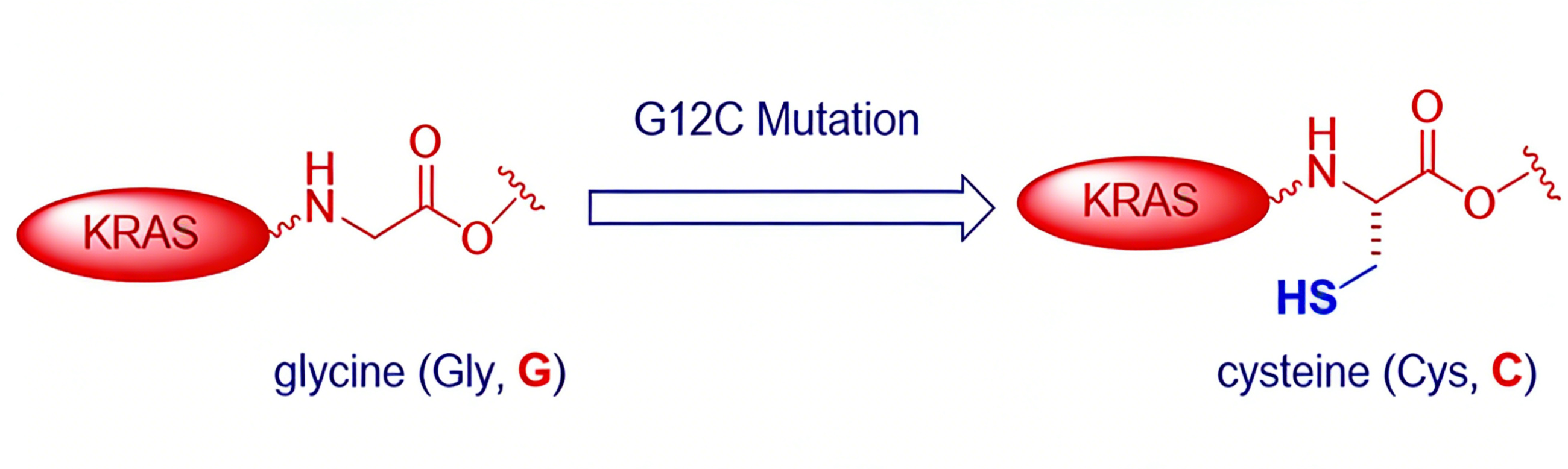
The KRAS[G12C] mutation refers to the substitution of glycine (Gly, G) with cysteine (Cys, C) at codon 12 of the KRAS protein. This specific mutation is particularly prevalent in non-small cell lung cancer, representing about 45-50% of KRAS mutation subtypes. From a structural biology perspective, this mutation provides unique opportunities for targeted therapy: the introduced cysteine residue contains a nucleophilic thiol group (-SH) that can form covalent bonds with specific small-molecule inhibitors. This characteristic makes KRAS[G12C] an ideal drug target, overcoming the traditional notion that RAS proteins are "undruggable." In contrast, the KRAS[G12D] mutation (glycine to aspartic acid) is more common in pancreatic cancer (~61%) and colorectal cancer (~42%), demonstrating tumor-type specificity in KRAS mutation patterns.
3. How has KRAS-targeted drug development evolved?
Over the past three decades, drug development targeting RAS has faced significant challenges. Because the RAS protein surface lacks traditional small-molecule binding pockets, its structure was once described as a "smooth sphere," leading to its long-standing reputation as "undruggable." This predicament fundamentally changed in 2013 when Professor Kevan Shokat's team published a landmark study in Nature, reporting the first covalent inhibitors that could specifically target KRAS[G12C] mutants. These inhibitors form covalent bonds with the cysteine at position 12, allosterically modulating KRAS's affinity for guanosine triphosphate (GTP) and interfering with its interactions with downstream effector proteins. This breakthrough opened new avenues for KRAS-targeted therapy, leading to multiple KRAS[G12C] covalent inhibitors entering clinical development.
4. What is the innovative significance of PROTAC-based KRAS[G12C] degradation strategy?
Proteolysis-targeting chimera (PROTAC) technology offers an innovative solution for KRAS[G12C]-targeted therapy. KRAS[G12C]/CRBN PROTAC degraders employ a bifunctional molecular design: one end specifically binds the KRAS[G12C] mutant, while the other recruits the CRL4CRBN E3 ubiquitin ligase complex, inducing target protein ubiquitination and proteasomal degradation. Compared to traditional inhibitors, PROTAC degraders offer several advantages: complete elimination of the target protein rather than temporary inhibition; sub-stoichiometric catalytic activity; potential to overcome certain resistance mechanisms; and more thorough blockade of KRAS signaling through protein degradation itself. These properties make PROTAC technology a crucial direction in KRAS-targeted therapy.
5. What are the key applications of KRAS[G12C]/CRBN PROTAC detection kits?
| Application Direction | Specific Value and Description |
|---|---|
| Precise Degradation Efficiency Assessment | Quantitatively measure changes in intracellular KRAS[G12C] protein levels after PROTAC treatment to accurately evaluate different degraders' efficacy and optimal conditions. |
| Selectivity Validation Analysis | Simultaneously detect wild-type KRAS and other RAS family members' protein levels to assess PROTAC selectivity for mutants, providing data for safety evaluation. |
| Mechanistic Investigation | Elucidate the molecular mechanisms of PROTAC-induced KRAS degradation by measuring ubiquitination levels, proteasome activity, and related signaling pathway changes. |
| Pharmacodynamic Evaluation | Assess KRAS degradation's impact on downstream MAPK, PI3K, and other signaling pathways to validate degraders' biological effects. |
| Resistance Mechanism Study | Systematically analyze KRAS degradation efficiency and related pathways in resistance models to explore molecular bases of resistance. |
| Combination Therapy Assessment | Investigate synergistic effects between KRAS degraders and traditional chemotherapeutic or targeted drugs to optimize combination regimens. |
6. Which manufacturers provide KRAS[G12C]/CRBN PROTAC detection kits?
Nanjing U-Protein自主研发的 TR-FRET Human KRAS[G12C]/CRBN PROTAC Binding Kit (Catalog No.: UA086001) is a high-precision detection platform based on time-resolved fluorescence energy transfer (TR-FRET) technology, specifically designed for the research and development of CRBN-class PROTAC molecules targeting KRAS G12C mutant protein. This kit enables precise detection and quantification of the ternary complex formed when PROTAC molecules bridge the E3 ubiquitin ligase complex CRBN with the oncogenic target protein KRAS[G12C], providing an efficient, sensitive, and homogeneous standardized solution for KRAS-driven tumor targeted protein degradation therapy development, lead compound screening, molecular optimization, and mechanism studies.
| Core Product Advantages |
|---|
| Targeted Design for KRAS G12C Degradation: Directly simulates PROTAC-mediated KRAS[G12C] -- CRBN E3 ligase ternary complex assembly, accurately reflecting compounds' recruitment and degradation potential for the "undruggable" KRAS G12C target, facilitating full-cycle research from discovery to optimization. |
| High Sensitivity and Low Background Noise: Utilizes TR-FRET technology with time-resolved and dual-wavelength detection to effectively eliminate compound fluorescence interference and matrix background, significantly improving signal-to-noise ratio, especially for high-throughput screening of complex compound libraries and precise analysis of weak interactions. |
| Ready-to-Use Homogeneous Workflow: Features a "mix-incubate-detect" homogeneous operation mode without washing or separation steps, simplifying procedures and enabling compatibility with automated workstations to enhance experimental efficiency and data reproducibility. |
| Rigorously Validated Functional Protein Components: Provides high-purity, high-activity human recombinant KRAS[G12C] mutant protein and key CRBN complex components, both maintaining correct spatial conformation and functional activity to ensure biological relevance and data reliability in ternary complex formation. |
| Excellent Stability and Batch Consistency: Advanced recombinant expression systems and stringent quality control ensure high-purity protein products with superior long-term stability and batch-to-batch consistency, supporting continuous drug development and comparative studies. |
| Comprehensive Solutions and Professional Support: Includes detailed optimized protocols, standard curve examples, and data analysis guidelines, with additional technical support and customization services for specific needs in KRAS-targeted PROTAC development (e.g., linker structure-activity relationship studies, degradation activity correlation analysis). |
Nanjing U-Protein is dedicated to providing cutting-edge, high-performance research tools and solutions for undruggable target degradation, cancer targeted therapy, and innovative drug development. For detailed technical parameters, validation data, or application inquiries regarding the TR-FRET Human KRAS[G12C]/CRBN PROTAC Binding Kit (Catalog No.: UA086001), please feel free to contact us.
This article is reviewed and published by the technical expert team of UA
Disclaimer: This article partially utilizes artificial intelligence assistance in its creation. If any content involves copyright or intellectual property issues, please let us know and we promise to verify and remove it as soon as possible.
Purchase recombinant protein, choose 
UA protein focuses on providing various protein reagents, raw materials, and services required for drug research and development, cell therapy, gene therapy, and basic scientific research, including drug target proteins, immune checkpoint proteins, cytokines, tool enzymes, customized protein expression, and full-length transmembrane protein development. Nanjing Univ is committed to providing customers with high-quality products and professional services, and building a High-tech Biological Enterprise with International Competitiveness.







 Business license (three certificates in one)