
Research Progress on the Biological Characteristics and Targeted Degradation Strategies of KRAS[G12D] Mutant


The RAS gene family is the most commonly mutated gene family in human malignancies, with mutations present in approximately 30% of human tumors.
- Recent Advances
1. What is the significance of KRAS gene in human cancers?
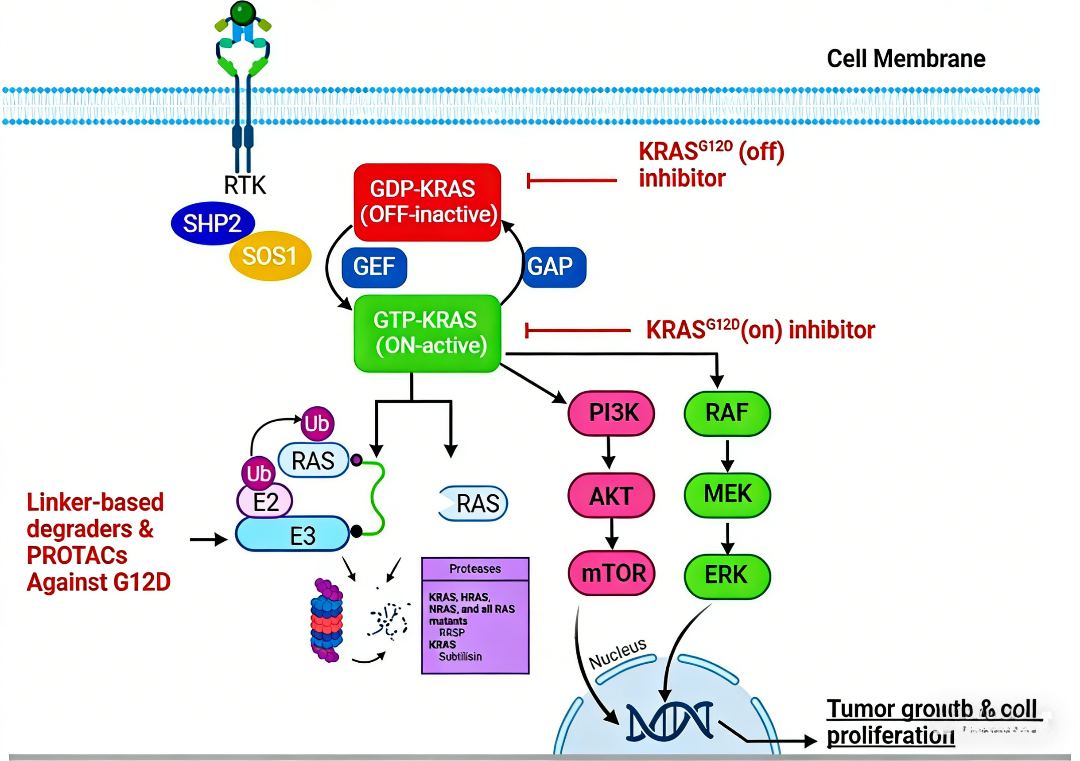
The RAS gene family is the most frequently mutated gene family in human malignancies, with mutations present in approximately 30% of human tumors. Among these, KRAS (Kirsten rat sarcoma viral oncogene homolog) is the most commonly mutated subtype, accounting for about 85% of all RAS mutations. Functionally, KRAS acts as a critical signal transduction protein, mediating signals from cell membrane receptors through switching between its active (GTP-bound) and inactive (GDP-bound) states, thereby regulating core cellular processes such as proliferation, differentiation, and survival. KRAS mutations primarily cluster at four hotspot codons (12, 13, 61, and 146), with codon 12 being the most frequently mutated. The G12D mutation (glycine to aspartic acid) is the most common variant at this position and shows significant distribution differences across various solid tumors.
2. What are the distribution characteristics of KRAS[G12D] mutation across different tumor types?
The KRAS[G12D] mutation exhibits distinct tissue-specific distribution patterns. It is most prevalent in pancreatic ductal adenocarcinoma, accounting for 40-50% of all KRAS mutation cases, followed by colorectal cancer (30-40%), while being relatively less common in non-small cell lung adenocarcinoma (10-15%). This distribution reflects the selective pressure exerted by different tissue microenvironments on specific KRAS mutation subtypes. Notably, unlike the KRAS[G12C] mutation which dominates in lung cancer, KRAS[G12D] is more prevalent in pancreatic and colorectal cancers, making targeted therapies for this mutation subtype clinically significant. Epidemiological data show that among annually diagnosed KRAS[G12D]-mutant tumors in the U.S., pancreatic cancer accounts for about 35%, colorectal cancer 30%, lung cancer 15%, and other tumor types 20%.
3. What unique scientific challenges does targeting KRAS[G12D] present?
For decades, the KRAS protein has been considered "undruggable" due to its unique structure and biochemical properties. Targeting KRAS[G12D] presents three major challenges: First, this mutant lacks a cysteine residue like the G12C mutation, preventing covalent binding strategies. Second, KRAS[G12D] has a 2-3 times slower GTP hydrolysis rate compared to G12C, resulting in more constitutive activation and reduced feasibility for inhibitors targeting the inactive state. Third, the KRAS protein surface lacks traditional small-molecule binding pockets, and high structural similarity among subtypes makes selective inhibition extremely difficult. These challenges necessitate innovative targeting strategies to overcome the bottleneck in KRAS[G12D] therapy.
4. What are the latest advances in targeting strategies for KRAS[G12D]?
Current global research on KRAS[G12D]-targeted therapies has made preliminary progress, with multiple innovative strategies under exploration. In small-molecule inhibitors, researchers are developing non-covalent inhibitors that specifically bind KRAS[G12D] through allosteric modulation or interference with protein-protein interactions. Proteolysis-targeting chimeras (PROTACs) offer a novel approach by designing bifunctional molecules to induce ubiquitin-mediated degradation. Additionally, cell therapies like TCR-T, gene silencing technologies like siRNA, and monoclonal antibodies are being developed. Several KRAS[G12D]-targeting candidates have entered clinical trials worldwide, with the most advanced reaching Phase II, covering indications such as non-small cell lung cancer, colorectal cancer, and pancreatic cancer.
5. What are the key applications of KRAS[G12D]/CRBN PROTAC detection kits?
| Application Value | Specific Description |
|---|---|
| Precise Degradation Efficiency Assessment | Quantitatively detects dynamic changes in intracellular KRAS[G12D] protein levels post-PROTAC treatment to accurately evaluate degradation efficacy, optimal concentrations, and time kinetics. |
| Selectivity Validation | Simultaneously monitors wild-type KRAS and other mutant subtypes (e.g., G12C, G12V) to assess PROTAC selectivity for G12D, providing critical safety data. |
| Mechanistic Insights | Elucidates PROTAC-induced degradation mechanisms by detecting ubiquitination levels, proteasome activity changes, and adapter protein recruitment. |
| Pathway Functional Validation | Evaluates KRAS degradation effects on downstream MAPK and PI3K pathway activities to verify biological and pharmacological impacts. |
| Resistance Mechanism Studies | Systematically analyzes KRAS degradation efficiency and pathway alterations in acquired resistance models to explore molecular bases of resistance. |
| Combination Therapy Evaluation | Investigates synergistic effects of KRAS[G12D] degraders with chemotherapy, targeted drugs, or immune checkpoint inhibitors to optimize combination regimens. |
6. Which manufacturers provide KRAS[G12D]/CRBN PROTAC detection kits?
Nanjing U-Protein's self-developed TR-FRET Human KRAS[G12D]/CRBN PROTAC Binding Kit (Catalog: UA086002) is a high-performance detection platform based on Time-Resolved Fluorescence Resonance Energy Transfer (TR-FRET) technology, specifically designed for CRBN-class PROTAC development targeting KRAS G12D mutant protein. This kit enables precise, efficient detection and quantification of PROTAC-mediated ternary complex formation between KRAS[G12D] and CRBN E3 ubiquitin ligase, offering a sensitive, homogeneous, and standardized solution for degradation therapy development, lead compound screening, and mechanistic studies targeting this prevalent yet challenging mutation.
| Core Product Advantages |
|---|
| Dedicated G12D Degradation System: Directly detects PROTAC-mediated KRAS[G12D]-CRBN ternary complex formation, reflecting compound specificity and degradation potential for G12D, addressing druggability challenges. |
| High Sensitivity & Low Background: TR-FRET technology enables time-resolved, dual-wavelength detection to minimize compound interference and noise, ideal for high-throughput screening and weak interaction analysis. |
| Ready-to-Use Homogeneous Workflow: "Mix-Incubate-Detect" protocol eliminates washing steps, simplifies operation, and enhances throughput and reproducibility. |
| Functionally Validated Components: Includes high-purity, active human recombinant KRAS[G12D] and CRBN complex components with proper conformation, ensuring biological relevance and data reliability. |
| Exceptional Stability & Lot Consistency: Advanced expression systems and strict QC ensure high purity, long-term stability, and batch-to-batch consistency for sustained research. |
| Comprehensive Support: Provides optimized protocols, standard curves, analysis guides, and custom services for PROTAC development needs. |
Nanjing U-Protein is committed to delivering cutting-edge research tools for undruggable target degradation, precision oncology, and drug discovery. For detailed technical information, validation data, or consultation on the TR-FRET Human KRAS[G12D]/CRBN PROTAC Binding Kit (Catalog: UA086002), please contact us.
This article is reviewed and published by the technical expert team of UA
Disclaimer: This article partially utilizes artificial intelligence assistance in its creation. If any content involves copyright or intellectual property issues, please let us know and we promise to verify and remove it as soon as possible.
Purchase recombinant protein, choose 
UA protein focuses on providing various protein reagents, raw materials, and services required for drug research and development, cell therapy, gene therapy, and basic scientific research, including drug target proteins, immune checkpoint proteins, cytokines, tool enzymes, customized protein expression, and full-length transmembrane protein development. Nanjing Univ is committed to providing customers with high-quality products and professional services, and building a High-tech Biological Enterprise with International Competitiveness.







 Business license (three certificates in one)