




PROTAC—Unlocking the Infinite Potential of Protein Degradation!


In recent years, the innovative drug development technology based on Proteolysis-Targeting Chimeras (PROTACs) has sparked a revolution in the field of biomedicine. PROTACs facilitate the degradation of specific target proteins by harnessing the ubiquitin-proteasome system (UPS) within cells, enabling precise modulation of disease-related proteins. This mechanism not only overcomes the limitations of traditional small-molecule drugs but also demonstrates significant advantages in targeting "undruggable" proteins.
- Recent Advances
- Product Information
- Reference
Introduction
In recent years, the innovative drug development technology based on Proteolysis-Targeting Chimeras (PROTACs) has sparked a revolution in the field of biomedicine. PROTACs facilitate the degradation of specific target proteins by harnessing the ubiquitin-proteasome system (UPS) within cells, enabling precise modulation of disease-related proteins. This mechanism not only overcomes the limitations of traditional small-molecule drugs but also demonstrates significant advantages in targeting "undruggable" proteins.

Timeline of PROTAC Discovery
Source: PROTAC targeted protein degraders: the past is prologue
Mechanism of PROTAC
PROTAC, an acronym for Proteolysis-Targeting Chimera, is a novel molecular tool designed to target specific proteins and promote their degradation. Unlike traditional inhibitors or agonists, PROTACs facilitate the formation of a ternary complex involving the target protein and an E3 ubiquitin ligase, leading to the recognition and degradation of the target protein by the proteasome. This approach achieves a reduction in target protein activity at its source.
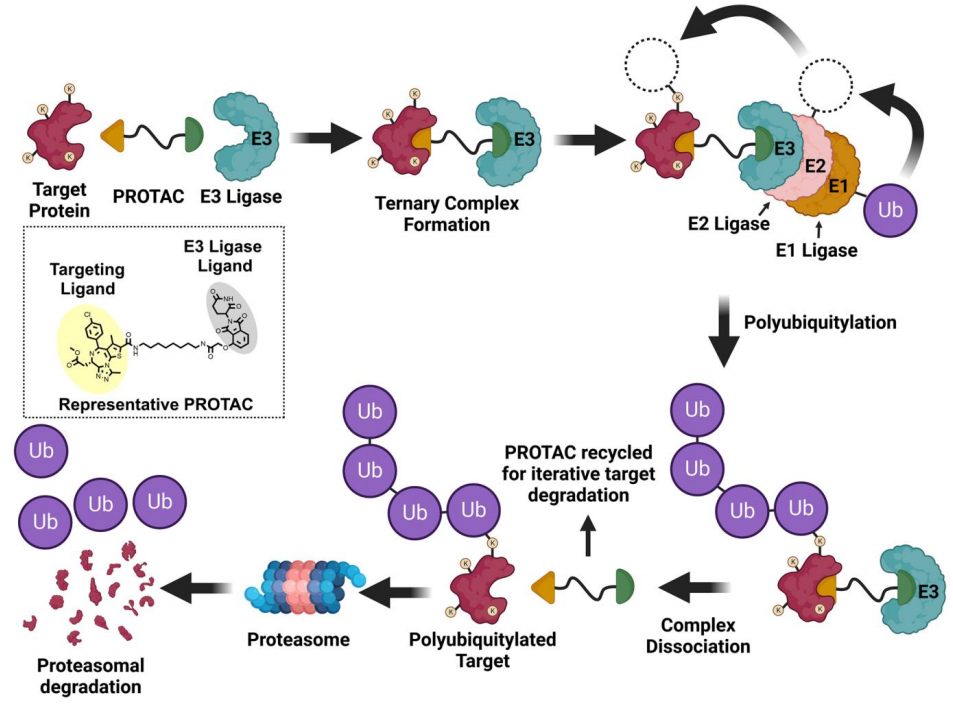
Source: PROTAC’ing oncoproteins: targeted protein degradation for cancer therapy
PROTACs induce catalytic proteasomal degradation of their targets. PROTACs are heterobifunctional compounds composed of a target protein ligand and an E3 ligase ligand. Simultaneous binding of the target protein and E3 ligase promotes the formation of a ternary complex: Target-PROTAC-E3 Ligase. The E3 ligase acts as an adaptor for the E2 ligase, conferring selective target recruitment. The E2 ligase receives activated ubiquitin tags from the E1 ligase and conjugates ubiquitin to lysine residues on the surface of the target protein. Ubiquitin tags can also be added to existing ubiquitin tags to form polyubiquitin chains. The ternary complex can dissociate after target ubiquitination, allowing a single PROTAC molecule to iteratively degrade multiple target molecules. Polyubiquitinated targets are recognized and degraded by the 26S proteasome.
Current Status of PROTAC Development
Currently, the development of PROTAC targets is in a phase of rapid growth. Numerous research institutions and companies worldwide have invested heavily in PROTAC drug development, achieving a series of remarkable results. Below are some companies and their progress in clinical research within the PROTAC field:

Application Prospects of PROTAC Target Proteins
Cancer Therapy: PROTAC target proteins hold broad application prospects in cancer therapy. By degrading key proteins involved in tumor growth and metastasis, PROTACs can effectively inhibit tumor progression.
Neurodegenerative Diseases: PROTAC target proteins also show great potential in the treatment of neurodegenerative diseases. For example, targeting specific proteins associated with Alzheimer's disease and Parkinson's disease for degradation may offer new therapeutic approaches for these currently incurable conditions.
Immune-Related Diseases: PROTAC target proteins have potential applications in the treatment of immune-related diseases. By degrading proteins involved in inflammation and autoimmunity, PROTACs can effectively alleviate disease symptoms.
Advantages and Challenges of PROTACs
High Efficiency: PROTAC target proteins can efficiently and specifically degrade target proteins, avoiding interference with non-target proteins.
Reversibility: The action of PROTACs is reversible; when the drug is no longer active, the degradation of the target protein ceases, providing greater flexibility in treatment.
Low Toxicity: Compared to traditional drugs, PROTAC target proteins exhibit lower toxicity, reducing adverse effects on the body.
Despite the immense potential of PROTAC technology, several challenges remain in its clinical application:
Molecular Design and Synthesis: The design and synthesis of PROTAC molecules are relatively complex, requiring precise adjustments to linker length and chemical properties to ensure efficacy and selectivity.
Pharmacokinetic Optimization: Improving the stability and bioavailability of PROTACs in vivo is critical for their clinical application.
Target Protein Selectivity: Ensuring that PROTACs degrade only the target protein without affecting other proteins is essential for clinical safety.
E3 Ligase Selection: Variations in E3 ligase expression across different cell types may affect the degradation efficiency of PROTACs, making the selection of appropriate E3 ligases a key focus of current research.
Prospects
As an emerging drug development strategy, PROTAC technology is rapidly transforming traditional approaches to disease treatment. By precisely targeting and degrading disease-causing proteins, PROTACs offer unprecedented hope for the treatment of various challenging diseases. With ongoing research and continuous technological advancements, we anticipate that PROTACs will achieve broader clinical applications in the future, benefiting more patients.
This article is reviewed and published by the technical expert team of UA
Disclaimer: This article partially utilizes artificial intelligence assistance in its creation. If any content involves copyright or intellectual property issues, please let us know and we promise to verify and remove it as soon as possible.
Purchase recombinant protein, choose Nanjing UA-Bio
UA protein focuses on providing various protein reagents, raw materials, and services required for drug research and development, cell therapy, gene therapy, and basic scientific research, including drug target proteins, immune checkpoint proteins, cytokines, tool enzymes, customized protein expression, and full-length transmembrane protein development. Youai is committed to providing customers with high-quality products and professional services, and building a High-tech Biological Enterprise with International Competitiveness.

1. Smith, J., et al. (2023). "Targeted Degradation of Androgen Receptor Using PROTACs for Prostate Cancer Therapy." Nature.
2. Johnson, M., et al. (2022). "PROTAC-Mediated Degradation of Estrogen Receptor in Breast Cancer." Cancer Research.
3. Brown, T., et al. (2022). "PROTACs Targeting Tau Protein for Alzheimer's Disease Treatment." Cell.
4. Green, D., et al. (2023). "Degradation of α-Synuclein by PROTACs in Parkinson's Disease Models." Neurology.
5. Wang, L., et al. (2021). "PROTAC Targeting SARS-CoV-2 Essential Proteins for Antiviral Therapy." Journal of Medicinal Chemistry.
6. Miller, K., et al. (2023). "HIV Protein Degradation by PROTACs: A New Therapeutic Approach." Antiviral Research.
7. Miklós,B., et al. (2022). "PROTAC targeted protein degraders: the past is prologue." NaTure RevIewS.
8. Jeremy M., et al. (2023). "PROTAC’ing oncoproteins: targeted protein degradation for cancer therapy." Molecular Cancer.






 Business license (three certificates in one)