

BCL-XL/CRBN PROTAC Kit: A Standardized Tool for Advancing Tumor-Selective Protein Degradation Therapy Development


Proteolysis Targeting Chimeras (PROTAC) is a revolutionary drug development platform that harnesses the cell's own ubiquitin-proteasome system to selectively degrade disease-causing proteins.
- Recent Advances
- Product Information
I. Current Development and Core Value of PROTAC Technology
Proteolysis-targeting chimeras (PROTAC) represent a revolutionary drug development platform that harnesses the cell's endogenous ubiquitin-proteasome system to selectively degrade disease-causing proteins. Compared to traditional inhibitors, PROTAC technology exhibits unique advantages through its event-driven catalytic degradation mode:
• Overcoming Drug Resistance: By eliminating the entire target protein, it effectively addresses drug tolerance caused by mutations or overexpression mechanisms.
• Expanding Druggable Targets: Theoretically, it can target proteins lacking catalytic active pockets or traditionally considered undruggable, such as transcription factors and scaffold proteins.
• High Selectivity: The dual-targeting mechanism enables higher subtype or tissue selectivity.
With these immense potentials, the PROTAC field has attracted widespread attention from top global pharmaceutical companies and biotech firms. Approximately 20 PROTAC candidates have entered clinical research, with the most advanced projects reaching Phase III trials, fully validating their broad prospects in cancer and other disease treatments.
II. The Central Role of E3 Ligases and the Importance of CRBN
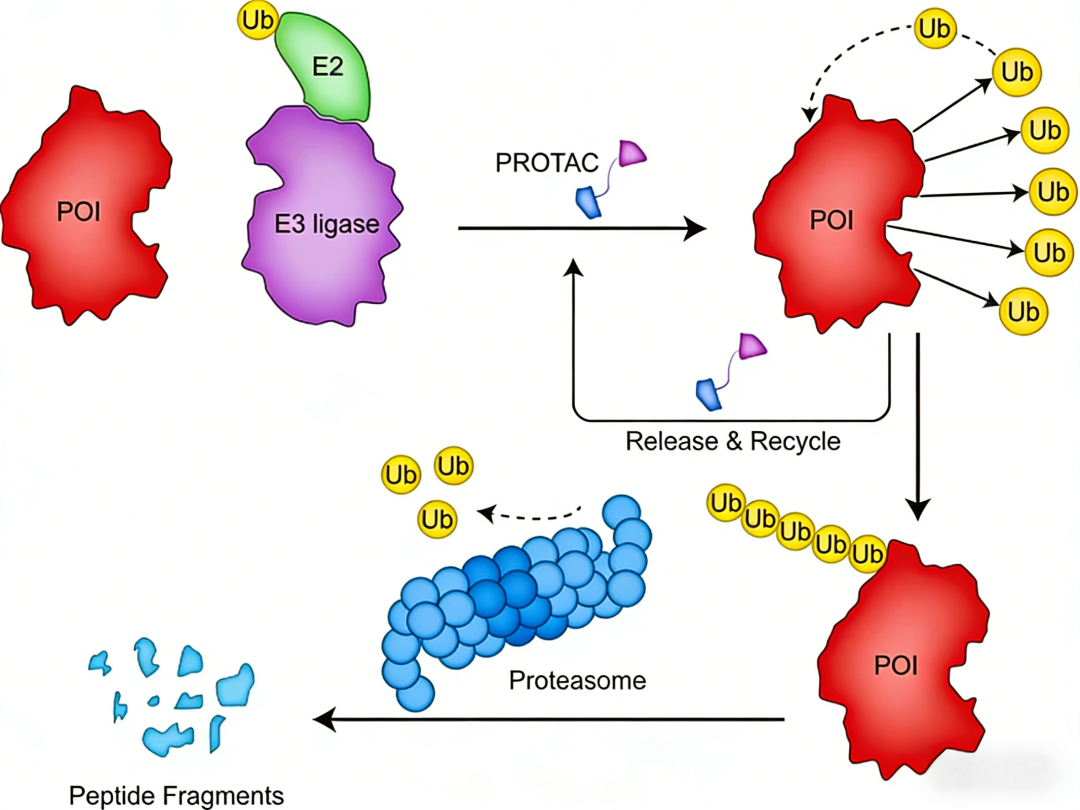
PROTAC molecules typically consist of three parts: a target protein ligand, an E3 ligase ligand, and a linker. Their mechanism hinges on simultaneously recruiting the target protein and E3 ubiquitin ligase to form a ternary complex, inducing polyubiquitination and subsequent proteasomal degradation of the target protein.
Among various E3 ligases, Cereblon (CRBN) is the most widely used and deeply studied. CRBN-based PROTACs often demonstrate favorable drug-like properties, including oral bioavailability. However, developing highly efficient and specific PROTAC molecules, especially for targets like the anti-apoptotic protein BCL-XL, remains challenging. A core issue lies in distinguishing degradation activity between tumor cells and normal tissues (e.g., platelets).
III. Key Challenges in BCL-XL-Targeted PROTAC Development: Selective Degradation
BCL-XL, a key member of the BCL-2 protein family, is overexpressed in various tumor cells and mediates apoptosis resistance, making it a critical anti-tumor target. However, since BCL-XL is essential for platelet survival, traditional inhibitors (e.g., ABT263) often cause severe dose-limiting platelet toxicity, significantly limiting clinical applications.
Thus, the primary goal of developing BCL-XL-targeted PROTAC degraders is to construct molecules that selectively degrade BCL-XL in tumor cells while minimizing platelet toxicity. This requires rational design and optimization of CRBN ligands, linker chemistry, and ternary complex formation kinetics, followed by rigorous in vitro functional validation of candidate molecules.
IV. BCL-XL/CRBN PROTAC Kit: Enabling Precision Research and Efficacy Evaluation
To address these challenges and accelerate the discovery and optimization of high-quality BCL-XL/CRBN PROTAC molecules, the standardized BCL-XL/CRBN PROTAC Kit has been developed. This kit provides a comprehensive, reliable, and user-friendly in vitro research platform covering key steps from mechanism validation to functional assessment:
1. Ternary Complex Formation and Binding Affinity Analysis
• Using homogeneous detection technologies like time-resolved fluorescence resonance energy transfer (TR-FRET) or AlphaLISA, the kit quantitatively evaluates the efficiency of candidate PROTAC molecules in mediating BCL-XL and CRBN E3 ligase ternary complex formation—a prerequisite for triggering effective degradation.
2. Target Protein Degradation Potency and Selectivity Assessment
• It offers optimized cell culture and treatment protocols to precisely measure BCL-XL degradation efficiency (DC50 and Dmax) in various cell lines (e.g., specific tumor cell lines).
• Crucially, the kit includes standardized methods to assess BCL-XL degradation activity and cytotoxicity in platelets or platelet precursor cells, providing critical data for screening highly selective molecules.
3. Functional Validation and Synergy Studies
• Integrated cell viability assays (e.g., CellTiter-Glo) evaluate tumor cell apoptosis induced by BCL-XL degradation, calculating EC50 values.
• The kit also facilitates exploration of combination therapies (e.g., with BCL-2 inhibitors like Venetoclax or chemotherapy drugs), calculating synergy indices (CI) to inform treatment strategies.
4. Off-Target Effects and Selectivity Verification
• The Western Blot module enables simultaneous detection of PROTAC effects on other BCL-2 family members (e.g., BCL-2, MCL-1), validating degradation selectivity.
V. Suppliers of BCL-XL/CRBN PROTAC Kits
Nanjing UniLove Biotech's TR-FRET Human BCL-XL/CRBN PROTAC Binding Kit (Catalog No.: UA086017) is a high-performance detection platform based on time-resolved fluorescence resonance energy transfer (TR-FRET) technology, specifically designed for CRBN-class PROTAC molecules targeting BCL-XL. This kit accurately and efficiently detects and quantifies ternary complex formation between BCL-XL and CRBN E3 ligase mediated by PROTAC molecules, providing a sensitive, homogeneous, and reliable solution for apoptosis pathway regulation, tumor therapy, and PROTAC drug development.
| Core Product Advantages |
|---|
| Specialized Design for BCL-XL Apoptosis Pathway: Directly detects PROTAC-mediated ternary complex formation between BCL-XL protein and CRBN E3 ligase, reflecting compound specificity and degradation potential for anti-tumor PROTAC development. |
| High Sensitivity and Low Background: TR-FRET technology enables time-resolved, dual-wavelength detection, minimizing compound autofluorescence and matrix interference for high signal-to-noise ratios, ideal for high-throughput screening and weak-binding analysis. |
| Ready-to-Use Homogeneous Workflow: Features a "mix-incubate-detect" homogeneous protocol, eliminating wash steps for simplicity, automation compatibility, and enhanced reproducibility. |
| Rigorously Validated Functional Proteins: Includes high-purity, bioactive human recombinant BCL-XL protein and CRBN complex components, ensuring physiological relevance and data reliability. |
| Exceptional Stability and Batch Consistency: Advanced expression systems and stringent QC ensure high purity, long-term stability, and batch-to-batch consistency for continuous R&D. |
| Comprehensive Support: Provides detailed protocols, standard curve examples, data analysis guides, and expert support for BCL-XL-targeted PROTAC development, including linker optimization and degradation activity correlation. |
Nanjing UniLove Biotech is dedicated to providing cutting-edge research tools for targeted cancer therapy, apoptosis regulation, and protein degradation drug development. For detailed technical information, validation data, or application inquiries regarding the TR-FRET Human BCL-XL/CRBN PROTAC Binding Kit (Catalog No.: UA086017), please contact us.
This article is reviewed and published by the technical expert team of UA
Disclaimer: This article partially utilizes artificial intelligence assistance in its creation. If any content involves copyright or intellectual property issues, please let us know and we promise to verify and remove it as soon as possible.
Purchase recombinant protein, choose 
UA protein focuses on providing various protein reagents, raw materials, and services required for drug research and development, cell therapy, gene therapy, and basic scientific research, including drug target proteins, immune checkpoint proteins, cytokines, tool enzymes, customized protein expression, and full-length transmembrane protein development. Nanjing Univ is committed to providing customers with high-quality products and professional services, and building a High-tech Biological Enterprise with International Competitiveness.







 Business license (three certificates in one)