The Dual Role of IL-10 Signaling in Tumor Immunotherapy and Precision Research Strategies


Interleukin-10 and its receptors play a complex dual role in the tumor immune microenvironment. Traditionally, IL-10 is known for its ability to suppress antigen-presenting cell activation and the production of pro-inflammatory cytokines.
- Recent Advances
- Product Information
```html
1. The Complexity and Research Background of IL-10/IL-10R Signaling Pathway in Tumor Immunity
Interleukin-10 (IL-10) and its receptor play a dual and complex role in the tumor immune microenvironment. Traditionally, IL-10 has been regarded as an immunosuppressive factor due to its ability to inhibit antigen-presenting cell activation and pro-inflammatory cytokine production, often associated with tumor immune escape. However, recent studies have shown that, in specific spatiotemporal contexts, IL-10 can directly act on CD8+ T cells, enhancing their cytotoxic function, maintaining memory phenotypes, and promoting anti-tumor immune responses. This seemingly contradictory functional characteristic makes IL-10 a highly intriguing yet mechanistically unclear target in the field of tumor immunotherapy. A deeper understanding of the dynamic regulatory mechanisms of IL-10 signaling in the tumor microenvironment, particularly the expression and functional regulation of its receptor (IL-10RA), is crucial for developing precise immunotherapeutic strategies.
2. The Lag in IL-10R Expression: Mechanistic Insights and Its Core Role in Engineered Bacterial Therapy
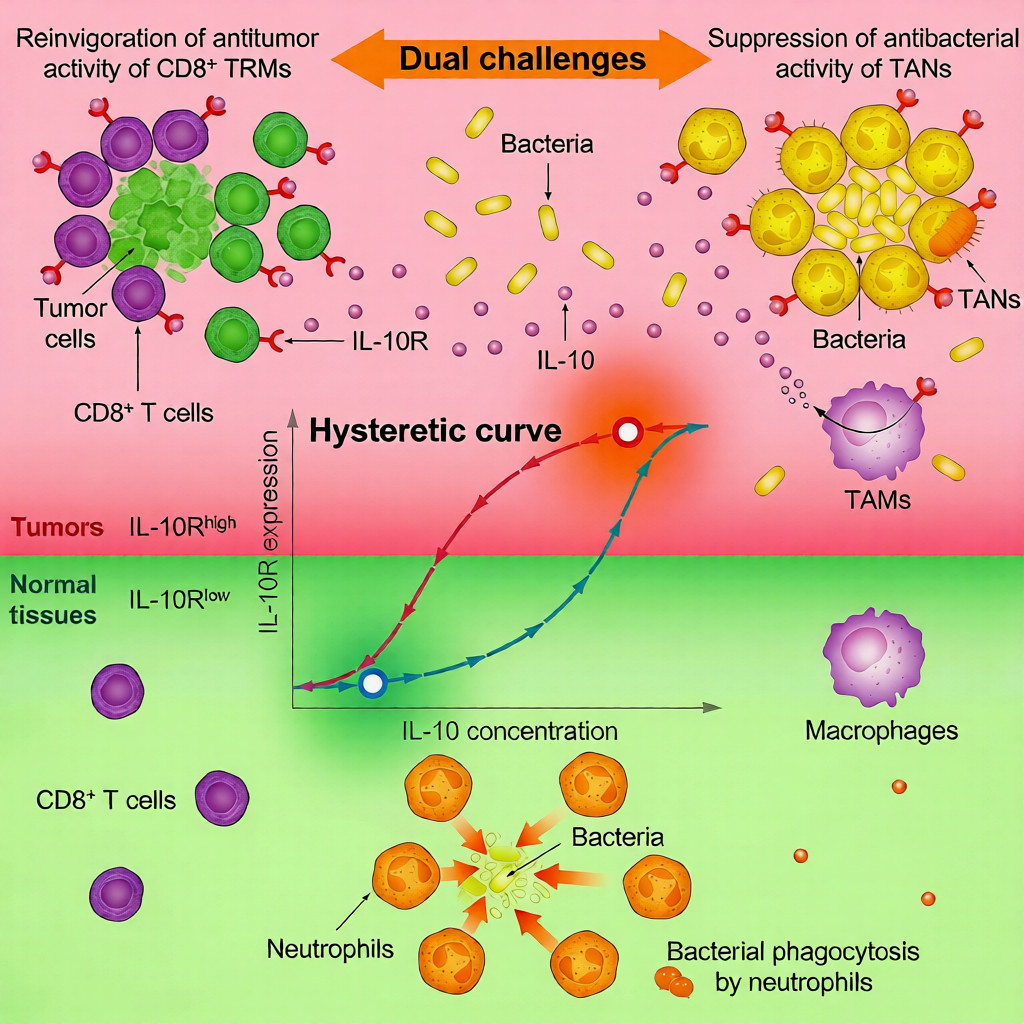
A groundbreaking study by a research team from the Chinese Academy of Sciences revealed the core mechanism of IL-10 receptor (IL-10R) expression dynamics in coordinating anti-tumor immune responses. The study found that tumor-infiltrating immune cells (e.g., CD8+ T cells, macrophages) exhibit a "lagged nonlinear" characteristic in IL-10R expression.
1. Molecular Basis of the Lag: After exposure to high concentrations of IL-10, cells form a positive feedback loop via the IL-10/STAT3 signaling pathway, leading to sustained transcriptional activation of IL-10R. Even if subsequent IL-10 concentrations significantly decrease, the high expression state of IL-10R can persist for an extended period. This "molecular memory" effect predisposes immune cells in the tumor to a highly IL-10-sensitive "IL-10Rhi" state.
2. Key Role in Engineered Bacterial Therapy: The research team utilized synthetic biology techniques to construct an engineered Salmonella strain capable of specifically colonizing hypoxic regions of tumors. Upon entering the tumor microenvironment, the bacterial strain induces IL-10Rhi tumor-associated macrophages to produce large amounts of IL-10 via TLR4 signaling pathway stimulation. Subsequently, high levels of IL-10 act on:
• IL-10Rhi CD8+ Tissue-Resident Memory T Cells: Promotes their proliferation and functional recovery, revitalizing anti-tumor immunity.
• IL-10Rhi Neutrophils: Inhibits their chemotaxis and phagocytic functions toward bacteria, allowing the bacteria to survive in the tumor and continuously exert immunomodulatory effects. This mechanism ingeniously unifies the dual requirements of "immune evasion" (protecting bacteria) and "immune activation" (attacking tumors) in bacterial therapy.
3. Clinical Relevance Validation: Analysis of tissue microarrays covering 27 human tumor types confirmed that tumor-infiltrating CD8+ T cells and macrophages universally exhibit high IL-10R expression, suggesting this mechanism may have broad clinical significance.
3. IL10/IL10RA Research Kit: A Standardized Tool for Deciphering Complex Signaling Pathways
Given the complexity and highly context-dependent nature of IL-10 signaling, precise and reproducible research is fundamental to advancing related therapeutic development. The specialized IL10/IL10RA Research Kit provides a critical technological platform for this purpose.
1. IL-10 Signaling Activity Detection:
• The kit quantitatively assesses IL-10 signaling pathway activation by detecting key downstream signaling events (e.g., STAT3 phosphorylation levels, reporter gene activity). This helps evaluate the responsiveness of different cell types or treatment conditions to IL-10.
2. IL-10RA Expression Level and Cell Typing Analysis:
• Using optimized cell surface staining and flow cytometry protocols, the kit accurately detects and quantifies IL-10RA expression levels on specific immune cell subsets (e.g., CD8+ T cells, macrophages, neutrophils), identifying IL-10Rhi cell populations.
• Combined with cell typing markers, it dynamically tracks changes in IL-10RA expression across immune cell subsets in response to the tumor microenvironment, bacterial therapy, or drug treatments, validating the "lagged" phenomenon.
3. Functional Correlation Validation:
• The kit can integrate functional detection modules. For example, after validating high IL-10R expression, it further evaluates the effects of IL-10 on CD8+ T cell proliferation (via CFSE or Ki67 detection), cytokine (e.g., IFN-γ) secretion, or cytotoxic function.
• For neutrophils, it assesses the impact of IL-10 treatment on their chemotactic ability or phagocytic function, directly linking receptor expression to specific immune functional changes.
4. Synergistic Mechanisms and Combination Therapy Research:
• This platform can explore interactions between IL-10 signaling and other therapeutic approaches (e.g., immune checkpoint inhibitors, chemotherapy drugs). By comparing the effects of combined versus single treatments on IL-10 signaling activity, receptor expression, and downstream functions, it provides data support for designing effective combination therapies.
4. Which Manufacturers Provide IL10/IL10RA Research Kits?
Nanjing UA Biotech independently developed the TR-FRET Human IL10/IL10RA Binding Kit (Catalog No.: UA086016), a high-sensitivity detection platform based on advanced time-resolved fluorescence energy transfer (TR-FRET) technology, specifically designed for accurately quantifying the binding activity between interleukin-10 (IL-10) and its specific receptor IL-10RA. This kit is suitable for research and drug screening in anti-inflammatory immune regulation, autoimmune diseases, tumor microenvironments, and cell therapy, providing an efficient, homogeneous, and reliable standardized solution.
| Core Product Advantages |
|---|
| High Sensitivity and Low Background Interference: Based on TR-FRET detection principles, it leverages time-resolved and dual-wavelength detection advantages to effectively eliminate sample autofluorescence and compound interference, significantly improving the signal-to-noise ratio and enabling high-sensitivity detection of low-affinity binding. |
| Simulation of Natural Binding Conformation: The kit provides rigorously validated high-purity, high-activity human IL-10 and IL-10RA proteins, both maintaining correct spatial conformations and full biological activity, ensuring binding experiments accurately reflect physiological ligand-receptor interactions. |
| Homogeneous Detection and Operational Convenience: Adopting a "mix-incubate-detect" homogeneous operation mode, it eliminates the need for washing or separation steps, streamlining the workflow and enabling compatibility with automated workstations, greatly enhancing experimental efficiency and data consistency. |
| Exceptional Stability and Batch-to-Batch Consistency: Through advanced recombinant expression systems and strict production quality control, the protein products exhibit high purity, excellent long-term stability, and outstanding batch-to-batch consistency, supporting long-term, continuous drug screening and mechanistic research. |
| Comprehensive Solutions and Professional Support: We provide detailed and optimized experimental protocols, typical data curves, and result interpretation guides, along with professional technical support and customized analysis recommendations for various application scenarios (e.g., antibody/antagonist screening, receptor competition assays). |
Nanjing UA Biotech is committed to providing high-performance, high-quality core tools and solutions for immune regulation, inflammation research, and innovative drug development. For detailed technical information, validation data, or application inquiries regarding the TR-FRET Human IL10/IL10RA Binding Kit (Catalog No.: UA086016), please feel free to contact us.
```
This article is reviewed and published by the technical expert team of UA
Disclaimer: This article partially utilizes artificial intelligence assistance in its creation. If any content involves copyright or intellectual property issues, please let us know and we promise to verify and remove it as soon as possible.
Purchase recombinant protein, choose 
UA protein focuses on providing various protein reagents, raw materials, and services required for drug research and development, cell therapy, gene therapy, and basic scientific research, including drug target proteins, immune checkpoint proteins, cytokines, tool enzymes, customized protein expression, and full-length transmembrane protein development. Nanjing Univ is committed to providing customers with high-quality products and professional services, and building a High-tech Biological Enterprise with International Competitiveness.







 Business license (three certificates in one)