




Diagnostic strategy for transthyretin-related familial amyloid polyneuropathy


Transthyretin-related familial amyloid polyneuropathy (TTR-FAP) is an autosomal dominant inherited disorder caused by mutations in the transthyretin (TTR, also known as prealbumin) gene.
- Recent Advances
- Product Information
I. Disease Overview and Clinical Challenges
Transthyretin-related familial amyloid polyneuropathy (TTR-FAP) is an autosomal dominant inherited disorder caused by mutations in the transthyretin (TTR, also known as prealbumin) gene. The core pathological mechanism involves misfolding of mutant TTR proteins, forming amyloid fibrils that abnormally deposit in peripheral nerves, heart, and other organs, leading to progressive sensorimotor neuropathy, autonomic dysfunction, and cardiomyopathy. The disease has a global distribution but exhibits significant geographical and genetic heterogeneity: in high-prevalence regions like Portugal and Sweden, early-onset cases with the Val30Met hotspot mutation predominate, while other regions often present with late-onset, diverse gene mutations, and atypical clinical manifestations. Due to complex and nonspecific clinical presentations coupled with insufficient clinical awareness, misdiagnosis and diagnostic delays are common for TTR-FAP. Given its rapid progression and poor prognosis in advanced stages, establishing systematic early diagnostic protocols is crucial.
II. Clinical Identification and Symptom Screening: "Red Flags" of TTR-FAP
Efficient diagnosis begins with keen recognition of clinical features. TTR-FAP primarily manifests as "length-dependent" sensorimotor peripheral neuropathy, often accompanied by significant multisystem involvement.
1. Clinical Subtypes and Features:
- Early-onset: Typically begins between ages 20-40, characterized by early symptoms of pain/temperature sensation impairment in the feet and severe autonomic symptoms (gastrointestinal disturbances, orthostatic hypotension), progressing to motor dysfunction later, often with a clear family history.
- Late-onset: Usually starts after age 50, with varying severity of sensorimotor impairment, possible early walking difficulties, and frequent cardiac symptoms (hypertrophic cardiomyopathy, arrhythmias), sometimes without a clear family history.
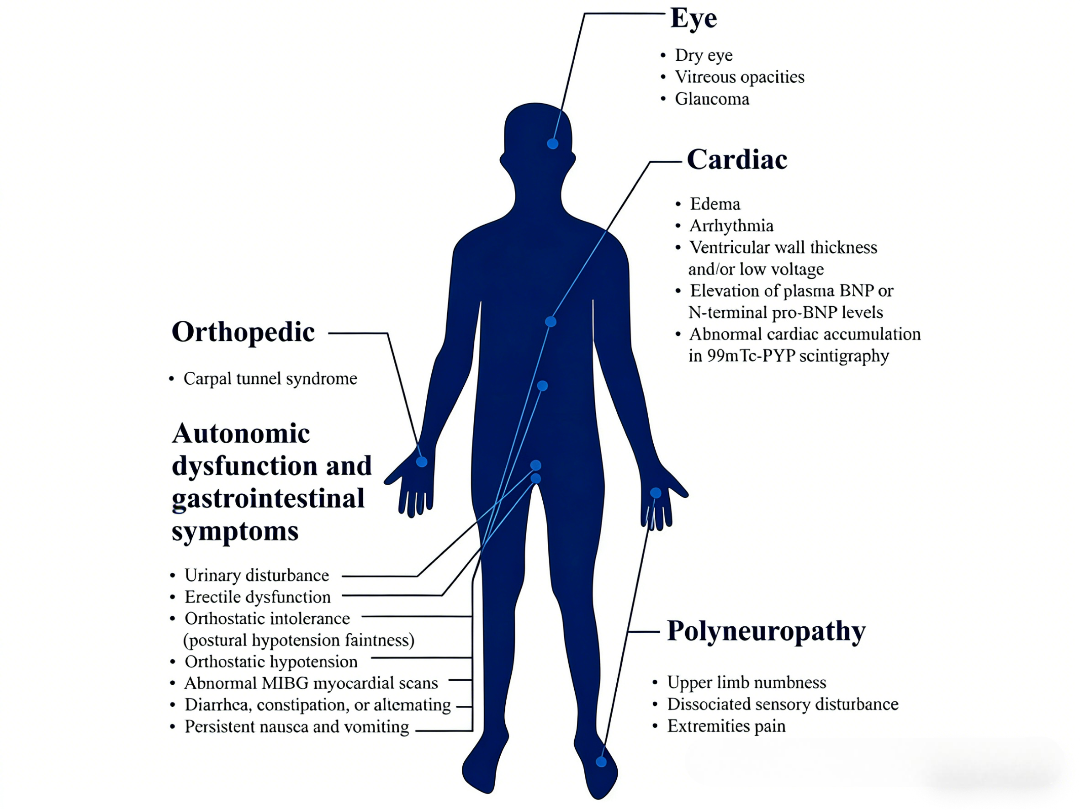
2. Systemic Symptoms and "Red Flags": Beyond peripheral neuropathy, patients may exhibit cardiac (cardiomyopathy, conduction block), ocular (vitreous opacities, glaucoma), renal (proteinuria, renal failure), and other organ involvement. Integrating these features, the academic community has proposed "red flags" for TTR-FAP as highly suggestive indicators. If a patient with progressive polyneuropathy presents with at least one of the following, TTR-FAP should be strongly suspected: positive family history, ineffective conventional immunotherapy, early significant autonomic symptoms, unexplained weight loss, bilateral carpal tunnel syndrome, cardiac hypertrophy/cardiomyopathy, or vitreous opacities.
3. Auxiliary Screening Methods: For suspected cases, comprehensive neurophysiological examinations (assessing large and small fiber function), cardiac evaluations (ECG, echocardiography, serum BNP/NT-proBNP), and other relevant systemic tests should be performed.
III. Diagnostic Methods: From Pathology to Molecular Diagnosis
After clinical screening, confirmation requires one or more of the following methods, with genetic testing being the gold standard.
1. Histopathological Examination: A traditional method to obtain direct evidence of amyloid deposits. Common biopsy sites include abdominal fat, labial salivary glands, rectal mucosa, or sural nerves. Congo red staining of tissues shows "apple-green" birefringence under polarized light, characteristic of amyloid. Further immunohistochemical staining can confirm the deposits as TTR-derived.
2. Genetic Testing: The most reliable method for diagnosing TTR-FAP. Sequencing the TTR gene on chromosome 18 can detect pathogenic mutations. Over 130 TTR gene variants have been identified, with more than 40 associated with the disease. For typical cases with a clear family history, testing for known mutations suffices; for sporadic or atypical cases, full TTR gene sequencing is needed.
3. Serum Protein Mass Spectrometry: An emerging blood test. By immunoprecipitating and enriching serum TTR proteins, followed by mass spectrometry analysis of protein isoforms, approximately 90% of variant TTR can be detected, providing an important non-invasive diagnostic supplement.
IV. Research Tools: Application Value of Transthyretin/Prealbumin His Tag Protein
In studying TTR-FAP pathogenesis, developing novel diagnostic techniques, and exploring treatments, high-purity, standardized recombinant TTR protein is an indispensable core tool. Transthyretin/Prealbumin His Tag Protein is a high-quality research reagent designed for this purpose.
- Mechanistic Studies: This protein can be used in vitro to study TTR folding/misfolding kinetics, tetramer stability, amyloid fibril formation, and interactions with molecular chaperones or inhibitors.
- Diagnostic Technology Development: As a standard or coating antigen, it can be used to develop or calibrate immunology-based detection methods (e.g., ELISA) or evaluate the sensitivity and specificity of mass spectrometry protocols.
- Drug Screening Platforms: As a target protein, it enables high-throughput screening of small molecules or biologics (e.g., TTR stabilizers like tafamidis analogs) that can stabilize TTR tetramers or inhibit misfolding and aggregation.
- Antibody and Reagent Production: As an immunogen, it can generate highly specific anti-TTR antibodies, which are foundational for pathological diagnosis, immunoassays, and some therapeutic drug development (e.g., monoclonal antibodies).
V. Summary
Diagnosing TTR-FAP is a stepwise process combining high clinical suspicion, systematic symptom screening, and precise laboratory validation. Enhancing clinicians' awareness of "red flags" and appropriately utilizing histopathology, genetic sequencing, and serum mass spectrometry are key to reducing misdiagnosis and enabling early intervention. Meanwhile, standardized research tools like Transthyretin/Prealbumin His Tag Protein will continue to advance understanding of molecular mechanisms and innovative diagnostic and therapeutic strategies, ultimately improving patient outcomes.
VI. Which Manufacturers Provide Transthyretin/Prealbumin His Tag Protein?
Nanjing UniLove Biotech independently developed Transthyretin/Prealbumin His Tag Protein, Human (Catalog No.: UA030086), a high-purity, high-activity recombinant human transthyretin (TTR, also known as prealbumin) protein. It is produced using a mammalian expression system and carries a C-terminal His tag for easy purification and detection. Transthyretin plays a key role in thyroid hormone and retinol transport, as well as amyloidosis (e.g., ATTR amyloidosis). This product is suitable for disease mechanism research, drug screening, diagnostic reagent development, and protein interaction analysis, providing a reliable and high-quality research tool.
| Core Product Advantages |
|---|
| High Purity and Native Tetramer Structure: Expressed in mammalian systems, ensuring correct native tetramer conformation with full biological activity. Purified via affinity chromatography to >95% purity with low endotoxin levels, ideal for structural and functional studies. |
| High Stability and Solubility: Exhibits excellent solubility and stability in solution, supporting long-term storage and repeated experimental use, suitable for high-concentration amyloid fibril formation studies or crystallization experiments. |
| His Tag for Convenience: The C-terminal His tag enables rapid, efficient purification via nickel columns and facilitates His tag-based detection, immobilization, or compatibility with high-throughput screening platforms, enhancing experimental flexibility. |
| Broad Application Compatibility: Suitable for diverse experimental systems, including amyloid aggregation kinetics studies, small-molecule inhibitor screening (e.g., TTR stabilizers), diagnostic antibody development, protein-ligand interaction analysis (SPR/BLI/ELISA), and structural biology research. |
| Excellent Batch Consistency and Stability: Standardized production and strict quality control ensure consistent purity, activity, and tetramer stability across batches, guaranteeing reliable and reproducible data. |
| Professional Technical Support: We provide detailed product manuals, recommended protocols, storage guidelines, and expert consultation for TTR-related research in amyloidosis, drug discovery, and diagnostic development. |
Nanjing UniLove Biotech is committed to providing high-quality, high-performance recombinant protein tools for disease mechanism research, drug development, and diagnostic innovation. For detailed technical specifications, activity validation data, or application guidance for Transthyretin/Prealbumin His Tag Protein, Human (Catalog No.: UA030086), please contact us anytime.
This article is reviewed and published by the technical expert team of UA
Disclaimer: This article partially utilizes artificial intelligence assistance in its creation. If any content involves copyright or intellectual property issues, please let us know and we promise to verify and remove it as soon as possible.
Purchase recombinant protein, choose Nanjing UA-Bio
UA protein focuses on providing various protein reagents, raw materials, and services required for drug research and development, cell therapy, gene therapy, and basic scientific research, including drug target proteins, immune checkpoint proteins, cytokines, tool enzymes, customized protein expression, and full-length transmembrane protein development. Youai is committed to providing customers with high-quality products and professional services, and building a High-tech Biological Enterprise with International Competitiveness.







 Business license (three certificates in one)