




Regulation of the Bone Morphogenetic Protein Pathway, Detection Techniques, and Evaluation Applications of the Core Inhibitor Noggin


Bone Morphogenetic Proteins (BMPs) belong to the transforming growth factor-β (TGF-β) superfamily and are key signaling molecules that regulate embryonic development, organ formation, and postnatal tissue homeostasis.
- Recent Advances
- Product Information
I. Overview of Bone Morphogenetic Protein Signaling Pathway
Bone Morphogenetic Proteins (BMPs), belonging to the Transforming Growth Factor-β (TGF-β) superfamily, are key signaling molecules that regulate embryonic development, organ formation, and postnatal tissue homeostasis. Beyond their classical roles in bone and cartilage development, the BMP signaling pathway extensively participates in the morphogenesis of organs such as the nervous system, limbs, kidneys, and lungs, and plays a significant role in adult tissue repair and regeneration. Additionally, research indicates that BMP signaling has dual regulatory effects in tumor development, involving complex processes such as tumor cell proliferation, invasion, angiogenesis, and immune microenvironment modulation.
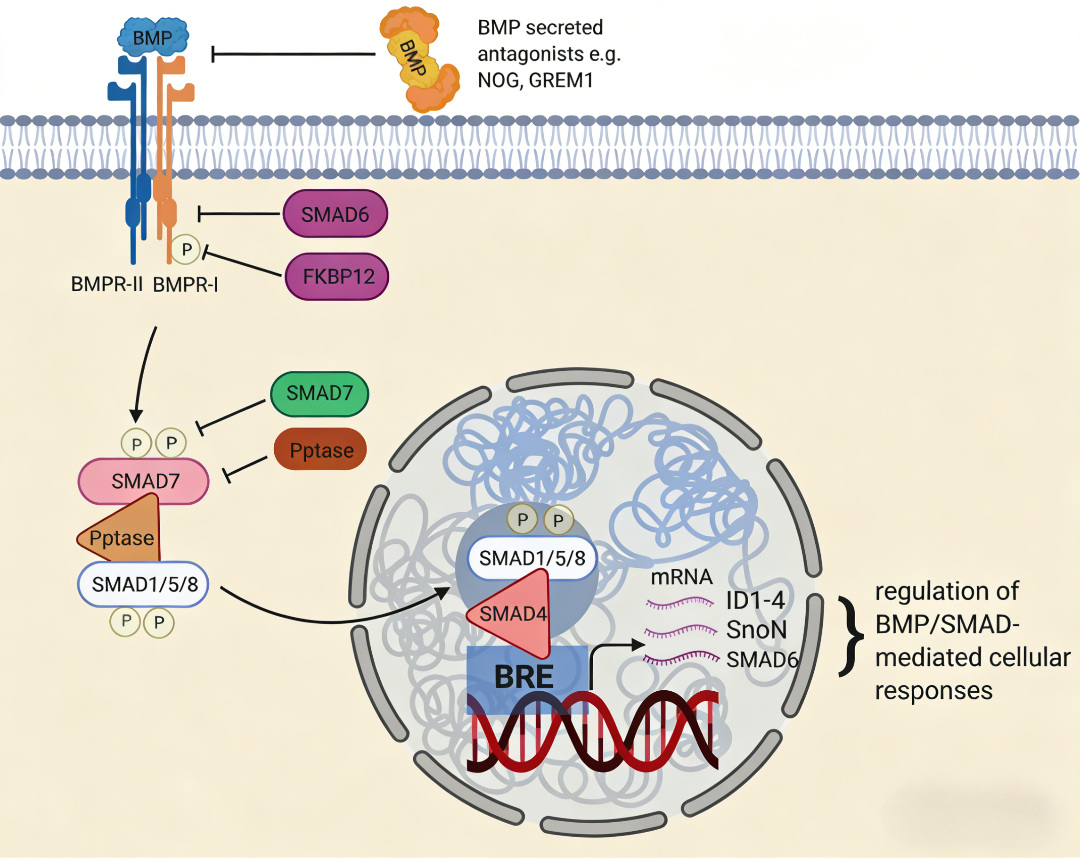
BMP signal transduction primarily occurs through the Smad-dependent canonical pathway. When BMP ligands bind to type I and type II serine/threonine kinase receptors on the cell surface, they activate intracellular signaling molecules Smad1/5/8 (R-Smads), inducing their phosphorylation. Phosphorylated R-Smads form a complex with the common mediator Smad4 (Co-Smad), which then translocates to the nucleus to regulate the transcription of downstream target genes (e.g., Id1), thereby precisely controlling cell proliferation, differentiation, and fate.
II. Functional Detection Strategies for BMP Pathway Activity
To accurately and quantitatively assess the activation level of BMP signaling, the reporter gene assay is widely used due to its high sensitivity and specificity.
Principle and Application: The core of this method lies in constructing a reporter system driven by BMP pathway-specific response elements. Typically, the promoter sequence of the BMP downstream target gene Id1 (containing Smad-binding elements) is cloned upstream of a luciferase reporter gene. When the BMP-Smad signaling pathway is activated, the activated transcriptional complex binds to this promoter, driving luciferase expression. By measuring luciferase activity in cell lysates, the activation level of the BMP pathway can be indirectly and quantitatively reflected. This cell-based assay effectively distinguishes BMP signaling from other TGF-β superfamily members (e.g., TGF-β) and serves as a powerful tool for screening and evaluating candidate compounds that act as BMP pathway agonists or antagonists.
III. Noggin Protein: A Natural Antagonist of the BMP Signaling Pathway and Its Functional Evaluation
Among the numerous endogenous regulators of the BMP pathway, Noggin protein plays a central role as a physiological antagonist.
1. Biological Functions: Noggin is a secreted glycoprotein that binds with high affinity to various BMP ligands (e.g., BMP2, BMP4, BMP7), creating steric hindrance to prevent BMP interactions with cell surface receptors, thereby efficiently and specifically blocking downstream signal transduction. This property makes Noggin a key regulator of patterning during embryonic development and an important factor in maintaining homeostasis in adult tissues.
2. Applications in Organoid Culture: Leveraging its potent BMP signaling inhibition, recombinant Noggin protein has become a core additive in various organoid (e.g., intestinal, liver, brain) in vitro culture systems. By suppressing BMP signaling in the culture environment, Noggin synergizes with pathways like Wnt to maintain the self-renewal and proliferation potential of stem/progenitor cells, supporting long-term growth and structural differentiation of organoids. It is an indispensable component for constructing physiologically relevant 3D in vitro models.
3. Activity Quality Control and Evaluation: Given the importance of Noggin in basic research and regenerative medicine applications, standardized and quantitative assessment of its bioactivity is critical. The aforementioned BMP reporter gene assay provides an ideal platform for quality control. By co-treating reporter cells with the tested Noggin protein and known concentrations of BMP ligands (e.g., BMP2), the antagonistic efficacy of Noggin can be accurately evaluated based on its inhibition of BMP-induced luciferase activity. This offers a reliable method for quality control and potency determination of Noggin protein products from different batches or sources.
IV. Summary
The BMP signaling pathway is a core network regulating development and homeostasis, and precise detection of its activity is crucial for mechanistic studies and drug development. The Id1 promoter-based reporter gene system provides a sensitive and specific tool for assessing BMP pathway activity and screening regulatory molecules. Within this framework, Noggin protein, as a key endogenous inhibitor, is not only significant for understanding physiological and pathological processes but also plays a central role in cutting-edge biotechnologies like organoids. Quantitative evaluation of Noggin protein activity using standardized BMP reporter assays ensures its reliability and consistency in research and production applications, offering robust support for advancements in life science research and translational medicine.
V. Which Manufacturers Provide Noggin Protein?
Nanjing YouAi Protein independently developed Noggin Protein, Human (Catalog No.: UA040041), a high-purity, high-activity human recombinant Noggin protein produced using a mammalian expression system to preserve its complete native structure and biological functions. Noggin is a key Bone Morphogenetic Protein (BMP) antagonist that plays important roles in embryonic development, neural differentiation, skeletal formation, and stem cell regulation. This product is suitable for developmental biology, stem cell research, skeletal diseases, tissue engineering, and other fields, providing a reliable and efficient research tool.
| Core Product Advantages |
|---|
| High Purity and Native Active Conformation: Expressed in a mammalian system to ensure correct dimer folding and necessary post-translational modifications. Purified via multi-step chromatography with >95% purity and low endotoxin levels, it efficiently antagonizes BMP2/BMP4 ligands and maintains natural biological functions. |
| Exceptional BMP Antagonistic Activity: Validated by cell reporter assays (e.g., BRE-Luc) or stem cell differentiation models, it exhibits high specific activity, effectively inhibiting BMP signaling and is suitable for neural stem cell maintenance, osteogenic differentiation inhibition, and other functional studies. |
| Broad Application Compatibility: Suitable for various in vitro and in vivo experimental systems, including stem cell culture and directed differentiation regulation, BMP signaling mechanism studies, developmental biology model construction, tissue engineering research, and as a positive control for related activity assays. |
| Excellent Stability and Batch Consistency: Manufactured using standardized processes and strict quality control to ensure consistent purity, activity, and stability across batches, guaranteeing experimental reproducibility and data reliability. |
| Professional Technical Support: We provide detailed product technical documentation, recommended application protocols (e.g., stem cell culture concentration), storage guidelines, and specialized technical consultation for Noggin research in neural development, skeletal diseases, organoid culture, and regenerative medicine. |
Nanjing YouAi Protein is committed to providing high-quality core protein tools for developmental biology, stem cell research, and regenerative medicine. For detailed technical specifications, activity validation data, or application inquiries regarding Noggin Protein, Human (Catalog No.: UA040041), please feel free to contact us.
This article is reviewed and published by the technical expert team of UA
Disclaimer: This article partially utilizes artificial intelligence assistance in its creation. If any content involves copyright or intellectual property issues, please let us know and we promise to verify and remove it as soon as possible.
Purchase recombinant protein, choose Nanjing UA-Bio
UA protein focuses on providing various protein reagents, raw materials, and services required for drug research and development, cell therapy, gene therapy, and basic scientific research, including drug target proteins, immune checkpoint proteins, cytokines, tool enzymes, customized protein expression, and full-length transmembrane protein development. Youai is committed to providing customers with high-quality products and professional services, and building a High-tech Biological Enterprise with International Competitiveness.







 Business license (three certificates in one)