




Targeting the IL-4/IL-13 signaling pathway in chronic rhinosinusitis with nasal polyps: mechanisms and therapeutic advances


Chronic rhinosinusitis with nasal polyps (CRSwNP) is an upper respiratory disease characterized by chronic inflammation of the sinus mucosa and the formation of polyps.
- Recent Advances
- Product Information
I. Chronic Rhinosinusitis with Nasal Polyps and Type 2 Immune Response
Chronic rhinosinusitis with nasal polyps (CRSwNP) is an upper respiratory disease characterized by chronic inflammation of the sinus mucosa and polyp formation. Its pathogenesis is complex, closely related to immune dysregulation, tissue remodeling, and changes in the microbial environment. Increasing evidence suggests that type 2 immune responses play a dominant role in the pathological process of this disease, with interleukin-4 (IL-4) and interleukin-13 (IL-13) as key drivers. These cytokines activate downstream signaling pathways, promoting typical pathological features such as eosinophil infiltration, goblet cell hyperplasia, mucus hypersecretion, tissue fibrosis, and IgE production.
II. Molecular Structure and Regulatory Network of the IL-4/IL-13 Signaling Pathway
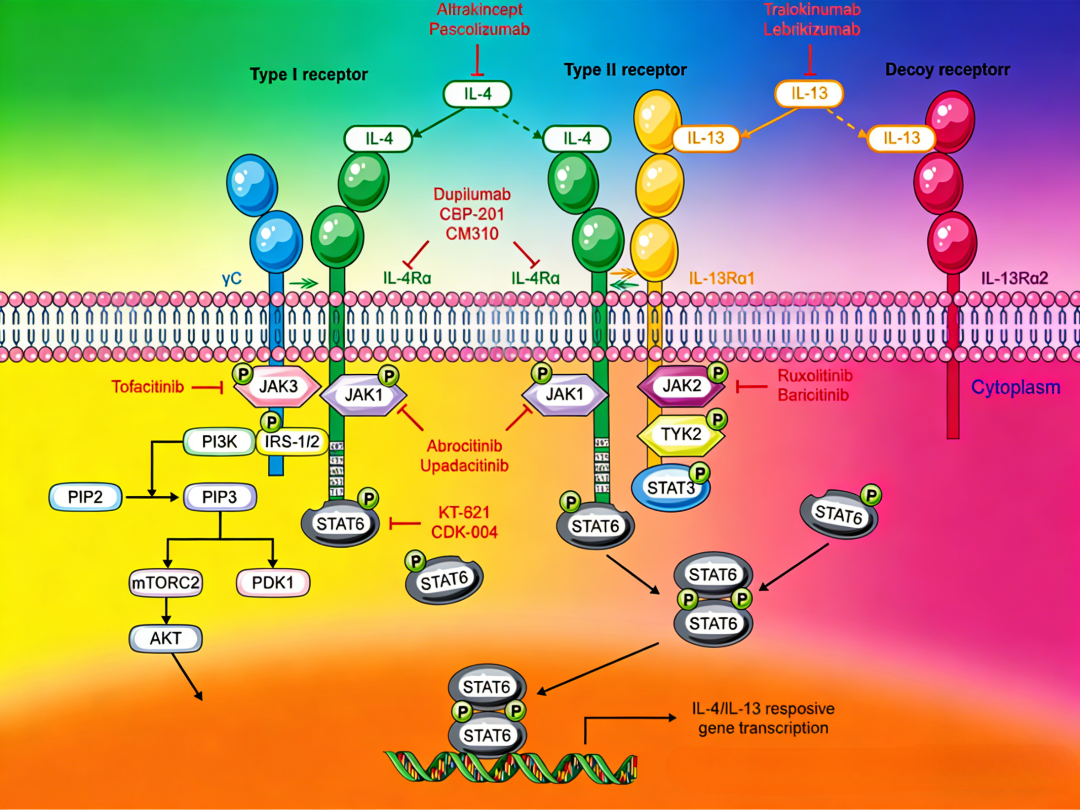
IL-4 and IL-13 are functionally closely related and initiate intracellular signal transduction through shared and specific receptor subunits, forming a finely tuned regulatory network.
1. Receptor Complexes and Ligand Specificity:
- Type I Receptor: Specifically activated by IL-4. IL-4 first binds to the IL-4Rα subunit, then recruits the common γ-chain (γc) to form a functional complex.
- Type II Receptor: Can be activated by both IL-4 and IL-13. This receptor consists of the IL-4Rα subunit and the IL-13Rα1 subunit. Both IL-4 and IL-13 can transmit signals through this complex, albeit with slight differences in activation mechanisms.
2. Downstream Signaling Pathways: After ligand-receptor binding, two classical pathways are primarily activated:
- JAK-STAT Pathway: Particularly the phosphorylation and nuclear translocation of STAT6, which is the core mechanism regulating the expression of type 2 inflammation-related genes (e.g., eotaxin, MUC5AC).
- IRS-PI3K-AKT Pathway: Involved in cell survival, proliferation, and metabolic regulation, playing a role in tissue remodeling.
III. IL-13 Protein as a Key Effector Molecule and Research Tool
In the pathological environment of CRSwNP, IL-13 protein is the core effector cytokine inducing goblet cell metaplasia, mucus hypersecretion, and tissue fibrosis. Its expression levels are closely correlated with disease severity and resistance to corticosteroid therapy.
In basic and translational research, high-purity, biologically active recombinant IL-13 protein is an indispensable tool for elucidating its pathological role and developing and evaluating targeted therapies:
1. In Vitro Mechanism Studies: Used to stimulate nasal mucosal epithelial cells, fibroblasts, and immune cells to mimic its role in the CRSwNP microenvironment, studying its effects on mucus-related gene expression, epithelial barrier function, and extracellular matrix production.
2. Animal Model Construction: Local or systemic application of IL-13 can induce type 2 inflammation and mucosal remodeling phenotypes similar to CRSwNP in animal models, facilitating disease mechanism exploration and drug efficacy evaluation.
3. Drug Screening and Evaluation Platforms: As a key target molecule, it is used to screen and evaluate the binding activity and biological neutralizing efficacy of IL-13 neutralizing antibodies (e.g., dupilumab, lebrikizumab) or other small-molecule inhibitors.
IV. Therapeutic Strategies and Prospects Targeting the IL-4/IL-13 Pathway
Given the central pathogenic role of this pathway, targeting the IL-4/IL-13 signaling axis has become a major direction for CRSwNP biotherapy.
1. Existing Therapies: Biologics such as dupilumab (targeting IL-4Rα, simultaneously blocking IL-4 and IL-13 signaling) have demonstrated significant clinical efficacy, effectively reducing polyp size, improving nasal symptoms, and decreasing dependence on oral corticosteroids. This confirms the importance of the pathway in clinical practice.
2. Future Directions: With the in-depth application of multi-omics technologies and high-throughput sequencing, future research is expected to more precisely analyze the heterogeneity of the IL-4/IL-13 signaling network in CRSwNP patients, identifying biomarker subgroups more sensitive to specific targeted therapies. This will drive treatment strategies toward personalized and precision medicine. Meanwhile, continued research on IL-13 protein and its signaling network will provide theoretical foundations and candidate targets for developing next-generation, more selective therapies.
V. Summary
The IL-4/IL-13 signaling pathway is one of the core molecular mechanisms driving the development of CRSwNP. The signaling network centered around IL-13 protein serves as a critical bridge connecting immune inflammation and tissue pathological changes. A deep understanding of the molecular details of this pathway and its role in disease, along with the use of tools like IL-13 protein for mechanistic exploration, not only supports the success of existing biologics but also opens broad prospects for precise classification and treatment of CRSwNP. In the future, combining basic research with clinical translation, targeting this pathway will continue to provide important strategies for improving clinical outcomes in CRSwNP patients.
VI. Which Manufacturers Provide IL-13 Protein?
Nanjing UniLove Protein independently developed IL-13 Protein, Human (Catalog No.: UA040506), a high-purity, high-activity recombinant human interleukin-13 (IL-13) protein produced using a mammalian expression system, with spatial conformation and post-translational modifications consistent with the natural protein. This product has undergone rigorous validation in purity, stability, and biological activity, making it an essential tool for studying type 2 immune responses, allergic diseases, asthma mechanisms, and targeted drug development.
| Core Product Advantages |
|---|
| High Purity and Natural Conformation: Expressed via a mammalian system, ensuring proper folding and glycosylation. Purified through multiple chromatography steps, with purity >95% and low endotoxin levels, accurately mimicking the biological activity of natural IL-13. |
| Exceptional Biological Activity: Validated by IL-13-dependent cell (e.g., TF-1) proliferation assays, exhibiting high specific activity. Effectively activates the IL-13Rα1/IL-4Rα receptor complex and downstream STAT6 signaling, suitable for cell function studies and in vitro efficacy evaluation. |
| Broad Application Compatibility: Compatible with various experimental systems, including cell stimulation and signal transduction studies, antibody/inhibitor screening (e.g., ELISA/SPR/BLI competitive binding assays), as a standard for quantitative detection, and as an immunogen for antibody development. |
| Excellent Stability and Batch Consistency: Produced using standardized manufacturing processes and strict quality control systems, ensuring consistent purity, activity, and stability across batches, guaranteeing experimental reproducibility and data reliability. |
| Professional Technical Support: We provide detailed product technical documentation, recommended experimental protocols, storage suggestions, and professional technical consultation and support for research in allergies, asthma, fibrosis, and tumor microenvironments. |
Nanjing UniLove Protein is committed to providing high-quality core protein tools for immunology research, disease model construction, and innovative drug development. For detailed technical parameters, activity validation data, or application inquiries regarding IL-13 Protein, Human (Catalog No.: UA040506), please feel free to contact us.
This article is reviewed and published by the technical expert team of UA
Disclaimer: This article partially utilizes artificial intelligence assistance in its creation. If any content involves copyright or intellectual property issues, please let us know and we promise to verify and remove it as soon as possible.
Purchase recombinant protein, choose Nanjing UA-Bio
UA protein focuses on providing various protein reagents, raw materials, and services required for drug research and development, cell therapy, gene therapy, and basic scientific research, including drug target proteins, immune checkpoint proteins, cytokines, tool enzymes, customized protein expression, and full-length transmembrane protein development. Youai is committed to providing customers with high-quality products and professional services, and building a High-tech Biological Enterprise with International Competitiveness.







 Business license (three certificates in one)