




ILC3s protect the intestinal epithelium by secreting HB-EGF: a novel mechanism against TNF-mediated intestinal inflammation


Tumor necrosis factor (TNF) plays a complex dual role in the intestine: on one hand, it is a key mediator of host defense and tissue repair
- Recent Advances
- Product Information
I. Research Background and Scientific Questions
Tumor necrosis factor (TNF) plays a complex dual role in the intestine: on one hand, it is a key mediator of host defense and tissue repair; on the other hand, excessive TNF drives the pathological progression of inflammatory bowel disease (IBD), including inducing excessive apoptosis of epithelial cells and pro-inflammatory cascades. Although anti-TNF therapy has become an important treatment for IBD, some patients still respond poorly or develop resistance, suggesting the existence of endogenous regulatory networks that balance the harmful effects of TNF.
Group 3 innate lymphoid cells (ILC3s) are key immune cells resident in the intestinal mucosa, involved in maintaining epithelial barrier homeostasis and regulating inflammatory responses. However, the specific protective mechanisms of ILC3s in TNF-mediated intestinal damage are not fully understood. This study aims to reveal how ILC3s protect intestinal epithelial cells from TNF-induced damage through specific molecular pathways.
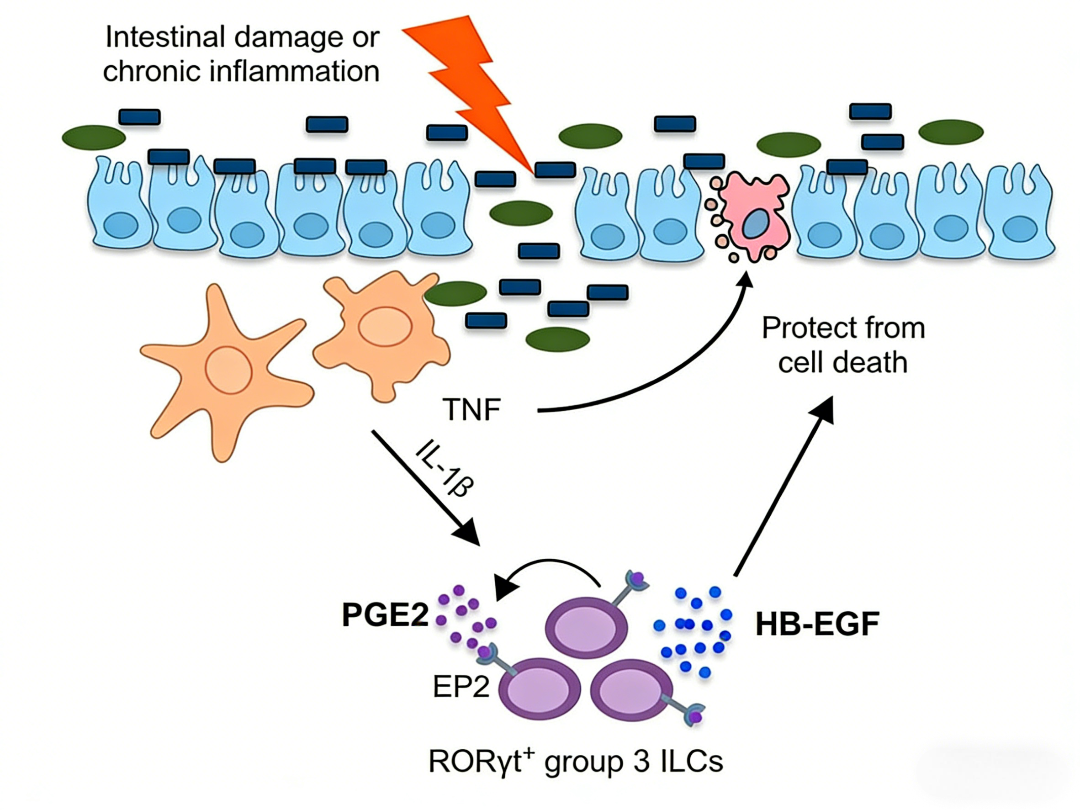
II. Core Discovery: ILC3s Exert Protective Effects by Secreting HB-EGF
The study confirmed that ILC3s can effectively protect intestinal epithelial cells from TNF-induced apoptosis through a new mechanism independent of their classic effector factor IL-22.
1. Functional Confirmation: In mouse models lacking ILC3s, TNF-induced intestinal epithelial cell death was significantly increased. Using antibodies to deplete ILC3s or specifically knocking out their key transcription factor RORγt both reproduced similar phenotypes of exacerbated epithelial damage, confirming the protective function of ILC3s.
2. Identification of Key Effector Molecules: Single-cell RNA sequencing analysis revealed that ILC3s, particularly the CCR6+ subset, are the main cellular source of heparin-binding epidermal growth factor-like growth factor (HB-EGF) in the intestine. Under TNF stimulation, HB-EGF expression in ILC3s was significantly upregulated.
3. Analysis of Protective Mechanisms:
- In Vitro Validation: Recombinant HB-EGF protein significantly alleviated TNF's cytotoxic effects on intestinal epithelial cell lines. This protection depends on HB-EGF binding to its receptor ErbB1 (EGFR) and activating the downstream PI3K-Akt survival signaling pathway.
- In Vivo Validation: In mice with conditional knockout of the Hbegf gene in ILC3s (Hbegf ∆ILC3), TNF-induced intestinal epithelial cell apoptosis was significantly exacerbated, clearly demonstrating that HB-EGF derived from ILC3s is the essential molecule for their protective effects.
III. Upstream Regulatory Pathway: IL-1β-PGE2-EP2 Axis Drives HB-EGF Production in ILC3s
The study further elucidated the upstream signaling network regulating HB-EGF secretion by ILC3s.
1. Initiating Signal: The pro-inflammatory cytokine IL-1β (but not IL-23) selectively induces ILC3s to express cyclooxygenase-2 (COX-2) and microsomal prostaglandin E synthase-1 (mPGES-1), thereby promoting ILC3s to synthesize and secrete prostaglandin E2 (PGE2).
2. Core Pathway: Autocrine PGE2 acts on the EP2 receptor highly expressed on the surface of ILC3s, forming a self-feedback loop that strongly drives HB-EGF expression in ILC3s. Specific knockout of the EP2 receptor in ILC3s (Ptger2 ∆ILC3) severely impaired their ability to produce HB-EGF and made mice more sensitive to TNF-induced intestinal epithelial damage.
3. Pathway Integration: Therefore, in inflammatory environments, the IL-1β→ILC3s-PGE2→EP2 receptor→HB-EGF axis constitutes a precise protective signaling cascade.
IV. Therapeutic Potential and Clinical Relevance of HB-EGF Protein
1. Protective Effects in Disease Models: In dextran sulfate sodium (DSS)-induced acute colitis and Helicobacter hepaticus infection-associated chronic colitis models, Hbegf ∆ILC3 mice exhibited more severe disease activity, tissue damage, and epithelial cell death. Conversely, exogenous administration of recombinant HB-EGF protein significantly reduced the severity of DSS-induced colitis, demonstrating its therapeutic potential.
2. Clinical Relevance: In human IBD tissues, the study found that the number of ILC3s in inflamed areas was significantly reduced, which may weaken the local protective effects mediated by HB-EGF. In vitro experiments confirmed that PGE2 similarly upregulates HB-EGF expression in human ILC3s, suggesting the conservation of this pathway in humans. This provides a theoretical basis for treating IBD by targeting the enhancement or supplementation of HB-EGF signaling.
V. Summary and Future Perspectives
This study systematically reveals for the first time that ILC3s sense IL-1β inflammatory signals, upregulate and secrete HB-EGF protein through the PGE2-EP2 autocrine loop, thereby activating the EGFR-Akt survival pathway in intestinal epithelial cells to counteract TNF-mediated intestinal damage and inflammation. This mechanism has been confirmed to have important protective effects in both acute and chronic colitis models.
This discovery deepens our understanding of intestinal homeostasis and inflammatory regulatory networks, organically linking the functions of ILC3s, the lipid mediator PGE2, and the growth factor HB-EGF. HB-EGF protein is not only a key effector molecule but may also become a potential therapeutic target or biologic. Future research could explore pharmacological approaches (such as EP2 receptor agonists) to enhance endogenous HB-EGF production by ILC3s or directly use recombinant HB-EGF protein as an adjunctive therapy, providing new intervention strategies for IBD and other intestinal inflammatory diseases.
VI. Which Manufacturers Provide HB-EGF Protein?
Nanjing YouAi Protein independently developed HB-EGF Protein, Human (Catalog No.: UA040500), a high-purity, high-activity recombinant human heparin-binding epidermal growth factor (HB-EGF) protein, prepared using a mammalian expression system with spatial conformation and post-translational modifications consistent with the natural protein. This product has undergone rigorous validation in purity, stability, and biological activity, making it a key tool for research in cell proliferation, migration, tissue repair, and tumor development.
| Core Product Advantages |
|---|
| High Purity and Natural Conformation: Expressed via a mammalian expression system to ensure proper folding and glycosylation, purified through multiple chromatography steps with >95% purity and low endotoxin levels, accurately mimicking the biological activity of natural HB-EGF. |
| Exceptional Biological Activity: Validated through EGFR/ErbB4-dependent cell (e.g., Ba/F3-EGFR or MCF-7) proliferation or phosphorylation assays, exhibiting high specific activity capable of effectively activating EGFR/ErbB4 receptors and downstream MAPK/PI3K signaling pathways, suitable for cell function research and in vitro efficacy evaluation. |
| Broad Application Compatibility: Suitable for various experimental systems, including cell proliferation and migration studies, wound healing model construction, antibody/inhibitor screening (e.g., ELISA/SPR/BLI competitive binding assays), as a standard for quantitative detection, and as an immunogen for antibody development. |
| Excellent Stability and Batch Consistency: Standardized production processes and strict quality control systems ensure consistent purity, activity, and stability across batches, guaranteeing experimental reproducibility and data reliability. |
| Professional Technical Support: We provide detailed product technical documentation, recommended experimental protocols, storage suggestions, and professional technical consultation and support for HB-EGF research in tissue repair, cardiovascular diseases, tumor microenvironments, and other fields. |
Nanjing YouAi Protein is committed to providing high-quality core protein tools for cell biology, regenerative medicine, and innovative drug development. For detailed technical parameters, activity validation data, or application consultation regarding HB-EGF Protein, Human (Catalog No.: UA040500), please feel free to contact us.
This article is reviewed and published by the technical expert team of UA
Disclaimer: This article partially utilizes artificial intelligence assistance in its creation. If any content involves copyright or intellectual property issues, please let us know and we promise to verify and remove it as soon as possible.
Purchase recombinant protein, choose Nanjing UA-Bio
UA protein focuses on providing various protein reagents, raw materials, and services required for drug research and development, cell therapy, gene therapy, and basic scientific research, including drug target proteins, immune checkpoint proteins, cytokines, tool enzymes, customized protein expression, and full-length transmembrane protein development. Youai is committed to providing customers with high-quality products and professional services, and building a High-tech Biological Enterprise with International Competitiveness.







 Business license (three certificates in one)