




VEGF signaling pathway: biological functions, mechanisms, and regulatory targets


The Vascular Endothelial Growth Factor (VEGF) signaling pathway is a key signaling network that regulates angiogenesis and vasculogenesis.
- Recent Advances
- Product Information
I. Overview and Core Functions of the VEGF Signaling Pathway
The Vascular Endothelial Growth Factor (VEGF) signaling pathway is a critical network that regulates angiogenesis and vasculogenesis. VEGF family proteins act as ligands by binding to VEGF receptors (VEGFRs) on the cell membrane, activating the tyrosine kinase activity of the receptor's intracellular domain, thereby initiating complex downstream signaling cascades that precisely control endothelial cell proliferation, migration, survival, and vascular permeability.
This pathway plays a dual role in both physiological and pathological processes. Under physiological conditions, VEGF signaling is essential for embryonic vascular development, bone growth, wound healing, and tissue repair. However, in pathological conditions, particularly in solid tumors, tumor cells often overexpress VEGF, inducing neovascularization (pathological angiogenesis) to provide nutrients for tumor growth and promote metastasis, making the VEGF pathway a key target for anti-tumor therapy.
II. VEGF Family and Receptors
The mammalian VEGF family primarily includes VEGFA (commonly referred to as VEGF), VEGFB, VEGFC, VEGFD, VEGFE, and Placental Growth Factor (PGF). These ligands selectively bind to three main transmembrane tyrosine kinase receptors (VEGFR-1, VEGFR-2, VEGFR-3) to mediate distinct biological effects:
- VEGFR-2: Considered the primary receptor mediating the pro-angiogenic effects of VEGF (mainly VEGFA), it governs endothelial cell proliferation, migration, and survival.
- VEGFR-1: Its signaling function is complex, acting both as a negative regulator of VEGFR-2 signaling and as a participant in embryonic and pathological angiogenesis through binding with PGF and VEGFB.
- VEGFR-3: Primarily binds VEGFC and VEGFD, playing a central role in lymphangiogenesis.
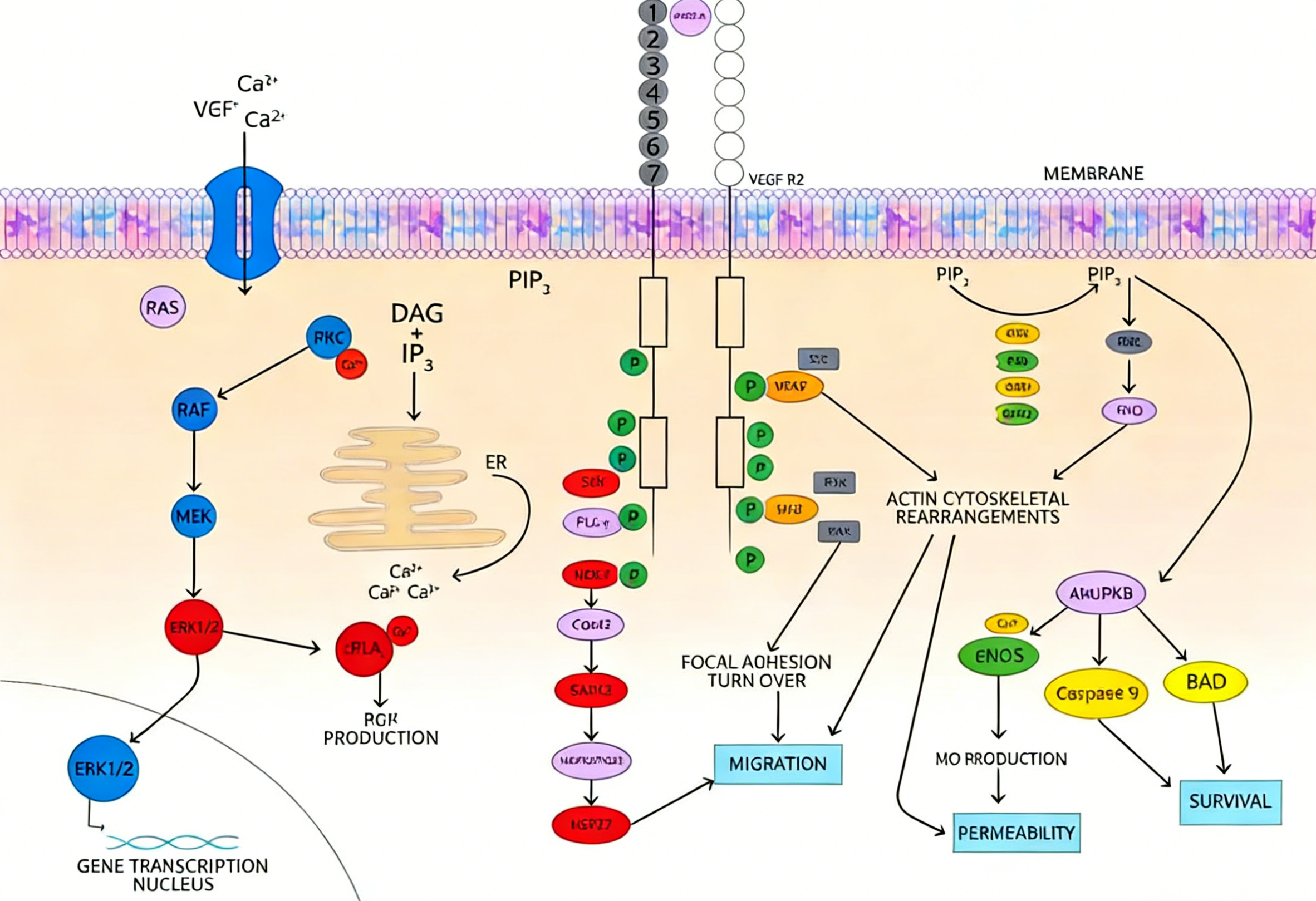
III. VEGF 120 Protein and Its Significance as a Research Tool
Among the various isoforms of VEGF-A, the VEGF 120 protein (i.e., VEGF-A121, named for its 121 amino acid residues, with a molecular weight of approximately 12-14 kDa, varying slightly depending on calculation methods) is an important soluble subtype. Due to its lack of a heparin-binding domain, it exhibits greater diffusion capacity, making it particularly significant in physiological and pathological angiogenesis research. As a research tool, highly pure and bioactive recombinant VEGF 120 protein is indispensable in basic research and drug development:
1. Functional Studies and Mechanism Validation: Can be used to stimulate endothelial cells in vitro, specifically studying VEGF signal transduction independent of extracellular matrix binding, and observing its effects on cell proliferation, migration, tube formation, and survival. It is a core reagent for elucidating the fundamental biological functions of VEGF-A.
2. Signal Pathway Analysis: By applying VEGF 120 protein, the downstream pathways mediated by VEGFR-2 (such as the PLCγ-PKC-MAPK pathway, PI3K-Akt pathway, p38 MAPK pathway, etc.) can be clearly activated, enabling the study of the specific roles and interrelationships of these pathways in endothelial cell function regulation.
3. Drug Screening and Potency Evaluation: In the development of VEGF/VEGFR inhibitors (such as monoclonal antibodies, small-molecule tyrosine kinase inhibitors), VEGF 120 protein can serve as a standard ligand to evaluate the ability of candidate drugs to block ligand-receptor binding, inhibit downstream signal activation, and antagonize endothelial cell function.
4. Animal Model Applications: In animal experiments, it can be administered locally or systemically to simulate or enhance pathological angiogenesis, enabling the evaluation of anti-angiogenic drug efficacy in vivo.
IV. Signal Transduction Mechanisms and Related Diseases
Upon binding of VEGF (primarily VEGFA) to VEGFR-2, receptor dimerization and autophosphorylation are triggered, recruiting and activating various downstream signaling molecules to form three main effector pathways:
1. Proliferation Pathway: Activation of the PLCγ-PKC-Raf-MEK-ERK/MAPK cascade promotes endothelial cell proliferation.
2. Survival Pathway: Activation of the PI3K-Akt pathway inhibits apoptosis, enhancing endothelial cell survival.
3. Migration and Permeability Pathway: Activation of the Cdc42/p38 MAPK pathway regulates cytoskeletal reorganization, promoting cell migration, while activation of the Src pathway significantly increases vascular permeability.
Abnormal activation of this pathway is closely associated with various diseases, particularly solid tumors (such as glioblastoma, breast cancer, melanoma), retinal vascular diseases, and hypoxia-related conditions. Tumor cells "hijack" this pathway by overexpressing VEGF, inducing tumor angiogenesis to support rapid growth and distant metastasis.
V. Therapeutic Strategies Targeting the VEGF Signaling Pathway
Given the central role of the VEGF pathway in pathological angiogenesis, inhibitors targeting this pathway have become important therapeutic tools. Current strategies primarily include:
- Targeting VEGF Ligands: For example, Bevacizumab, a humanized anti-VEGF monoclonal antibody, neutralizes VEGF activity.
- Targeting VEGFR: Such as various small-molecule tyrosine kinase inhibitors that inhibit VEGFR kinase activity.
- Decoy Receptors: For example, Aflibercept, a VEGFR extracellular domain fusion protein, acts as a "trap" to bind and neutralize VEGF.
VEGF 120 protein, as a standardized active ligand, is an indispensable key reagent in the mechanistic studies, in vitro screening, and preclinical pharmacodynamic evaluations of all the above inhibitors.
VI. Which Manufacturers Provide VEGF 120 Protein?
Nanjing UniLove Protein has independently developed VEGF 120 Protein, Mouse (Catalog No.: UA040501), a high-purity, high-activity recombinant mouse-derived vascular endothelial growth factor 120 (VEGF120) protein, produced using a mammalian expression system with spatial conformation and post-translational modifications consistent with the natural protein. VEGF120 is a soluble splice variant of VEGF-A that plays a crucial role in angiogenesis, endothelial cell proliferation, and developmental processes. This product has undergone rigorous validation in purity, stability, and bioactivity, making it a key tool for research in angiogenesis, tumor microenvironments, tissue repair, and related fields.
| Core Product Advantages |
|---|
| High Purity and Natural Conformation: Expressed via a mammalian expression system to ensure correct folding and glycosylation, purified through multiple chromatography steps with >95% purity and low endotoxin levels, accurately mimicking the bioactivity of natural VEGF120. |
| Exceptional Bioactivity: Validated through endothelial cell (e.g., HUVEC) proliferation, migration, or tube formation assays, exhibiting high specific activity and effectively activating VEGFR2 and downstream signaling pathways. Suitable for angiogenesis research and in vitro efficacy evaluation. |
| Broad Application Compatibility: Compatible with various experimental systems, including endothelial cell function studies, angiogenesis model construction, antibody/inhibitor screening (e.g., ELISA/SPR/BLI competitive binding assays), as a standard for quantitative detection, and as an immunogen for antibody development. |
| Excellent Stability and Batch Consistency: Manufactured using standardized processes and strict quality control to ensure consistent purity, activity, and stability across batches, guaranteeing experimental reproducibility and data reliability. |
| Professional Technical Support: We provide detailed product technical documentation, recommended experimental protocols, storage recommendations, and professional technical consultation and support for VEGF120 research in tumor angiogenesis, ischemic diseases, tissue engineering, and related fields. |
Nanjing UniLove Protein is committed to providing high-quality core protein tools for vascular biology, tumor research, and regenerative medicine. For detailed technical parameters, activity validation data, or application consultation regarding VEGF 120 Protein, Mouse (Catalog No.: UA040501), please feel free to contact us.
This article is reviewed and published by the technical expert team of UA
Disclaimer: This article partially utilizes artificial intelligence assistance in its creation. If any content involves copyright or intellectual property issues, please let us know and we promise to verify and remove it as soon as possible.
Purchase recombinant protein, choose Nanjing UA-Bio
UA protein focuses on providing various protein reagents, raw materials, and services required for drug research and development, cell therapy, gene therapy, and basic scientific research, including drug target proteins, immune checkpoint proteins, cytokines, tool enzymes, customized protein expression, and full-length transmembrane protein development. Youai is committed to providing customers with high-quality products and professional services, and building a High-tech Biological Enterprise with International Competitiveness.







 Business license (three certificates in one)