




Sortase A: The Enchantment of ADC Drug Conjugation


Since its first reported application as a tool for protein or peptide ligation in 2004, Sortase A, a bacterial enzyme, has rapidly emerged as a research hotspot in fields such as biochemistry, proteomics, biomedicine, and bioengineering. Particularly in the development of antibody-drug conjugates (ADCs), Sortase A has played a pivotal role.
- Recent Advances
- Reference
Introduction
Since its first reported application as a tool for protein or peptide ligation in 2004, Sortase A, a bacterial enzyme, has rapidly emerged as a research hotspot in fields such as biochemistry, proteomics, biomedicine, and bioengineering. Particularly in the development of antibody-drug conjugates (ADCs), Sortase A has played a pivotal role.
Fundamental Principles of Sortase A
Sortase A is a transpeptidase that primarily catalyzes transamidation reactions, enabling the precise attachment of various functional groups to proteins. It recognizes specific peptide sequences on target proteins, typically LPXTG (where X can be any amino acid), and cleaves between the threonine (T) and glycine (G) residues. This cleavage exposes a reactive threonine residue, which can form a new peptide bond with an oligoglycine-modified substrate, allowing the attachment of diverse molecules, including drugs, fluorophores, and other tags.
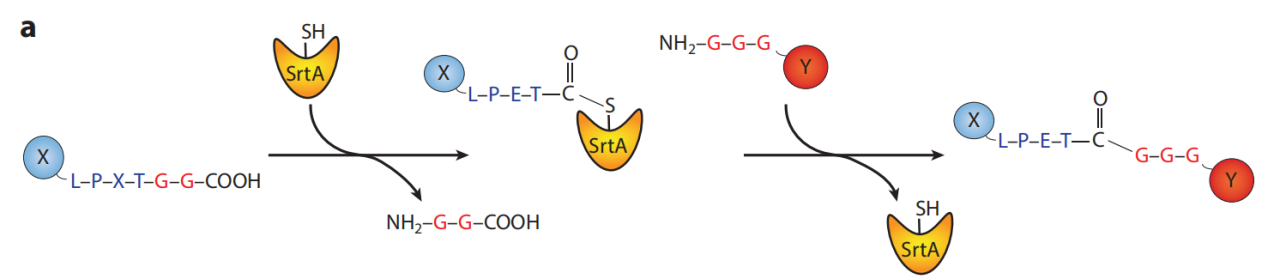
Advantages in ADC Drug Conjugation
Site-Specific Conjugation:
Sortase A-mediated antibody conjugation (SMAC) technology enables the efficient conjugation of toxins to antibodies at predefined sites, resulting in homogeneous drug-to-antibody ratio (DAR) products with high stability. This site-specific conjugation is crucial for consistent therapeutic efficacy and reduced off-target effects in ADCs.
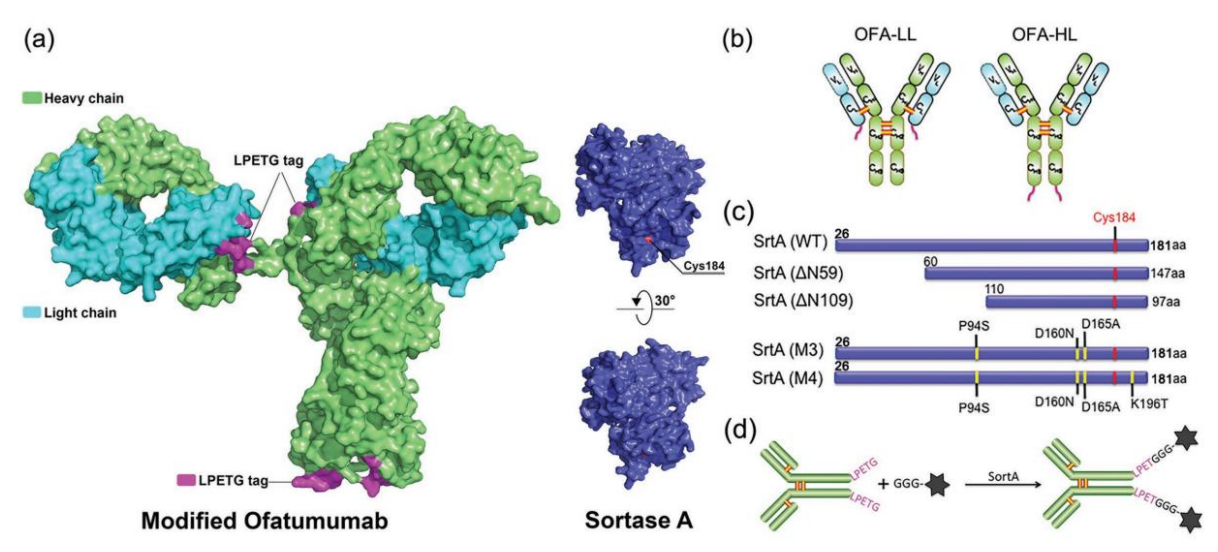
High Catalytic Efficiency:
Sortase A efficiently and specifically catalyzes covalent ligation reactions between proteins or peptides with specific sequences under mild reaction conditions, preserving the structure and function of the substrates.
Specific Recognition Sequence:
Sortase A can recognize substrates containing the LPXTG sequence and link them to various glycine-containing acceptors, making it applicable to a wide range of proteins and peptides.
Mild Reaction Conditions:
Sortase A functions under physiological conditions (e.g., neutral pH, room temperature), avoiding the degradation of proteins or peptides under extreme conditions.
Controllable Reaction Conditions:
By adjusting calcium ion concentration, substrate concentration, and reaction time, the catalytic reaction of Sortase A can be precisely controlled, enhancing reaction efficiency and yield.
Future Prospects
The application of Sortase A in the ADC field demonstrates its potential in biomedical technology. Through site-specific conjugation, Sortase A not only improves the stability and homogeneity of ADCs but also helps reduce off-target effects, offering more precise therapeutic strategies for cancer treatment. With further research and application, the prospects of Sortase A in protein engineering and drug development will continue to expand.
This article is reviewed and published by the technical expert team of UA
Disclaimer: This article partially utilizes artificial intelligence assistance in its creation. If any content involves copyright or intellectual property issues, please let us know and we promise to verify and remove it as soon as possible.
Purchase recombinant protein, choose Nanjing UA-Bio
UA protein focuses on providing various protein reagents, raw materials, and services required for drug research and development, cell therapy, gene therapy, and basic scientific research, including drug target proteins, immune checkpoint proteins, cytokines, tool enzymes, customized protein expression, and full-length transmembrane protein development. Youai is committed to providing customers with high-quality products and professional services, and building a High-tech Biological Enterprise with International Competitiveness.

1. Gébleux, R., Briendl, M., Grawunder, U., & Beerli, R. R. (2019). Sortase A Enzyme-Mediated Generation of Site-Specifically Conjugated Antibody-Drug Conjugates. Enzyme-Mediated Ligation Methods,1064-3745,1940-6029.
2. Witte MD, Wu T, Guimaraes CP, Theile CS, Blom AEM, et al. 2015. Site-specific protein modification using immobilized sortase in batch and continuous-flow systems. Nat. Protoc. 10(03):508–16.
3. Witte MD, Theile CS, Wu T, Guimaraes CP, Blom AEM, et al. 2013. Production of unnaturally linked chimeric proteins using a combination of sortase-catalyzed transpeptidation and click chemistry. Nat. Protoc. 8(9):1808–19.
4. Rashidian M, Keliher EJ, Bilate AM, Duarte JN,Wojtkiewicz GR, et al. 2015. Noninvasive imaging of immune responses. PNAS 112(19):6146–51.
5. Antos JM, Miller GM, Grotenbreg GM, Ploegh HL. 2008. Lipid modification of proteins through sortasecatalyzed transpeptidation. J. Am. Chem. Soc. 130(48):16338–43.
6. Pishesha, N., Ingram, J. R., & Ploegh, H. L. (2018). Sortase A: A Model for Transpeptidation and Its Biological Applications. Annual Review of Cell and Developmental Biology, 34(1).
7. Pan, L., Zhao, W., Lai, J., Ding, D., Zhang, Q., Yang, X., … Chen, S. (2016). Sortase A-Generated Highly Potent Anti-CD20-MMAE Conjugates for Efficient Elimination of B-Lineage Lymphomas. Small, 13(6), 1602267.






 Business license (three certificates in one)