NEK7 Target: The Next Value Blue Ocean in Biomedicine


NIMA-related kinase 7 (NEK7), once considered a "supporting actor" in cell cycle regulation, has now emerged as one of the most promising novel targets in the treatment of inflammatory diseases and tumors. As the critical "gatekeeper" for NLRP3 inflammasome assembly, targeted intervention of NEK7 offers a groundbreaking strategy for addressing a broad spectrum of diseases, ranging from myelodysplastic syndromes to neurodegenerative disorders.
- Recent Advances
- Product Information
NIMA-related kinase 7 (NEK7), once considered a "supporting actor" in cell cycle regulation, has now emerged as one of the most promising novel therapeutic targets in inflammatory diseases and oncology. As the essential gatekeeper for NLRP3 inflammasome assembly, targeted intervention of NEK7 provides innovative strategies for treating a broad spectrum of diseases ranging from myelodysplastic syndromes to neurodegenerative disorders.
NEK7 is the smallest serine/threonine protein kinase (∼35 kDa) in the NEK (Never in Mitosis A) family, sharing 85% structural homology with NEK6. Unlike other NEK members, NEK7 lacks a C-terminal regulatory domain, conferring unique substrate specificity in cell cycle regulation.
Canonical function: NEK7 plays a central role in the spindle assembly checkpoint during mitosis, regulating spindle polarity and cytokinesis through phosphorylation of dynein-related components. Its aberrant expression is closely associated with the pathogenesis of various solid tumors including breast cancer, colon cancer, and non-small cell lung cancer.
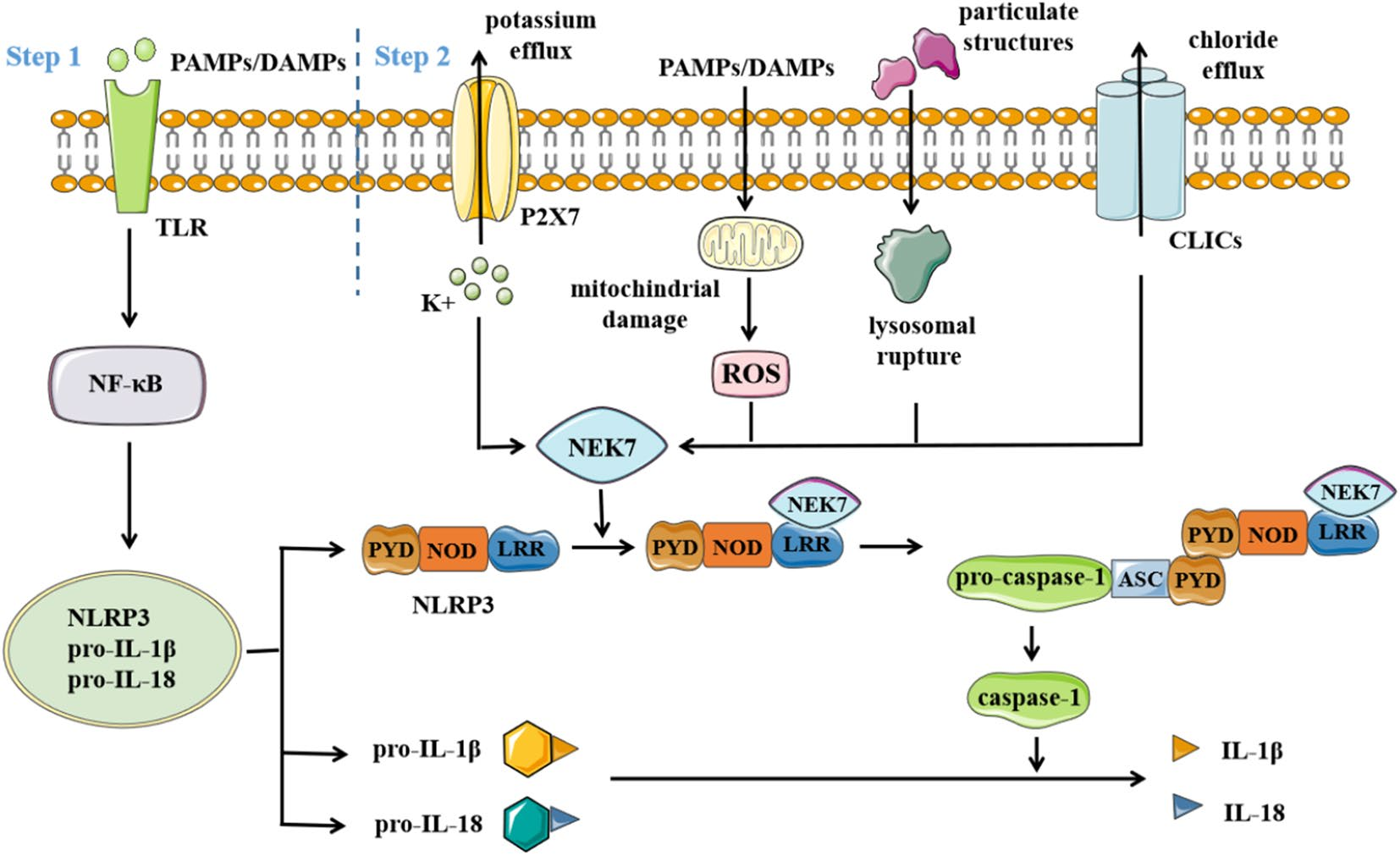
Source: doi.org/10.1007/s10787-022-01026-7
A 2019 Nature structural biology study revolutionized the scientific understanding of NEK7: it is an essential component for NLRP3 inflammasome assembly and activation. In resting state, NEK7's low-activity conformation prevents NLRP3 oligomerization; upon sensing danger signals (e.g., PAMPs or DAMPs), NEK7 binds to NLRP3's LRR domain, inducing conformational changes that promote ASC recruitment and caspase-1 activation, ultimately driving IL-1β/IL-18 maturation and pyroptosis.
This discovery redefined NEK7 from a cell cycle regulator to a core hub of innate immune inflammation pathways, establishing a new paradigm for treating chronic inflammatory diseases and inflammation-driven cancers.
Myelodysplastic syndromes (MDS) represent the clearest NEK7-associated indication. In low-risk MDS patients, aberrant NLRP3 inflammasome activation in bone marrow hematopoietic stem/progenitor cells drives continuous release of proinflammatory cytokines (IL-1β, IL-6, IL-8), promoting ineffective hematopoiesis, transfusion dependence, and progression to secondary AML. As an upstream essential factor, NEK7 becomes a critical intervention point.
Recurrent pericarditis and atherosclerosis involve IL-1β-mediated chronic sterile inflammation. Preclinical studies show NEK7 inhibition significantly reduces cardiovascular risk markers like CRP, enabling oral targeted strategies against NLRP3 pathway.
Alzheimer's (AD) and Parkinson's (PD) disease progression correlates with neuroinflammation. CNS NLRP3 activation drives tau hyperphosphorylation and amyloid deposition. Blood-brain barrier-penetrant NEK7 inhibitors may delay progression.
NEK7 inhibition ameliorates meta-inflammation in type 2 diabetes models. Tumor microenvironment studies reveal NEK7 promotes immune escape in esophageal squamous carcinoma via PD-L1 upregulation, showing synergy with checkpoint inhibitors.
Current NEK7-targeted drug development features multiple parallel approaches:
Halia Therapeutics' Ofirnoflast is the most advanced first-in-class oral allosteric inhibitor with unique mechanisms:
- Non-competitive inhibition: binds NEK7's allosteric site to block NEK7-NLRP3 PPI without direct kinase inhibition
- Promotes disassembly: inhibits both inflammasome formation and existing complex dissociation
Clinical progress (as of Nov 2025 ASH meeting):
- MDS (Phase 2): 18 low-risk MDS patients showed sustained hematologic improvement (HI-E) with reduced inflammatory markers (mtDNA, IL-8/IL-1β/IL-6) under intermittent dosing. FDA granted Orphan Drug Designation.
- Obesity/T2D (Phase 2, NCT07172867): Exploring combination with semaglutide for inflammation-induced anemia.
- Alzheimer's: Early clinical trials.
Key advantage: precise inflammasome targeting without broad immunosuppression seen with NSAIDs/steroids/IL-1 biologics.
Monte Rosa's MRT-8102 represents innovative TPD application in inflammation. This selective NEK7 degramer recruits cereblon E3 ligase to induce ubiquitination/proteasomal degradation.
Key preclinical data (Phase 1 started July 2025):
- In NHPs, 5-day oral dosing reduced PBMC NEK7 by 85% and nearly abolished IL-1β release ex vivo.
- Outperformed standard NLRP3 inhibitors in obese human blood ex vivo models.
- GLP tox showed >200-fold therapeutic window.
Phase 1 (NCT07172867) includes SAD/MAD cohorts and early PoC in high-CVD-risk patients. Initial results expected H1 2026. Potential advantage: event-driven pharmacology enables durable suppression with less frequent dosing.
2024 studies revealed Phase III anticancer drug Rociletinib (ROC) covalently binds NEK7 Cys79, blocking NEK7-NLRP3 interaction and alleviating metabolic inflammation in T2D models, suggesting:
1. NEK7 has druggable cysteine pockets;
2. Clinically safe drugs can be repurposed for rapid NEK7 indication development.
As a "molecular bridge" connecting cell proliferation and innate immunity, NEK7-targeted therapies represent precision medicine advancement. From the 2019 NLRP3-NEK7 crystal structure to Ofirnoflast/MRT-8102 clinical progress by 2025, NEK7 has rapidly transformed from basic discovery to transformative target.
Despite challenges in PPI targeting and hematologic toxicity management, clinical data (especially MDS hematologic improvements) preliminarily validate therapeutic hypotheses. With accumulating Phase 2/3 data and next-gen degraders, NEK7 inhibitors may become new pillars in inflammation/oncology after JAK/IL-1 therapies. By 2030, the first NEK7-targeted drug approval may herald a new era of inflammatory disease precision treatment.
This article is reviewed and published by the technical expert team of UA
Disclaimer: This article partially utilizes artificial intelligence assistance in its creation. If any content involves copyright or intellectual property issues, please let us know and we promise to verify and remove it as soon as possible.
Purchase recombinant protein, choose 
UA protein focuses on providing various protein reagents, raw materials, and services required for drug research and development, cell therapy, gene therapy, and basic scientific research, including drug target proteins, immune checkpoint proteins, cytokines, tool enzymes, customized protein expression, and full-length transmembrane protein development. Nanjing Univ is committed to providing customers with high-quality products and professional services, and building a High-tech Biological Enterprise with International Competitiveness.







 Business license (three certificates in one)