




ITPRIPL1 as a novel inhibitory ligand of CD3ε in tumor immune escape: Mechanisms and targeting strategies


The advent of tumor immunotherapy, particularly immune checkpoint blockade therapy, has significantly transformed the treatment landscape for various malignant tumors.
- Recent Advances
- Product Information
I. Research Background: T-cell Activation Dysfunction and Immunotherapy Resistance
Cancer immunotherapy, particularly immune checkpoint blockade therapy, has significantly transformed the treatment landscape for various malignancies. However, a substantial number of patients exhibit primary or acquired resistance to this therapy. The suppression of T-cell function through complex mechanisms in the tumor microenvironment is one of the key factors leading to treatment failure. The T-cell receptor-CD3 complex is the core structure initiating T-cell activation, with the CD3ε subunit contributing two identical extracellular domains. Current research on the TCR-CD3 complex primarily focuses on activating major histocompatibility complex-peptide ligands, while naturally occurring ligands that directly inhibit signal transduction of this complex remain unknown. Identifying and elucidating such inhibitory ligands is crucial for understanding novel mechanisms of tumor immune evasion and developing innovative immunotherapies.
II. Key Discovery: ITPRIPL1 as a Novel Inhibitory Ligand for CD3ε
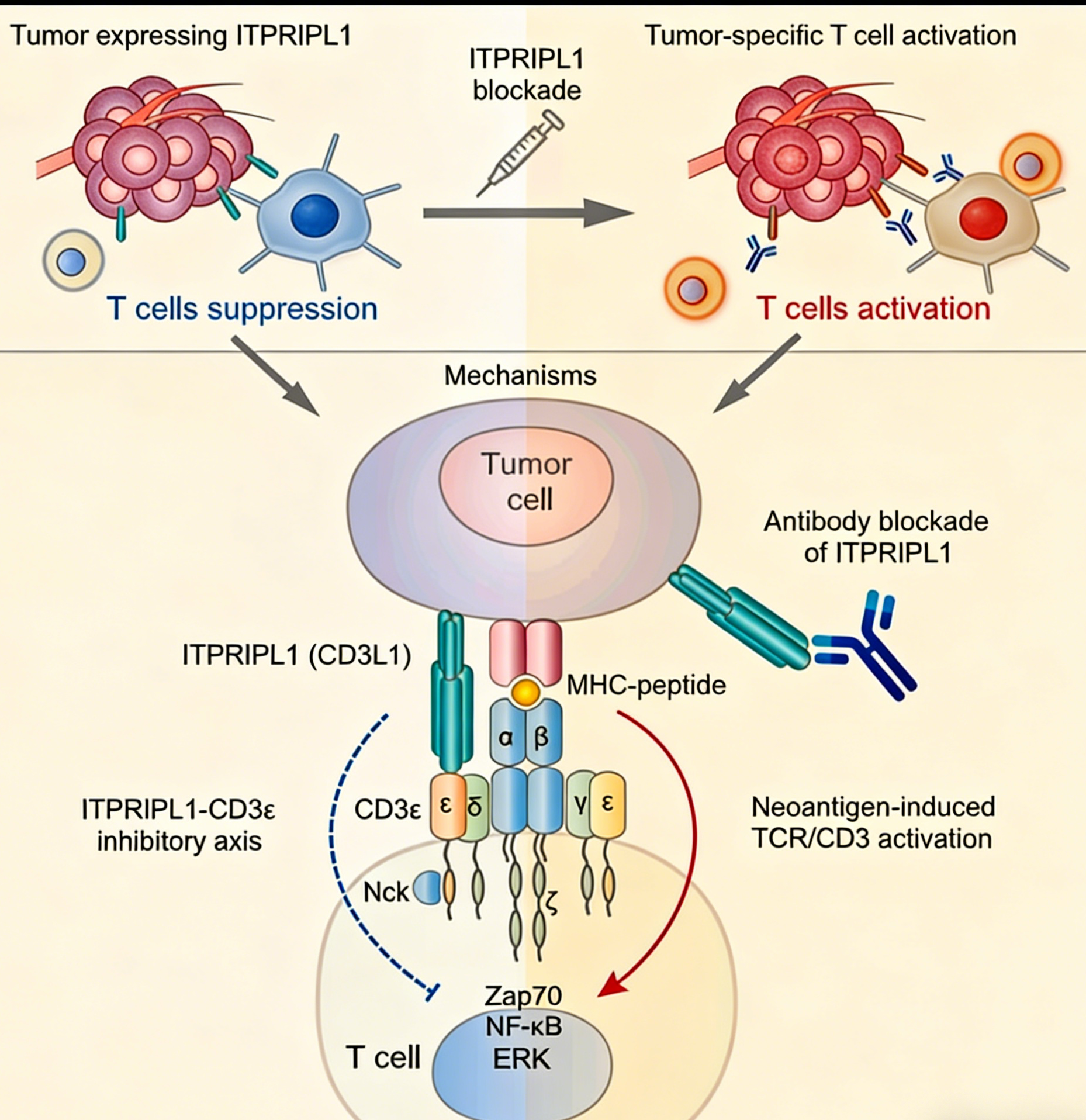
Recent studies have identified and validated a membrane protein named ITPRIPL1 as a critical inhibitory factor in effective anti-tumor immune responses by T cells.
1. Target Identification and Expression Profile: ITPRIPL1 is a type I transmembrane protein with highly restricted expression in normal tissues but widespread overexpression in tumor tissues, including various solid tumors, particularly those with low or no expression of programmed death-ligand 1.
2. Mechanism Elucidation: Research reveals that the extracellular domain of ITPRIPL1 directly binds to the CD3ε subunit on the T-cell surface. This binding exerts inhibitory effects at the earliest stage of T-cell activation ("signal one"), manifesting as significantly reduced calcium influx triggered by T-cell receptor signaling and impaired phosphorylation of the downstream kinase ZAP70. This signal blockade involves interactions with molecules such as Nck and ZAP70, ultimately hindering the activation of key pathways like extracellular signal-regulated kinase and nuclear factor κB, thereby comprehensively suppressing initial T-cell activation and function.
3. In Vitro and In Vivo Functional Validation: In mouse models of various solid tumors, treatment with neutralizing anti-ITPRIPL1 monoclonal antibodies effectively inhibited tumor growth and promoted the infiltration and activation of effector T cells in the tumor microenvironment. This anti-tumor effect was also validated in clinical treatments of naturally occurring tumors in pet dogs, demonstrating significant translational potential.
III. Research Tool: Application Value of Biotinylated CD3E&CD3D Fc, His, Avi tag&Fc, Flag, Avi Tag Protein
In studies elucidating the interaction between ITPRIPL1 and CD3ε and subsequent signaling mechanisms, well-designed, functionally defined recombinant protein complexes are critical tools for precise molecular interaction analysis and functional validation. The Biotinylated CD3E&CD3D Fc, His, Avi tag&Fc, Flag, Avi tag Protein, as a representative of such research tools, offers unique advantages through its composite design and multi-tag system:
1. Complex Simulation and Stability: This protein preparation mimics the heterodimeric form of CD3ε and CD3δ in the native TCR-CD3 complex, more accurately reflecting their natural conformation on the cell membrane. The Fc tag fusion enhances protein stability and solubility while facilitating efficient immobilization via Protein A/G for interaction studies.
2. Multiple Affinity Tags and Detection Flexibility: The integrated His tag and Flag tag enable affinity purification and immunodetection using various strategies. Pre-conjugated site-specific biotin labeling (achieved via the Avi tag) can bind with streptavidin systems, enabling ultra-high-affinity immobilization, particularly suitable for high-precision binding kinetics analyses like surface plasmon resonance and bio-layer interferometry, which require low background and high stability to accurately determine the binding constants of ITPRIPL1 with the CD3ε/CD3δ complex.
3. Core Application Scenarios:
- High-Precision Binding Validation: As a standardized receptor complex, it is used to directly and quantitatively validate the binding of ITPRIPL1's extracellular domain via SPR/BLI technologies and evaluate the competitive inhibition efficiency of candidate neutralizing antibodies.
- Signal Complex Studies: Useful for pull-down or co-immunoprecipitation experiments to investigate whether and how ITPRIPL1 binding affects the interaction between the CD3 complex and downstream signaling molecules (e.g., Nck, ZAP70).
- Antibody Screening and Characterization Platform: Serves as an antigen for high-throughput screening of monoclonal antibodies or small-molecule inhibitors targeting the CD3ε-ITPRIPL1 interaction interface.
IV. Which Vendors Provide Biotinylated CD3E&CD3D Fc, His, Avi tag&Fc, Flag, Avi Tag Protein?
Nanjing U-Protein自主研发的 Biotinylated CD3E&CD3D Fc, His, Avi tag&Fc, Flag, Avi tag Protein, Human (Catalog No.: UA011360) is a highly complex, functionally precise engineered T-cell receptor (TCR) complex subunit protein, specifically designed for the development and evaluation of next-generation T-cell-directed therapies (e.g., bispecific antibodies, CAR-T). This product co-expresses and purifies the human CD3ε-CD3δ heterodimeric complex, with each subunit carrying distinct tag combinations and achieving efficient site-specific biotinylation to mimic the key recognition and signaling modules of the TCR-CD3 complex on T-cell surfaces.
| Core Product Advantages |
|---|
| Accurate Simulation of Native CD3 Heterodimer: This product is not a monomeric protein but a co-expressed and purified CD3ε-CD3δ heterodimer, structurally highly consistent with the assembly state in the native TCR-CD3 complex, providing a more physiologically relevant and challenging evaluation target for CD3-targeting therapeutic drugs. |
| Tailored for Bispecific Antibody/CAR-T Development: - Drug Screening and Optimization: As the closest-to-native target protein, it is used to screen and optimize bispecific antibodies, antibody-drug conjugates (ADCs), or CAR domains targeting CD3ε or CD3δ, assessing their binding affinity, specificity, and activation potential. - Safety and Off-Target Effect Evaluation: Used to detect potential nonspecific binding of candidate drugs to non-target cells (e.g., Fc receptor-expressing cells) and assess "off-target toxicity" risks. - Quality Control: Serves as an advanced reference for activity determination and quality control during production or final product testing. |
| Superior Process and Quality Control: The production and purification of this complex protein are highly challenging. Nanjing U-Protein leverages advanced co-expression and purification platforms to ensure high purity, correct assembly ratios, and excellent batch-to-batch consistency. |
Nanjing U-Protein is committed to providing innovative, predictive preclinical research tools for cutting-edge fields like cancer immunotherapy and T-cell redirection therapies. For detailed structural schematics, specific tag locations, application protocols, or customized service inquiries regarding Biotinylated CD3E&CD3D Fc, His, Avi tag&Fc, Flag, Avi tag Protein, Human (Catalog No.: UA011360), please feel free to contact me.
Disclaimer: This article partially utilizes artificial intelligence assistance in its creation. If any content involves copyright or intellectual property issues, please let us know and we promise to verify and remove it as soon as possible.
Purchase recombinant protein, choose Nanjing UA-Bio
UA protein focuses on providing various protein reagents, raw materials, and services required for drug research and development, cell therapy, gene therapy, and basic scientific research, including drug target proteins, immune checkpoint proteins, cytokines, tool enzymes, customized protein expression, and full-length transmembrane protein development. Youai is committed to providing customers with high-quality products and professional services, and building a High-tech Biological Enterprise with International Competitiveness.







 Business license (three certificates in one)