




Study on the mechanism by which exosomes transmit IFN-α antiviral signals by mimicking viral invasion mechanisms


Chronic hepatitis B virus infection is a major global public health problem, and interferon-α is one of the important clinical treatment methods.
- Recent Advances
- Product Information
I. Research Background and Scientific Questions
Chronic hepatitis B virus infection is a major global public health issue, and interferon-alpha (IFN-α) is one of the key clinical treatment approaches. Its efficacy relies on both direct antiviral effects and indirect immunomodulatory functions. However, hepatocytes—the primary targets of HBV infection—have limited intrinsic responsiveness to IFN-α, while non-parenchymal liver cells (e.g., macrophages) can generate and transmit potent IFN-α-induced antiviral effects. Preliminary studies revealed that macrophages and other non-parenchymal cells release exosomes capable of transferring IFN-α-induced antiviral activity to HBV-replicating hepatocytes, effectively suppressing viral replication. Yet, the detailed molecular mechanisms by which these exosomes enter target cells and release their cargo to deliver antiviral signals remain unclear. Elucidating this process is critical for understanding the complete IFN-α-mediated anti-HBV network and developing novel antiviral strategies.
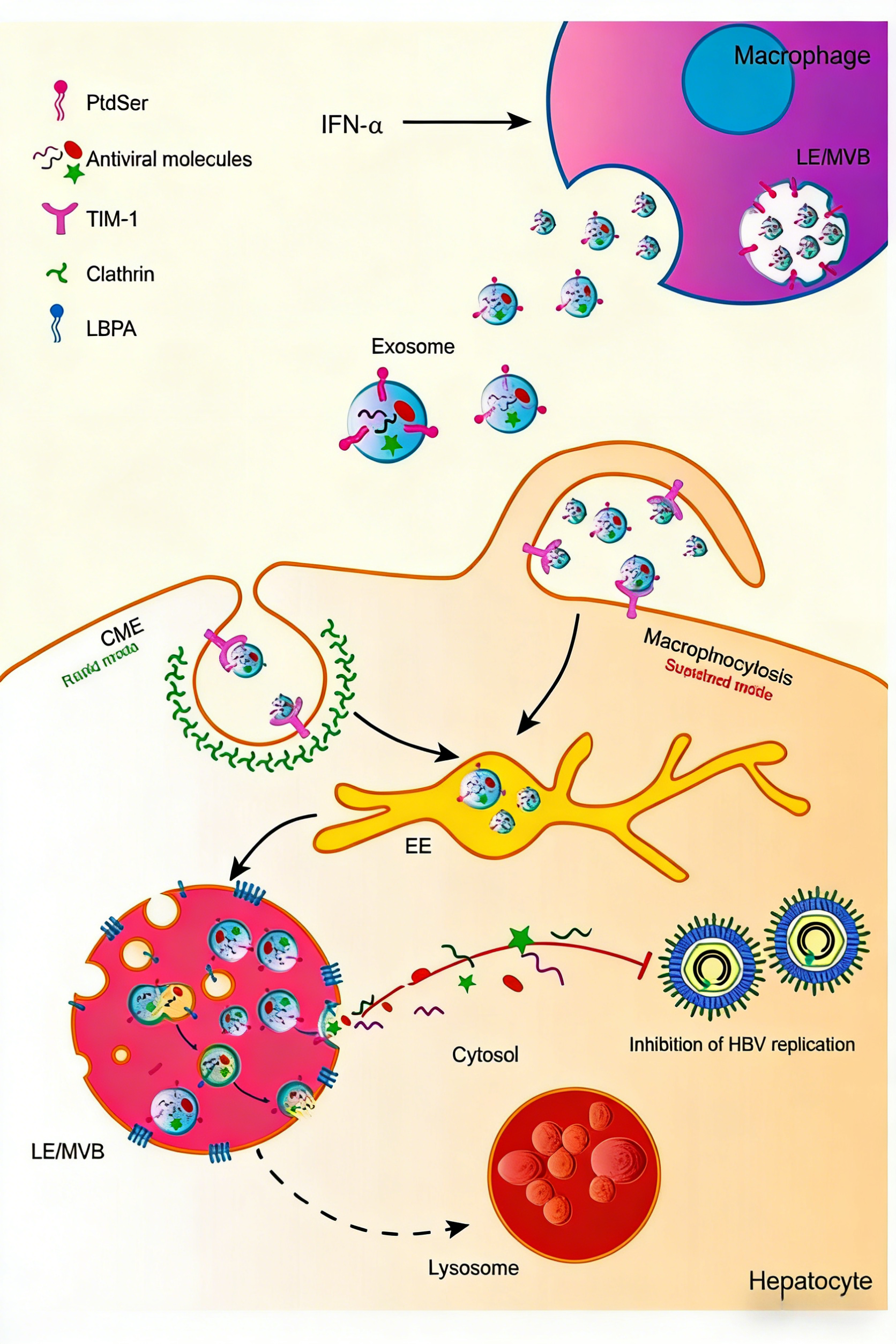
II. Core Discovery: Exosomes "Mimic" the Complete Viral Entry Pathway
This study systematically reveals the full pathway by which macrophage-derived exosomes transmit antiviral effects, demonstrating their clever "co-optation" of multiple key steps in viral host cell invasion.
1. Surface Receptor Recognition and Binding: The study found that macrophage exosomes expose phosphatidylserine (PtdSer) on their surface. As an "eat-me" signal, PtdSer is recognized by the T-cell immunoglobulin mucin receptor 1 (TIM-1) on hepatocytes, mediating binding. TIM-1 is a known entry receptor for hepatitis A virus and other viruses. Inhibition of TIM-1 expression in hepatocytes significantly impedes exosome internalization and antiviral signal transmission.
2. Clathrin- and Macropinocytosis-Mediated Endocytosis: After binding, exosomes primarily enter hepatocytes via two viral-like endocytic pathways:
- Clathrin-mediated endocytosis: Specific inhibitors or knockdown of clathrin heavy chain effectively suppress exosome uptake.
- Macropinocytosis: Exosome treatment stimulates fluid-phase uptake (a hallmark of macropinocytosis) in hepatocytes, while classic macropinocytosis inhibitors block entry. Intriguingly, this process is independent of canonical regulators Rac1 and Cdc42, suggesting a non-classical macropinocytosis pathway. Blocking either endocytic route attenuates the transmitted antiviral effect.
3. Endosomal Membrane Fusion and Cargo Release (Endosomal Escape): Internalized exosomes avoid lysosomal degradation. Instead, they fuse with late endosome/multivesicular body membranes to release cargo into the cytoplasm—a mechanism analogous to viral endosomal penetration. Live-cell imaging confirmed colocalization and fusion signals between exosomes and late endosome marker RAB7 or multivesicular body marker CD63. Further studies identified lysophosphatidic acid (LBPA), a lipid critical for viral membrane fusion, as essential for this process. LBPA blockade inhibits fusion and redirects exosomal cargo to lysosomal degradation.
III. Relevance of IFN-alpha/beta R1 His Tag Protein in the Study
While this study focuses on the antiviral "effectors" transmitted by exosomes rather than direct IFN-α-receptor binding, the IFN-alpha/beta R1 His Tag protein holds significant value in related upstream/downstream mechanistic research as the initiation point of Type I interferon signaling.
1. Upstream Signal Validation: When investigating how macrophages acquire a "transmissible antiviral state" upon IFN-α stimulation, this recombinant protein serves as a tool to verify IFN-α-IFNAR1 binding and downstream STAT pathway activation—a prerequisite for antiviral gene expression and potential exosomal cargo loading.
2. Cargo Composition Studies: Key antiviral effectors in exosomes may include IFN-stimulated gene products or non-coding RNAs. The IFN-alpha/beta R1 His Tag protein aids in validating complete IFN-α signal activation during studies of these molecules' biogenesis, enabling receptor-binding or signal-blocking experiments.
3. Comparative Research Tool: This protein facilitates parallel comparisons between "classical" direct IFN-α signaling and the "exosome-mediated" transmission pathway in terms of efficiency, kinetics, and effector profiles.
IV. Suppliers of IFN-alpha/beta R1 His Tag Protein
Nanjing U-Protein's self-developed IFN-alpha/beta R1 His Tag Protein, Human (Cat#: UA011351) is a high-purity, high-activity recombinant human IFNAR1 extracellular domain protein. Expressed in mammalian systems with a C-terminal His tag for purification/detection, IFNAR1 is the core component of Type I interferon (IFN-α/β) signaling, pivotal in antiviral immunity, antitumor responses, and autoimmune diseases. Ideal for receptor-ligand studies, antibody screening, and pathway analysis.
| Key Product Advantages |
|---|
| High Purity & Native Conformation: Mammalian expression ensures proper folding/glycosylation. Affinity-purified to >95% purity with low endotoxin, authentically mimicking natural IFNAR1 binding properties. |
| High-Affinity Specific Binding: Retains intact ligand-binding domains. Validated by SPR/BLI/ELISA for high-affinity, specific binding to Type I interferons (e.g., IFN-α2, IFN-β), suitable for competition assays, inhibitor screening, and functional studies. |
| His-Tag Convenience: C-terminal His tag enables nickel-column purification and compatibility with His-tag detection/immobilization systems, enhancing experimental flexibility. |
| Broad Applications: - Molecular Interaction Analysis: Quantifies binding kinetics/affinity between IFNAR1 and IFN/antibodies/small-molecule inhibitors. - Drug Screening: Immobilized target for high-throughput screening of IFN-signaling blockers. - Antibody Development: Superior immunogen/detection antigen for IFNAR1-specific therapeutic/diagnostic antibodies. |
| Exceptional Stability & Batch Consistency: Standardized production and rigorous QC ensure long-term stability and inter-batch consistency, guaranteeing reliable, reproducible data. |
Nanjing U-Protein specializes in premium recombinant protein tools for virology, immunology, and cancer immunotherapy. For detailed specifications, binding data, or application guidance on IFN-alpha/beta R1 His Tag Protein, Human (Cat#: UA011351), please contact us.
Disclaimer: This article partially utilizes artificial intelligence assistance in its creation. If any content involves copyright or intellectual property issues, please let us know and we promise to verify and remove it as soon as possible.
Purchase recombinant protein, choose Nanjing UA-Bio
UA protein focuses on providing various protein reagents, raw materials, and services required for drug research and development, cell therapy, gene therapy, and basic scientific research, including drug target proteins, immune checkpoint proteins, cytokines, tool enzymes, customized protein expression, and full-length transmembrane protein development. Youai is committed to providing customers with high-quality products and professional services, and building a High-tech Biological Enterprise with International Competitiveness.







 Business license (three certificates in one)