




Innovative Strategy for Engineering IL-21 Receptor to Enhance the Efficacy of TCR-T Cells Against Hepatocellular Carcinoma


Hepatocellular carcinoma is the most common primary liver cancer and has limited response to conventional therapies. Adoptive T cell therapies (such as TCR-T therapy) have shown significant efficacy in hematologic malignancies.
- Recent Advances
- Product Information
I. Research Background: Challenges of Solid Tumor Immunotherapy and the Potential of Cytokines
Hepatocellular carcinoma (HCC) is the most common primary liver cancer and has limited response to conventional therapies. Adoptive T cell therapies (e.g., TCR-T therapy) have shown remarkable efficacy in hematologic malignancies but face challenges in solid tumors like HCC, including tumor microenvironment suppression, T cell exhaustion, and insufficient persistence. Cytokines, particularly the γ-chain family (e.g., IL-2, IL-7, IL-15, IL-21), play a central role in regulating T cell proliferation, survival, differentiation, and effector functions. Among these, IL-21 stands out due to its unique biological properties: it promotes CD8+ T cell differentiation and cytotoxic function, maintains a "young" phenotype (e.g., central memory-like) during in vitro expansion, and may resist T cell exhaustion. However, systemic IL-21 application is hindered by its short half-life, broad effects on diverse immune cells, and potential dose-limiting toxicity. Thus, developing a strategy to safely and continuously deliver IL-21 signaling within T cells while avoiding systemic side effects is an urgent need to enhance the efficacy of T cell therapies against solid tumors.
II. Key Findings: IL-21 Enhances TCR-T Cell Function and Novel Engineered Receptor Construction
The research team first systematically evaluated the effects of γ-chain cytokines on AFP-specific TCR-T cells against HCC. In vitro repeated co-culture experiments demonstrated that exogenous IL-21 significantly enhanced the sustained killing capacity, interferon-γ secretion, and reduced apoptosis and PD-1 expression of AFP-TCR-T cells compared to IL-7 or IL-15. This advantage may be attributed to IL-21's ability to promote T cell proliferation and induce memory differentiation.
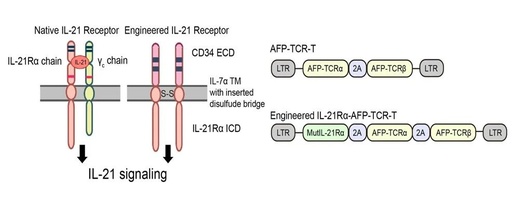
Based on this, the team innovatively designed and constructed a mutant IL-21 receptor. The core feature of this engineered receptor is its ability to spontaneously or constitutively activate downstream STAT3 signaling without requiring exogenous IL-21 ligand. Introducing this receptor into AFP-specific TCR-T cells yielded novel IL-21R-TCR-T cells.
III. Research Tools: Role of Biotinylated IL-21 R His&Avi Tag Protein in Mechanism Validation
High-precision, multifunctional standardized protein tools are critical for designing and validating the function of such engineered receptors and understanding IL-21 signaling mechanisms. The Biotinylated IL-21 R His&Avi Tag protein is a tailor-made premium reagent for such research:
1. Precise Structural Design and Labeling: This recombinant protein contains the extracellular ligand-binding domain of human IL-21 receptor, fused with His and Avi tags. The His tag facilitates purification, while the Avi tag enables site-specific, efficient biotinylation in vitro.
2. Ultra-High Affinity Immobilization and Detection: Pre-biotinylation allows near-irreversible immobilization via streptavidin systems, which is crucial for long-term, high-precision binding analyses (e.g., surface plasmon resonance for ligand-receptor binding kinetics).
3. Core Applications in Receptor Engineering Research:
- Receptor Function and Structure-Activity Relationship Analysis: Used to compare the affinity differences between wild-type IL-21R and engineered mutant receptors when binding IL-21, validating whether engineering alters binding properties.
- Signaling Complex Studies: Serves as a standardized "bait" protein to study interactions between IL-21R and downstream signaling molecules (e.g., JAK kinases, STAT3) and assess how engineered receptors affect these interactions.
- Antibody and Inhibitor Screening: Acts as an antigen for screening and evaluating antibodies or small molecules that mimic or block IL-21 signaling.
IV. Superior Performance of Engineered IL-21R-TCR-T Cells
Compared to conventional AFP-TCR-T cells, those carrying the engineered IL-21 receptor exhibited comprehensive performance enhancements:
1. Robust Autonomous Proliferation and Persistence: IL-21R-TCR-T cells showed significantly improved in vitro proliferation and long-term survival even without exogenous IL-21.
2. Outstanding In Vitro and In Vivo Antitumor Activity: In HCC xenograft mouse models, IL-21R-TCR-T cells more effectively controlled tumor growth and demonstrated stronger tumor infiltration.
3. Resistance to Exhaustion and Maintenance of Functional Phenotype: After repeated tumor antigen stimulation, IL-21R-TCR-T cells exhibited lower levels of exhaustion markers and maintained a memory-like/effector phenotype with stronger re-challenge capacity, delaying functional decline.
V. Which Vendors Provide Biotinylated IL-21 R His&Avi Tag Protein?
Nanjing U-Protein自主研发的 Biotinylated IL-21 R His&Avi Tag Protein, Human (Catalog No.: UA011359) is an innovative cytokine receptor tool integrating high purity, efficient biotinylation, and exceptional detection sensitivity. This product combines the extracellular domain of human interleukin-21 receptor (IL-21R) with C-terminal His and Avi tags, followed by site-specific, highly uniform biotinylation. IL-21R is a key receptor regulating T cell, B cell, and NK cell functions, garnering significant attention in tumor immunology, autoimmune diseases, and cell therapy. This product is suitable for ultra-sensitive detection, precise interaction analysis, and high-throughput drug screening.
| Core Product Advantages |
|---|
| High Purity and Native Active Conformation: Mammalian expression system ensures proper folding and glycosylation. Multi-step chromatography yields high-purity (>95%), low-endotoxin IL-21R protein with rigorously validated IL-21 binding capacity. |
| Efficient, Uniform Site-Specific Biotinylation: AviTag enables site-specific biotinylation with high efficiency and batch consistency. The product forms high-density, oriented, and stable conjugation with streptavidin-coated surfaces (e.g., biosensor chips, ELISA plates, magnetic beads), maximizing detection sensitivity, stability, and signal-to-noise ratio. |
| Dual Tags for Flexible Applications: His tag facilitates initial capture or purification via nickel columns, while the AviTag-biotin system unlocks advanced ultra-sensitive detection and immobilization technologies. This allows the same protein to be used for routine research and cutting-edge platforms like single-molecule detection. |
| Exceptional Stability and Batch Consistency: Rigorous production and QC ensure long-term stability and high consistency across batches in purity, biotinylation efficiency, and binding activity, making it a reliable choice for long-term projects. |
Nanjing U-Protein is committed to providing engineered, high-performance protein tools for immunotherapy, antibody engineering, and drug discovery. For detailed technical parameters (e.g., binding kinetics), experimental protocols, or customized service inquiries regarding Biotinylated IL-21 R His&Avi Tag Protein, Human (Catalog No.: UA011359), please feel free to contact us.
Disclaimer: This article partially utilizes artificial intelligence assistance in its creation. If any content involves copyright or intellectual property issues, please let us know and we promise to verify and remove it as soon as possible.
Purchase recombinant protein, choose Nanjing UA-Bio
UA protein focuses on providing various protein reagents, raw materials, and services required for drug research and development, cell therapy, gene therapy, and basic scientific research, including drug target proteins, immune checkpoint proteins, cytokines, tool enzymes, customized protein expression, and full-length transmembrane protein development. Youai is committed to providing customers with high-quality products and professional services, and building a High-tech Biological Enterprise with International Competitiveness.







 Business license (three certificates in one)