




Long R3 IGF-I protein: A highly efficient engineered variant of cell growth factor


Long R3 IGF-I is a highly active analog of insulin-like growth factor-I obtained through directed engineering. Its molecular structure incorporates two key modifications based on the natural IGF-I sequence.
- Recent Advances
- Product Information
I. Molecular Design and Engineering Advantages of Long R3 IGF-I Protein
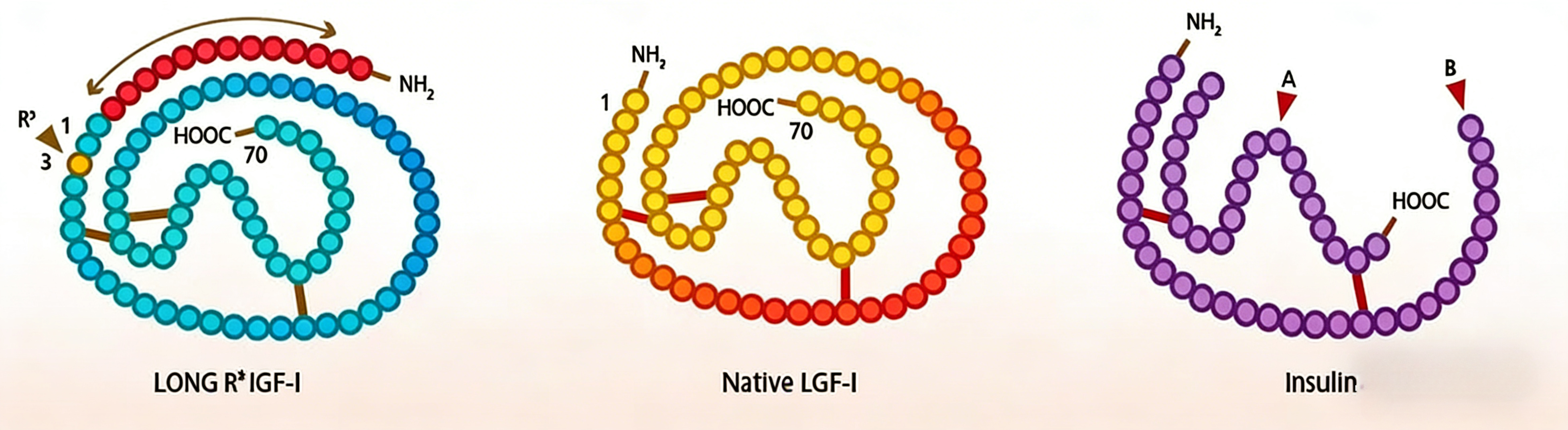
Long R3 IGF-I is a highly active analog of insulin-like growth factor-I obtained through directed engineering modifications. Its molecular structure features two key modifications based on the natural IGF-I sequence: first, an additional 13-amino acid extension peptide chain ("Long" modification) at the N-terminus; second, replacement of the glutamic acid residue at position 3 with an arginine residue ("R3" modification). These modifications endow the molecule with significantly superior biological properties compared to its natural counterpart, making it a powerful tool molecule in cell culture and biomanufacturing.
II. Core Biological Characteristics of Long R3 IGF-I
The functional advantages of Long R3 IGF-I are mainly reflected in its efficient intervention in cell growth regulation networks, with potent and specific effects.
1. Highly efficient activation of IGF-I receptor signaling pathway: Long R3 IGF-I primarily functions by specifically binding to IGF-I receptors on cell surfaces. Compared to insulin receptors, IGF-I receptors are more abundantly expressed on most cell surfaces. Therefore, Long R3 IGF-I can more effectively activate downstream PI3K-AKT and MAPK signaling pathways, which are crucial for promoting cell survival and proliferation, thereby strongly enhancing cell proliferation, inhibiting apoptosis, and increasing protein synthesis. Studies show that its efficacy in promoting growth of specific cell lines can be approximately 200 times higher than insulin.
2. Extremely low affinity for IGF binding proteins: In physiological environments and culture systems, the activity of natural IGF-I is significantly inhibited due to its high-affinity binding with various IGF binding proteins. The engineered modifications of Long R3 IGF-I reduce its affinity for IGF binding proteins by more than 1000-fold, effectively preventing "sequestration" inactivation and ensuring high bioavailability and functional activity even in complex systems.
III. Application Value of Long R3 IGF-I in Biopharmaceutical R&D and Production
Based on these exceptional properties, Long R3 IGF-I demonstrates important application value in multiple biotechnological fields:
1. Key additive component for serum-free/chemically defined media: In cell culture, especially in industrial-scale biopharmaceutical production, using serum-free media is critical for ensuring product safety and consistency. Due to its highly efficient and defined growth-promoting effects, Long R3 IGF-I has become a key additive to replace animal-derived serum or insulin. Its low usage concentration (typically at nanogram per milliliter levels) not only reduces costs but also simplifies downstream purification processes and avoids risks of contamination by exogenous viruses or prions.
2. Supporting expansion and protein expression of difficult-to-culture cell lines: For engineered cell lines such as CHO and HEK293, commonly used in recombinant protein production, Long R3 IGF-I can significantly improve cell viability, proliferation rates, and final target protein yields under serum-free conditions. Research confirms that adding it to media or achieving co-expression through genetic engineering can effectively enhance cell cloning efficiency, cell density, and recombinant protein expression levels.
3. Tool for tissue engineering and cell therapy research: In cutting-edge fields such as cultured meat, stem cell expansion, and tissue regeneration, Long R3 IGF-I is also used as a core growth factor to efficiently drive proliferation of specific cell types (e.g., muscle stem cells), providing reliable in vitro expansion support for related research.
IV. Summary and Outlook
As an engineered super-effective variant of IGF-I, Long R3 IGF-I protein overcomes the defect of natural molecules being easily neutralized by binding proteins through ingenious molecular design and amplifies their ability to activate IGF-I receptors, making it a powerful and widely applicable cell growth regulation tool. Its successful applications in biopharmaceutical process development, basic cell biology research, and emerging biomanufacturing fields fully demonstrate the tremendous potential of protein engineering in optimizing bioactive molecules. In the future, with deeper understanding of cell growth regulation networks, similar high-performance engineered growth factors obtained through rational design will continue to provide key technical support for life science research and biotechnological industry development.
V. Which Manufacturers Provide LR3-IGF-I Protein?
Nanjing YouAi Protein independently developed LR3-IGF-I Protein, Human/Porcine/Bovine (Catalog No.: UA040515), an engineered, long-acting insulin-like growth factor-I (IGF-I) analog with ultra-high activity and serum stability. This product features key modifications (e.g., N-terminal extension and specific amino acid substitutions) based on the natural IGF-I sequence, significantly enhancing its binding affinity for IGF-1 receptors while greatly reducing its affinity for IGF binding proteins (IGFBPs) in serum. This property makes it exhibit far higher biological activity and stability than wild-type IGF-I in in vitro cell experiments, making it an ideal tool for studying cell proliferation, differentiation, metabolism, and anti-apoptotic signaling pathways.
| Core Product Advantages |
|---|
| Ultra-high biological activity and serum stability: Its core advantage lies in its extremely low binding affinity for IGFBPs. In serum-containing cell culture media, this product exists almost entirely in a free, active form, directly and efficiently activating IGF-1R on cell surfaces, producing significant biological effects at very low concentrations (typically nanogram levels), making experimental results easier to observe and more reproducible. |
| Exceptional receptor activation capability: Engineering modifications enhance its affinity for IGF-1R, enabling more effective induction of receptor phosphorylation and activation of downstream PI3K/AKT and MAPK/ERK signaling pathways, suitable for high-response precision studies. |
| Broad species applicability: Based on human IGF-I sequence modifications, due to its high conservation, this product can effectively activate IGF-1R in cells from human, porcine, bovine, and other species, providing great convenience for cross-species comparative studies or experiments using non-human cell models. |
| Ready-to-use efficient tool: Directly replaces wild-type IGF-I in cell experiments, eliminating the need for ultra-high doses or serum-free culture condition optimization to overcome IGFBP inhibition in serum, simplifying experimental design and improving efficiency and reliability. |
Nanjing YouAi Protein is committed to providing engineered protein tools with performance surpassing natural molecules for cell biology, metabolism research, and signal transduction fields. For detailed information on modification sites, activity comparison data with wild-type IGF-I, or specific cell experiment protocols for LR3-IGF-I Protein, Human/Porcine/Bovine (Catalog No.: UA040515), please feel free to contact us.
This article is reviewed and published by the technical expert team of UA
Disclaimer: This article partially utilizes artificial intelligence assistance in its creation. If any content involves copyright or intellectual property issues, please let us know and we promise to verify and remove it as soon as possible.
Purchase recombinant protein, choose Nanjing UA-Bio
UA protein focuses on providing various protein reagents, raw materials, and services required for drug research and development, cell therapy, gene therapy, and basic scientific research, including drug target proteins, immune checkpoint proteins, cytokines, tool enzymes, customized protein expression, and full-length transmembrane protein development. Youai is committed to providing customers with high-quality products and professional services, and building a High-tech Biological Enterprise with International Competitiveness.







 Business license (three certificates in one)