




Study on the transcriptional memory phenomenon and its molecular mechanisms in TNF-α-mediated inflammatory response


Transcriptional memory refers to the phenomenon where certain genes exhibit a faster and stronger response to a secondary stimulus after an initial exposure to signaling molecules.
- Recent Advances
- Product Information
I. Research Background and Scientific Questions
Transcriptional memory refers to the phenomenon where certain genes exhibit faster and stronger responses to secondary stimuli after initial stimulation by signaling molecules. This mechanism plays a significant role in organisms' adaptation to environmental changes and gene expression regulation. The pro-inflammatory cytokine TNF-α, as a key inflammatory mediator, activates signaling pathways such as NF-κB and plays a central role in the pathogenesis of chronic inflammatory diseases like rheumatoid arthritis and ulcerative colitis. However, whether TNF-α can mediate transcriptional memory, its formation mechanism, and the molecular basis determining which genes possess memory potential had not been elucidated. This study systematically explores these questions, employing the Human TNF-α Kit (HICA) to quantitatively monitor TNF-α stimulation concentration and effects, providing technical support for mechanistic analysis.
II. Discovery of TNF-α-Mediated Transcriptional Memory
(1) Preliminary Observations in Reporter Gene Systems
The study first constructed a reporter gene system silenced by DNA methylation in HEK293F cells. After continuous TNF-α stimulation, the reporter gene exhibited faster and stronger activation upon secondary TNF-α stimulation, suggesting that TNF-α can induce transcriptional memory. This observation provided an experimental basis for subsequent screening of endogenous genes.
(2) Validation of Transcriptional Memory Effects in Endogenous Genes
Through genome-wide systematic screening, the study identified multiple endogenous genes exhibiting transcriptional memory effects in response to TNF-α stimulation. Among these, the CALCB gene, encoding the migraine treatment target CGRP, showed the strongest transcriptional memory effect and became the representative target for subsequent mechanistic studies.
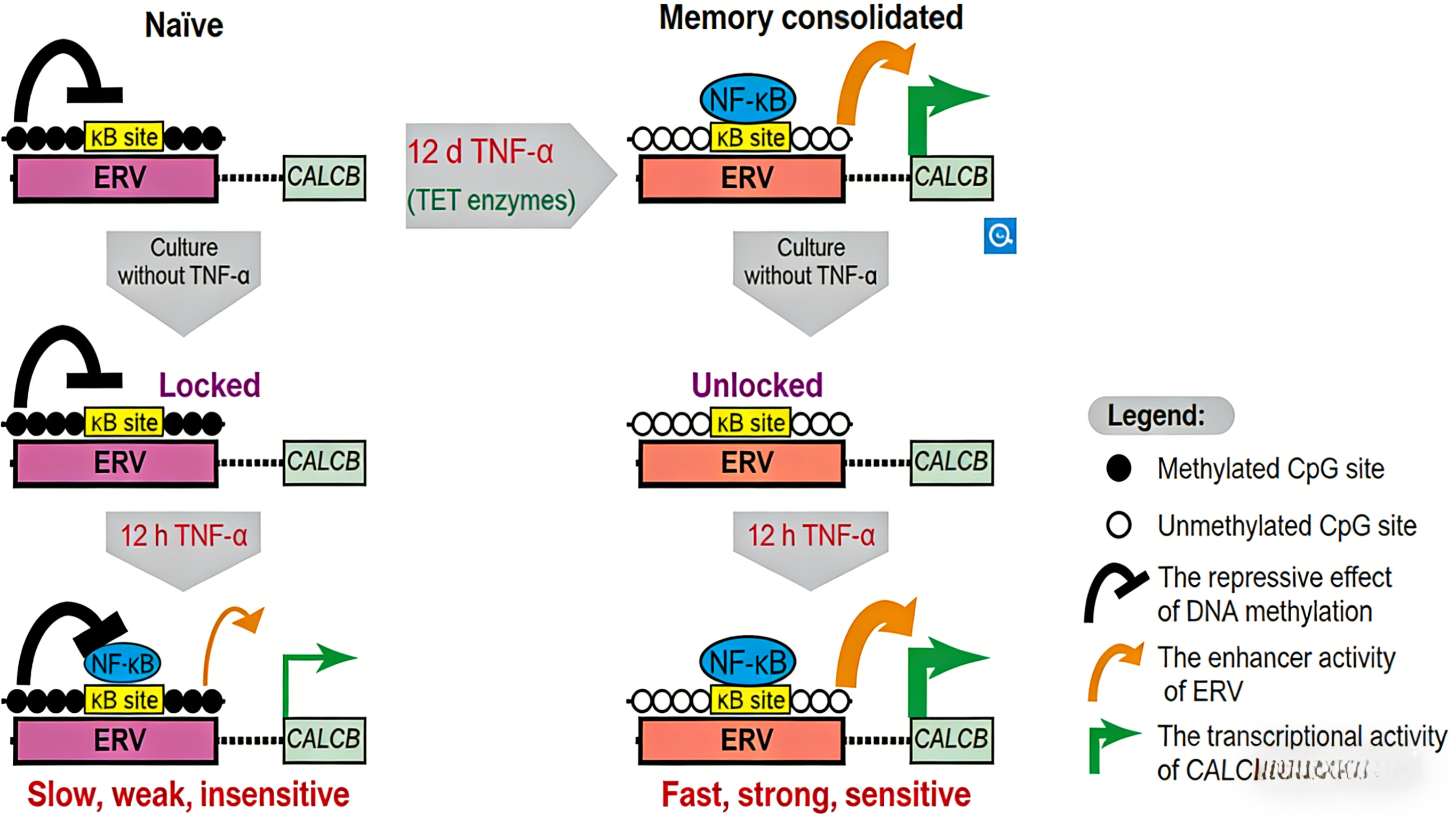
III. Molecular Mechanisms of Transcriptional Memory Formation
(1) DNA Demethylation at NF-κB Binding Regions
Mechanistic studies revealed significant DNA demethylation changes near NF-κB binding sites during transcriptional memory establishment. These dynamic epigenetic modifications were highly correlated with the formation of transcriptional memory, suggesting their potential involvement in memory establishment and maintenance.
(2) Critical Role of TET-Mediated Active DNA Demethylation
To validate the functional significance of DNA demethylation, knockout experiments were performed on TET family genes. Results showed that in TET-deficient cells, all endogenous genes with TNF-α transcriptional memory effects lost their memory capacity. This finding confirmed that active DNA demethylation is an indispensable core process in transcriptional memory establishment.
(3) Determinants of Gene Memory Potential
Notably, not all NF-κB target genes exhibited transcriptional memory effects. Further analysis indicated that genes with memory potential had higher baseline DNA methylation levels and higher CpG site density near their NF-κB binding sites. This feature determined the "memory-capable" molecular basis of these regulatory elements.
IV. Functional Significance of Transcriptional Memory
(1) Significant Enhancement of Response Sensitivity
The study observed that genes with transcriptional memory effects (e.g., CALCB) exhibited a substantial increase in response sensitivity upon secondary stimulation. Specifically, secondary TNF-α stimulation at concentrations 100-fold lower than the initial stimulation still induced significant gene activation. This phenomenon suggests that transcriptional memory establishment significantly enhances cells' ability to perceive subsequent inflammatory signals.
(2) Potential Explanation for Chronic Inflammation Transition
The transition from acute to chronic inflammation is a major challenge in clinical treatment. This study found that TNF-α-mediated transcriptional memory significantly lowers the activation threshold of inflammatory response genes. This mechanism may partially explain why tissues produce excessive inflammatory responses to minor stimuli after initial inflammatory events, thereby promoting the maintenance and progression of chronic inflammation.
V. Research Significance and Future Perspectives
(1) Revealing a New Dimension of Inflammatory Signal Regulation
This study is the first to demonstrate that TNF-α can induce transcriptional memory in some inflammatory response genes through the NF-κB signaling pathway and TET-mediated active DNA demethylation. This discovery extends inflammatory signal regulation from immediate responses to long-term memory, deepening the understanding of dynamic regulatory mechanisms in inflammatory responses.
(2) Providing New Perspectives for Chronic Inflammation Treatment
The enhanced signal response sensitivity caused by transcriptional memory may be an important mechanism in chronic inflammation maintenance. Intervention strategies targeting DNA methylation dynamics or TET enzyme activity could offer new potential therapeutic targets for chronic inflammation.
(3) Value of Research Paradigm and Detection Tools
The research workflow established in this study can serve as a template for exploring transcriptional memory phenomena in other signaling systems. The Human TNF-α Kit (HICA) played a critical supporting role in quantifying stimulation concentrations and monitoring effects, demonstrating its application value in inflammatory signal research.
VI. Which Manufacturers Provide the Human TNF-α Kit (HICA)?
Nanjing UA-Bio Technology Co., Ltd. (UA-Bio) has independently developed the "Human TNF-α Kit (HICA)", a high-performance in vitro detection platform specifically designed for studying key pathways in inflammatory responses and apoptosis. This kit aims to accurately and efficiently quantify the immunobinding activity of human tumor necrosis factor-α (TNF-α) protein, providing stable and reliable standardized solutions for efficacy evaluation, mechanism research, and biomarker analysis in fields such as autoimmune diseases, inflammatory diseases, tumor immunology, and antibody drug development.
| Core Product Advantages |
|---|
| High Purity and Complete Biological Activity: The kit's core components utilize highly purified, biologically active human TNF-α protein verified through multidimensional quality control. This protein maintains the correct natural homotrimeric conformation and full receptor (TNFR1/TNFR2) binding capacity, authentically simulating TNF-α-mediated inflammatory and apoptotic signals under physiological conditions, ensuring accurate, reproducible, and functionally relevant binding experimental data. |
| Exceptional Batch-to-Batch Consistency and Stability: Leveraging an internationally leading recombinant protein expression platform and highly standardized purification processes, combined with a stringent quality control release system, ensures the product exhibits outstanding long-term stability and excellent batch-to-batch consistency. This provides solid and reliable quality assurance for long-term, continuous critical experiments and high-throughput screening. |
| Ready-to-Use Flexible Detection Platform: Based on optimized enzyme-linked immunosorbent assay (ELISA) principles, the kit provides pre-coated microplate strips, highly specific detection antibodies, standards, and a complete set of optimized buffer systems. It is simple, fast, highly sensitive, and specific, suitable for various research applications such as anti-TNF-α antibody/receptor antagonist screening, neutralizing activity determination, competitive binding assays, affinity analysis, and immunogenicity evaluation. |
| Complete Solutions and Professional Support: We provide thoroughly validated standard experimental protocols, typical dose-response curves, and detailed result interpretation guidelines to help you quickly establish stable and reproducible detection workflows. Nanjing UA-Bio's professional technical team offers comprehensive technical consultation and support for your research design, experimental optimization, and data analysis. |
Nanjing UA-Bio Technology Co., Ltd. is committed to providing cutting-edge, high-quality core reagents and tools for immunology, cell therapy, and innovative drug development. For detailed technical parameters, validation data, or specific application inquiries regarding the "Human TNF-α Kit (HICA)" (Catalog No.: UA086047), please feel free to contact us.
This article is reviewed and published by the technical expert team of UA
Disclaimer: This article partially utilizes artificial intelligence assistance in its creation. If any content involves copyright or intellectual property issues, please let us know and we promise to verify and remove it as soon as possible.
Purchase recombinant protein, choose Nanjing UA-Bio
UA protein focuses on providing various protein reagents, raw materials, and services required for drug research and development, cell therapy, gene therapy, and basic scientific research, including drug target proteins, immune checkpoint proteins, cytokines, tool enzymes, customized protein expression, and full-length transmembrane protein development. Youai is committed to providing customers with high-quality products and professional services, and building a High-tech Biological Enterprise with International Competitiveness.







 Business license (three certificates in one)