




In-depth Analysis of Mismatch Repair (MMR)


The MMR system plays a crucial role in maintaining genomic stability. During DNA replication or recombination, errors such as base mismatches, small-scale base deletions, or insertions are inevitable. The MMR system, like a meticulous "proofreader," can accurately identify these errors and initiate the repair process. It mainly relies on the coordinated work of proteins encoded by key genes such as MLH1, PMS2, MSH2, and MSH6.
- Recent Advances
- Product Information
In the field of tumor immunotherapy, the search for precise and effective biomarkers to predict treatment responses and optimize treatment strategies has always been the focus of scientific research and clinical attention. The mismatch repair (MMR) system, as an important DNA repair mechanism, has become a research hotspot in tumor immunotherapy in recent years, bringing new hope for overcoming the challenges of tumors.
The MMR System
The MMR system plays a vital role in maintaining genomic stability. During DNA replication or recombination, errors such as base mismatches, small-scale base deletions, or insertions are bound to occur. The MMR system, like a meticulous "proofreader," can accurately identify these errors and initiate the repair process. It mainly relies on the coordinated work of proteins encoded by key genes such as MLH1, PMS2, MSH2, and MSH6.
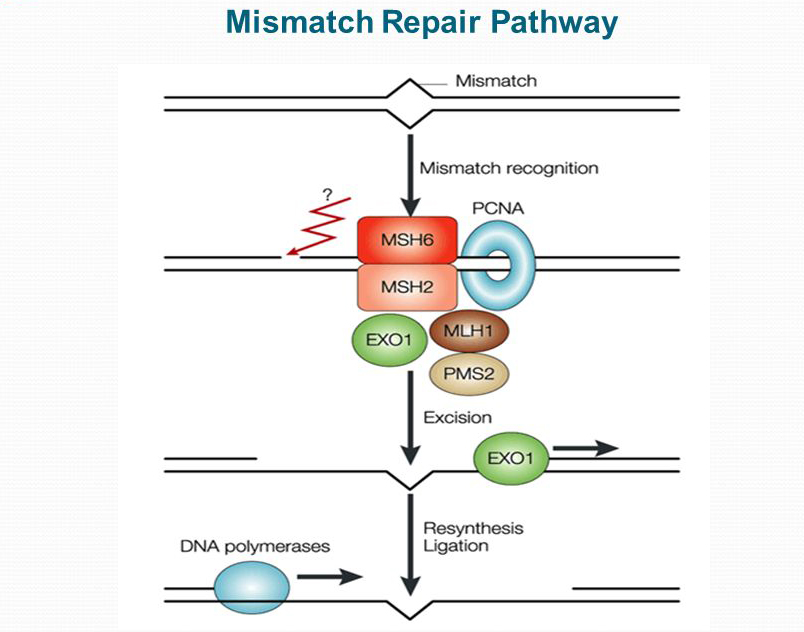
The repair process of the MMR system is extremely delicate. Firstly, MutS homologous proteins (such as the complex MutS-α formed by MSH2 and MSH6, or MutS-β formed by MSH2 and MSH3) identify the mismatch sites. Among them, MutS-α is proficient in recognizing single base mismatches and single base deletion/insertion mismatches, while MutS-β mainly recognizes deletion/insertion mismatches of 2-4 or even more bases. Subsequently, MutL homologous proteins (such as the complex MutL-α formed by MLH1 and PMS2, etc.) are involved, excising the incorrect DNA fragments at the mismatch sites. Finally, DNA polymerase III and DNA ligase synthesize the correctly paired double-stranded DNA to ensure the accuracy of genetic information transmission.
When the MMR system functions properly, that is, mismatch repair is proficient (pMMR), cells can effectively maintain genomic stability. However, once the MMR system malfunctions, such as mutations in related genes leading to mismatch repair deficiency (dMMR), errors in the DNA replication process cannot be corrected in a timely manner, which will lead to the occurrence of microsatellite instability (MSI). Generally, dMMR is manifested as high-frequency microsatellite instability (MSI-H), while pMMR corresponds to low-frequency microsatellite instability (MSI-L) or microsatellite stability (MSS).
MMR Detection
Currently, the commonly used method for MMR detection is immunohistochemistry (IHC), which mainly detects the expression of four proteins, MLH1, PMS2, MSH2, and MSH6, in cancer tissues. When interpreting the detection results, if any one of the proteins is completely absent, it is determined as dMMR; if all proteins are normally expressed, it is pMMR. In actual operation, some details need to be noted. For example, foreign literature emphasizes that "any positive tumor cells are judged as positive", but for cases with positive tumor cells in a very small number (less than 5%), it is usually recommended to further verify with the PCR method. In addition, poor tissue fixation may lead to false-negative results. Therefore, when making a judgment, attention should be paid to the expression of control cells in the stroma. If the lymphocytes, fibroblasts, vascular endothelial cells, etc. of the internal control are all negative, this area is not suitable for evaluation, and an area with positive expression of internal control cells needs to be found for judgment.
Although the IHC method is widely used, it also has certain limitations. On the one hand, approximately 5%-11% of MSI occurrences do not show defects in MMR protein function, which may lead to false-negative results. On the other hand, non-synonymous mutations in MMR genes sometimes result in the loss of MMR function but retain their antigenicity and can be detected and recognized by antibodies, thus leading to false-positive results. At this time, combining PCR detection of MSI or performing gene sequencing can help to more accurately determine the MMR status. However, although gene sequencing can detect MMR gene variations, it cannot directly determine gene function abnormalities based on the variation situation, nor can it directly determine the expression of MMR proteins or the MSI status.
Guiding the Treatment of Colorectal Cancer
The MMR status has important guiding significance for the treatment decision-making of colorectal cancer. In colorectal cancer, about 15% have chromosomal instability, which is closely related to microsatellite instability, of which 3% is caused by Lynch syndrome and 12% is sporadic. Colorectal cancer patients in TNM stage II or III with dMMR (MSI-H) have a relatively better prognosis, but they are not sensitive to adjuvant chemotherapy based on 5-FU. Instead, they are more responsive to chemotherapy containing oxaliplatin or irinotecan. Therefore, by detecting the MMR status, doctors can formulate more precise chemotherapy regimens for colorectal cancer patients, avoiding the side effects and economic burden caused by ineffective treatment.
Predicting the Efficacy of Tumor Immunotherapy
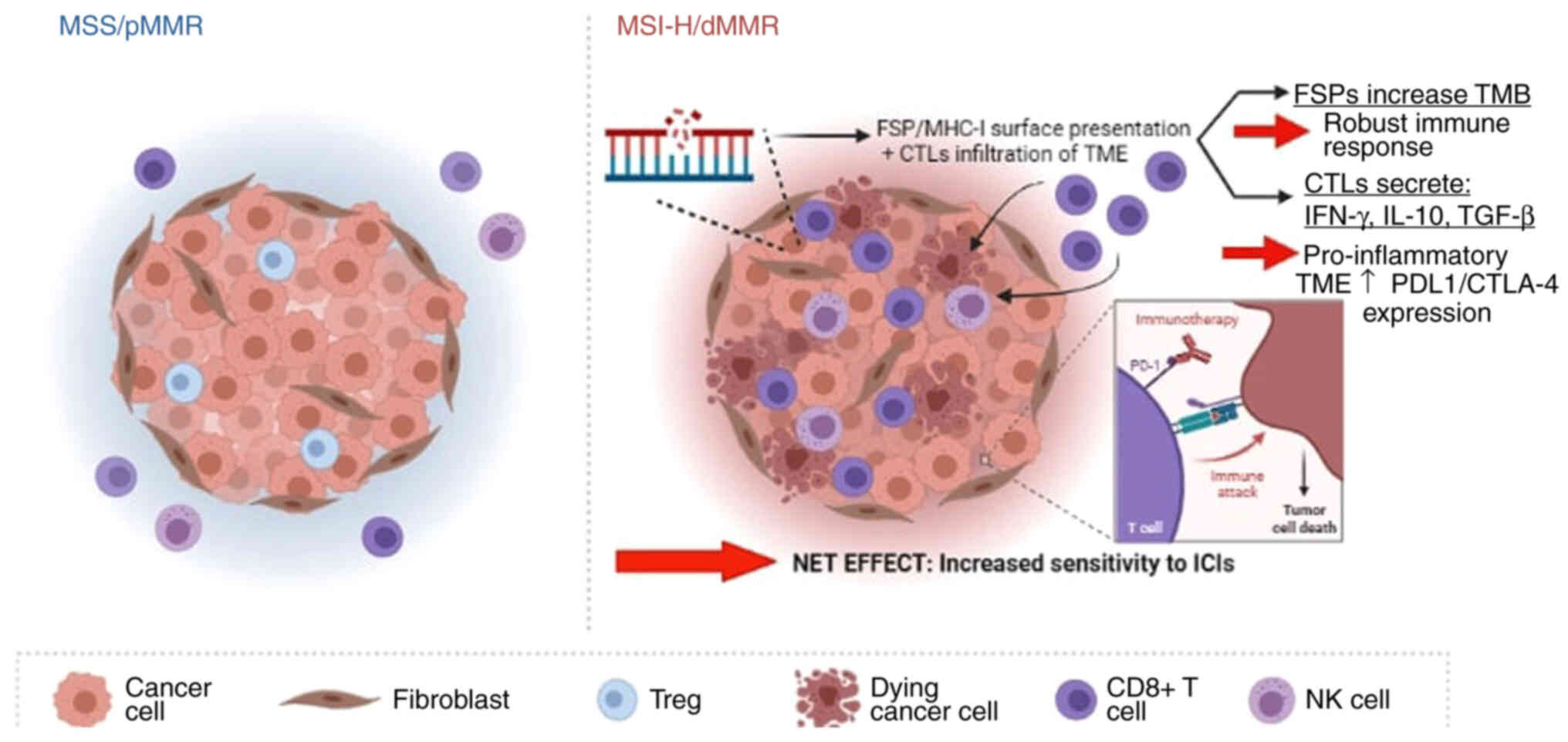
dMMR has been proven to be an effective biomarker for predicting the efficacy of tumor immunotherapy. In 2017, the FDA accelerated the approval of pembrolizumab for the treatment of adult and pediatric solid tumor patients with dMMR. Subsequently, nivolumab and others were also approved for the treatment of specific dMMR tumor patients. This is because dMMR tumor cells, due to defects in DNA repair function, will accumulate a large number of gene mutations and generate more neoantigens. These neoantigens can activate the body's immune system, making tumor cells more easily recognized and attacked by immune cells. Therefore, for dMMR tumor patients, immune checkpoint inhibitors can relieve immune suppression, enhance the anti-tumor activity of immune cells, and thus significantly improve the treatment effect.
Conclusion
As a key biomarker in tumor immunotherapy, MMR shows great potential in guiding clinical treatment and predicting treatment responses. With the continuous in-depth research, it is expected that the MMR detection method can be further optimized in the future, and its application in more tumor types can be expanded, bringing more precise and effective treatment regimens for tumor patients and pushing tumor immunotherapy to a new height.
This article is reviewed and published by the technical expert team of UA
Disclaimer: This article partially utilizes artificial intelligence assistance in its creation. If any content involves copyright or intellectual property issues, please let us know and we promise to verify and remove it as soon as possible.
Purchase recombinant protein, choose Nanjing UA-Bio
UA protein focuses on providing various protein reagents, raw materials, and services required for drug research and development, cell therapy, gene therapy, and basic scientific research, including drug target proteins, immune checkpoint proteins, cytokines, tool enzymes, customized protein expression, and full-length transmembrane protein development. Youai is committed to providing customers with high-quality products and professional services, and building a High-tech Biological Enterprise with International Competitiveness.







 Business license (three certificates in one)