

RIPK2 Research Booms: A "Cross-Disciplinary Star" in Tumor, Metabolism, and Immune Fields


Receptor-Interacting Serine/Threonine Kinase 2 (RIPK2, also known as RIP2) is a key adapter protein in innate immune signaling pathways, functioning as a downstream signaling molecule for NOD1/NOD2 and Toll-like receptors (TLRs). It plays a central role in various diseases such as inflammatory bowel disease (IBD), autoimmune disorders, and tumors.
- Recent Advances
- Product Information
Receptor-Interacting Serine/Threonine Kinase 2 (RIPK2, also known as RIP2) is a key adaptor protein in innate immune signaling pathways. As a downstream signaling molecule of NOD1/NOD2 and Toll-like receptors (TLRs), it plays a central role in various diseases such as inflammatory bowel disease (IBD), autoimmune disorders, and cancer. In recent years, significant progress has been made in the development of small-molecule inhibitors targeting RIPK2, with several candidate drugs entering clinical trials and demonstrating promising therapeutic potential.
1. Biological Functions and Signaling Mechanisms of RIPK2
1.1 Molecular Structure and Activation Mechanism
RIPK2 is a serine/threonine kinase containing a CARD (Caspase Activation and Recruitment Domain). Its N-terminal kinase domain and C-terminal CARD domain are connected by an intermediate linker region. The latest 2025 research using cryo-EM technology resolved the oligomerization structure of RIPK2-CARD, revealing the formation mechanism of the "RIPosome" complex: the CARD domain of NOD1/NOD2 interacts with RIPK2-CARD, inducing RIPK2 oligomerization and initiating downstream signal transduction.
1.2 Signal Pathway Integration
RIPK2 is a convergence point for multiple innate immune signaling pathways:
- NOD1/NOD2-RIPK2 Axis: Recognizes bacterial peptidoglycan components, activates NF-κB and MAPK pathways, and induces pro-inflammatory cytokines (TNF-α, IL-6, IL-12/23p40) production.
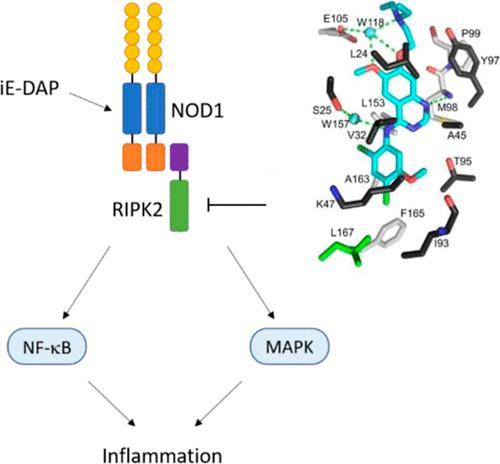
- TLRs-RIPK2 Axis: Toll-like receptors transmit signals through RIPK2, playing a pro-inflammatory role in IBD.
- Ubiquitination Regulation: E3 ubiquitin ligases such as XIAP and cIAP1/2 mediate K63-linked ubiquitination of RIPK2, a critical step in signal activation.
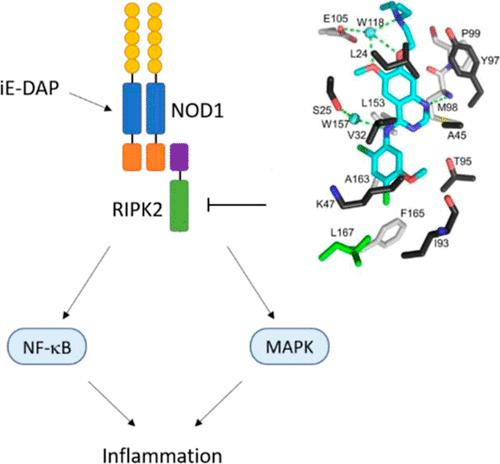
Notably, recent studies indicate that RIPK2's kinase activity is not essential for NOD2 signaling, and inhibitors primarily exert anti-inflammatory effects by blocking RIPK2-XIAP interactions and inhibiting RIPK2 ubiquitination.
2. Association of RIPK2 with Diseases
2.1 Inflammatory Bowel Disease (IBD)
RIPK2 plays a dual role in IBD pathogenesis:
- Protective Role: The NOD2-RIPK2 pathway activates IRF4 and ATG16L1, inhibiting TLR-induced pro-inflammatory responses and maintaining intestinal immune homeostasis.
- Pathogenic Role: The TLRs-RIPK2 pathway drives excessive inflammatory responses.
Clinical studies show that RIPK2 and its signaling molecules (cIAP2, TRAF6, TAK1) are significantly upregulated in the colonic mucosa of Crohn's disease (CD) and ulcerative colitis (UC) patients, positively correlating with inflammatory cytokine levels. NOD2 loss-of-function mutations are associated with increased CD risk, but interestingly, NOD2 expression is not elevated in the inflamed mucosa of IBD patients, suggesting the TLRs-RIPK2 pathway may be a more effective therapeutic target.
2.2 Cancer
A study published in April 2025 in *Cell Death & Disease* revealed a new mechanism of RIPK2 in colorectal cancer metastasis: RIPK2 protects YAP protein from ITCH-mediated ubiquitination degradation, promoting tumor metastasis. This finding expands the application prospects of RIPK2 inhibitors in cancer therapy.
2.3 Other Autoimmune Diseases
RIPK2 is also involved in the pathogenesis of rheumatoid arthritis, multiple sclerosis, psoriasis, and other diseases, making it a potential target for broad-spectrum anti-inflammatory therapy.
2.4 Metabolic Diseases
A 2026 study published in *Endocrine Connections* using a palmitate-induced L6 myotube insulin resistance model in rats showed that RIPK2 expression was significantly elevated under insulin resistance, while X-linked inhibitor of apoptosis protein (XIAP) expression was reduced.
The revealed XIAP-RIPK2 regulatory axis provides a new target for type 2 diabetes intervention. These findings suggest that RIPK2 may also be applicable to metabolic diseases. By restoring RIPK2 ubiquitination or inhibiting its kinase activity, insulin sensitivity and glucose homeostasis may be improved. This concept expands the application scenarios of RIPK2 targeting, extending from inflammatory diseases to metabolic disorders.
3. Progress in RIPK2 Inhibitor Development
3.1 First-Generation Inhibitors: Multi-Target Kinase Inhibitors
Early RIPK2 inhibitors were mostly repurposed from existing drugs:
| Compound | Original Indication | Mechanism | Features |
|---|---|---|---|
| Gefitinib | Non-small cell lung cancer | EGFR inhibitor, Type I | IC₅₀=51 nM, improves ileitis in SAMP1/YitFc mice |
| Erlotinib | Non-small cell lung cancer | EGFR inhibitor, Type I | Similar mechanism to Gefitinib |
| Ponatinib | Chronic myeloid leukemia | BCR-ABL inhibitor, Type II | FDA-approved, potently inhibits RIPK2 autophosphorylation and ubiquitination |
| Regorafenib | Colorectal cancer | Multi-kinase inhibitor, Type II | Clinically available, selectively blocks NOD-dependent inflammatory signaling |
Key Finding: Canning et al. (2015) first demonstrated that Type II kinase inhibitors (binding to the DFG-out conformation) improved RIPK2 inhibition efficacy by two orders of magnitude compared to Type I inhibitors. They resolved the RIPK2-Ponatinib co-crystal structure, revealing allosteric sites for selective inhibitor design.
3.2 Second-Generation Inhibitors: Highly Selective RIPK2 Inhibitors
3.2.1 GSK Series (GlaxoSmithKline)
- GSK583: A highly selective RIPK2 inhibitor that effectively suppresses spontaneous pro-inflammatory cytokine release in colon biopsy samples from CD patients.
- GSK2983559: A prodrug of GSK583, showing efficacy comparable to prednisolone in a TNBS-induced colitis model. It entered Phase I clinical trials (NCT03358407) but was discontinued due to toxicological findings and insufficient safety margins.
3.2.2 Macrocyclic Inhibitors
OD36 and OD38 (Tigno-Aranjuez et al., 2014):
- IC50 values of 5.3 nM and 14.1 nM, respectively.
- High selectivity (inhibits only a few kinases out of 366 tested).
- Downregulates MDP-induced inflammatory factors in the SAMP1/YitFc CD model.
- Proposes a 9-gene RIPK2 activation signature (GPR84, ICAM1, IRG1, etc.) for predicting patient response.
3.3 Clinical-Stage Candidate Drugs
BI 706039 (Boehringer Ingelheim)
- Optimized through high-throughput screening; structure undisclosed.
- Inhibits only 18 out of 285 kinases at 3 μM concentration.
- Currently in clinical trials for combination therapy with Ustekinumab in CD (NCT04978493).
4. Emerging Therapeutic Strategies
4.1 PROTAC Degraders
Beyond traditional inhibitors, RIPK2 degraders based on PROTAC (Proteolysis-Targeting Chimera) technology have demonstrated remarkable efficacy in IBD preclinical models, offering a new approach to overcome kinase inhibitor resistance.
4.2 Targeting Protein-Protein Interactions
All current RIPK2 inhibitors target the ATP-binding site of the kinase domain. Given that CARD-CARD interactions are critical for signal initiation, developing allosteric modulators to block NODs-RIPK2 interactions represents an unexplored but highly attractive direction, potentially achieving higher selectivity and fewer off-target effects.
4.3 Tissue-Specific Delivery
Due to RIPK2's widespread expression in various tissues, systemic inhibition may cause side effects. Local delivery strategies for intestinal diseases like IBD (e.g., rectally administered siRNA carriers) have shown efficacy in animal models. Future approaches could combine nanotechnology for precise targeting of inflammatory sites.
Conclusion
As a core node in innate immune signaling networks, RIPK2 demonstrates significant therapeutic potential in IBD, autoimmune diseases, and cancer. Advances in structural biology (e.g., RIPosome complex resolution) and medicinal chemistry have rapidly matured RIPK2-targeted therapies—from early multi-target inhibitors to highly selective Type II inhibitors, and now emerging PROTAC degraders and allosteric modulators. The entry of candidates like BI 706039 into clinical trials marks a critical phase in translational medicine. By addressing challenges such as tissue selectivity and mechanistic fine-tuning, RIPK2 inhibitors may become vital weapons in inflammatory disease treatment.
This article is reviewed and published by the technical expert team of UA
Disclaimer: This article partially utilizes artificial intelligence assistance in its creation. If any content involves copyright or intellectual property issues, please let us know and we promise to verify and remove it as soon as possible.
Purchase recombinant protein, choose 
UA protein focuses on providing various protein reagents, raw materials, and services required for drug research and development, cell therapy, gene therapy, and basic scientific research, including drug target proteins, immune checkpoint proteins, cytokines, tool enzymes, customized protein expression, and full-length transmembrane protein development. Nanjing Univ is committed to providing customers with high-quality products and professional services, and building a High-tech Biological Enterprise with International Competitiveness.







 Business license (three certificates in one)