




Exploring the Epidermal Growth Factor Receptor (EGFR)


The Epidermal Growth Factor Receptor (EGFR), also known as HER1/ErbB-1, is a member of the receptor tyrosine kinase (RTK) family. It is associated with tumor cell proliferation, tumor invasion, metastasis, and the inhibition of apoptosis, and is often regarded as one of the proto-oncogenes.
- Recent Advances
- Product Information
- Reference
The Epidermal Growth Factor Receptor (EGFR), also known as HER1/ErbB-1, is a member of the receptor tyrosine kinase (RTK) family. It is associated with tumor cell proliferation, tumor invasion, metastasis, and the inhibition of apoptosis, and is often regarded as one of the proto-oncogenes.
The Structure and Function of EGFR
As an important member of the receptor tyrosine kinase (RTK) family, EGFR is a transmembrane glycoprotein that plays an indispensable regulatory role in physiological processes such as cell growth, differentiation, and survival. The human EGFR gene is located in the p13~q22 region of chromosome 7 and consists of 28 exons. The protein encoded by it has a molecular weight of approximately 175 kDa, a half-life of about 30 hours, and an isoelectric point of 6.26. This protein can be divided into three functional regions: the extracellular ligand-binding region, the transmembrane region, and the intracellular kinase region.
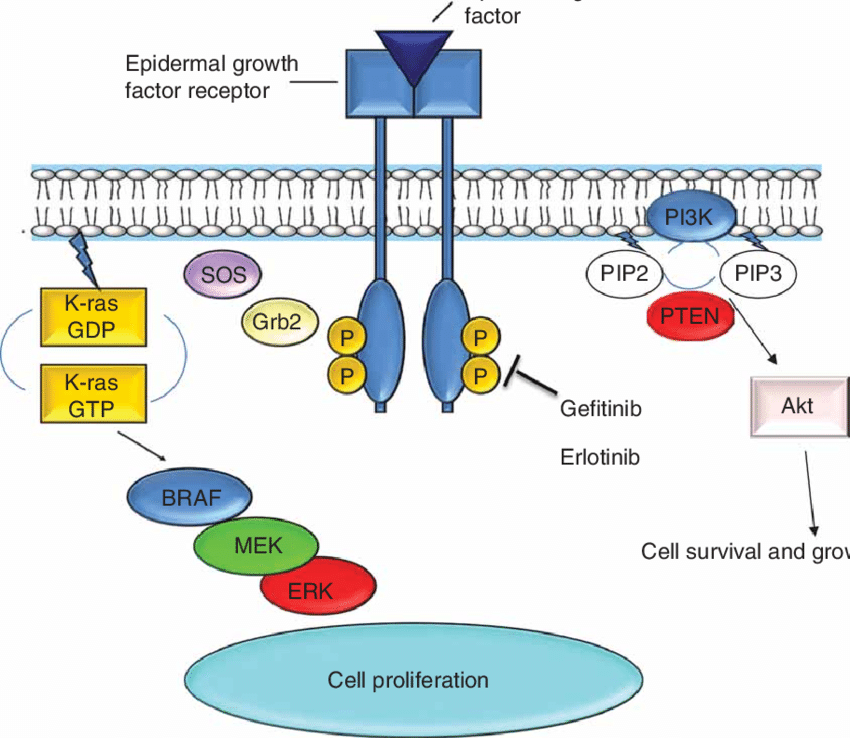
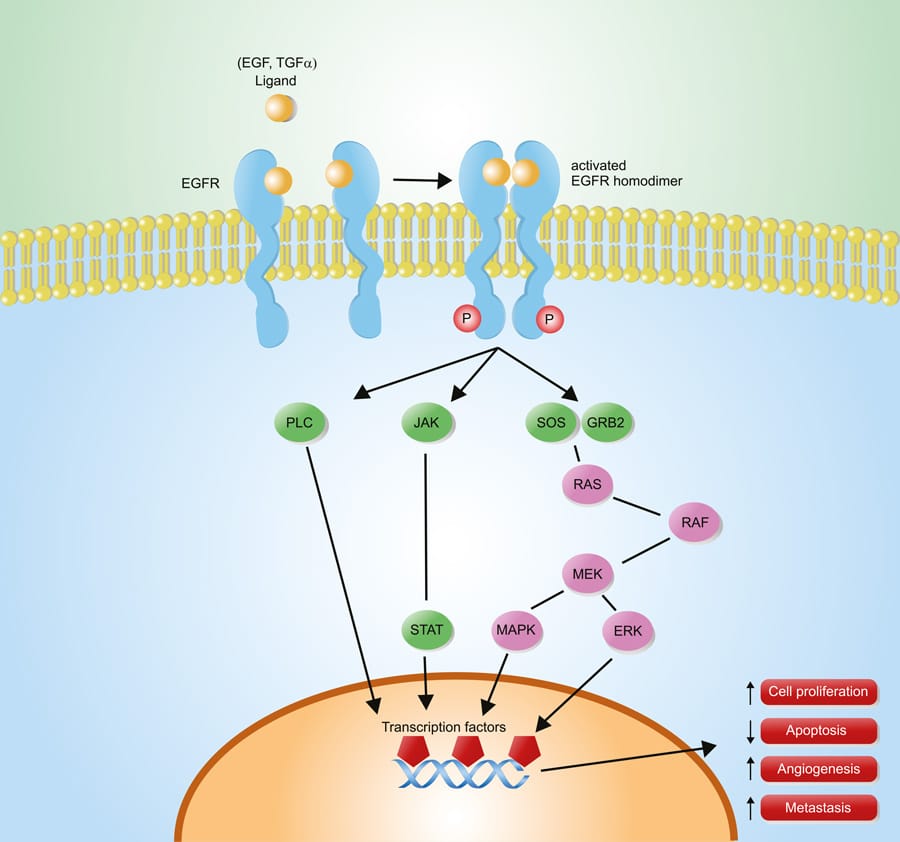
The extracellular ligand-binding region is composed of four sub-regions, which are like the "signal receivers" of the cell. It can specifically recognize and bind to a variety of ligands, such as epidermal growth factor (EGF), transforming growth factor-α (TGF-α), etc. After the ligand binds to the receptor, EGFR will dimerize to form homodimeric or heterodimeric structures. This dimerization process is like pressing the "start button" of intracellular signal transduction, which activates the tyrosine kinase in the intracellular region of the receptor, and then triggers a series of phosphorylation reactions to activate downstream signaling pathways.
The transmembrane region is composed of 23 amino acid residues, which is like a stable "bridge" to transmit extracellular signals into the cell. The intracellular kinase region is closely related to signal transduction. It includes sub-regions such as the juxtamembrane region, the tyrosine kinase region, and the C-terminus. After activation, it can initiate complex signal cascade reactions to regulate various biological behaviors of the cell.
EGFR is widely distributed in the body and is expressed on the surface of a variety of cells, including mammalian epithelial cells, fibroblasts, glial cells, etc. Among them, the expression level is the highest in the placenta, and it is also highly expressed in tissues such as the skin, liver, and adipose tissue, while the expression level in tissues such as the cerebellum and spinal cord is relatively low.
The Association between EGFR and Tumorigenesis and Development
In many tumors, EGFR often shows high expression or abnormal expression, which is closely related to the occurrence and development of tumors. When the EGFR gene is overexpressed, there will be an excessive number of receptors on the cell surface, causing the growth and division of cells to lose control, promoting the transformation of normal cells into cancer cells, and providing favorable conditions for the continuous survival of cancer cells. In addition, EGFR mutations can also cause the receptor to continuously attract ligands to the cell surface, thereby promoting abnormal cell growth.
Studies have found that the expression rate of EGFR is quite high in a variety of common tumors. The expression rate in lung cancer is 40%-80%, in breast cancer is 14%-91%, in gastric cancer is 33%-74%, in colorectal cancer is 25%-77%, in pancreatic cancer is 40%-80%, in renal cancer is 50%-90%, in ovarian cancer is 37%-70%, and in head and neck cancer is 36%-100%. Moreover, in cancer patients induced by EGFR mutations, with the progression of the disease or the implementation of targeted therapy, EGFR may also undergo secondary mutations. For example, in some patients who were originally responsive to EGFR tyrosine kinase inhibitors, after the secondary mutation, methionine at position 790 (T790M) in the kinase domain is replaced by threonine, resulting in drug resistance, which poses a great challenge to tumor treatment.
EGFR activates the main downstream signaling pathways, such as the Ras-Raf-MAPK pathway, the PI3K/AKT signaling pathway, and the JAK/STAT pathway. The out-of-control of these pathways will affect a variety of cell functions and further promote the occurrence and development of cancer. In terms of promoting cell proliferation, EGFR mainly activates the RAS/RAF/MEK/ERK pathway to shorten the cell cycle, promote DNA synthesis, and increase the rate and number of cell divisions; at the same time, it can also activate the PI3K/AKT/mTOR pathway to promote protein synthesis and metabolism, providing energy and material support for cell growth. In the process of anti-apoptosis, EGFR achieves this by inhibiting the signals or molecules that induce apoptosis and activating the signals or molecules that inhibit apoptosis. In addition, EGFR can also promote the proliferation, migration, and differentiation of vascular endothelial cells, promote the formation of new blood vessels, and enhance the invasion and migration abilities of tumor cells. By weakening the adhesion and cohesion between cancer cells and surrounding adjacent cells, it causes cancer cells to detach and become free, thereby exacerbating the spread of the tumor.
Tumor Treatment Strategies Targeting EGFR and Challenges
Given the crucial role of EGFR in tumorigenesis and development, anti-tumor therapy targeting EGFR has become an extremely active area in cancer research and has made remarkable progress. In 2004, the emergence of EGFR tyrosine kinase inhibitors (EGFR-TKIs) opened a new era of individualized treatment for lung cancer. The first-generation EGFR-TKI drugs, such as gefitinib and erlotinib, can specifically inhibit the tyrosine kinase activity of EGFR, block downstream signal transduction, and thus inhibit the growth of tumor cells. However, due to secondary mutations of EGFR, the first-generation drugs are prone to drug resistance.
Subsequently, the second-generation EGFR-TKI drugs, such as afatinib and dacomitinib, were launched. Although they enhanced the inhibitory ability of tyrosine kinase, they still could not effectively overcome the drug resistance caused by the T790M point mutation in the EGFR exon. It was not until 2017 that the third-generation EGFR-TKI drugs, osimertinib and almonertinib, were introduced, which successfully overcame the drug resistance caused by the T790M point mutation and brought new hope to tumor patients.
Although anti-tumor therapy targeting EGFR has achieved certain results, it still faces many challenges at present. In addition to the problem of drug resistance, issues such as the adverse reactions of drugs, the differences in drug sensitivity among different patients, and tumor heterogeneity all require further in-depth research and exploration of solutions by researchers.
This article is reviewed and published by the technical expert team of UA
Disclaimer: This article partially utilizes artificial intelligence assistance in its creation. If any content involves copyright or intellectual property issues, please let us know and we promise to verify and remove it as soon as possible.
Purchase recombinant protein, choose Nanjing UA-Bio
UA protein focuses on providing various protein reagents, raw materials, and services required for drug research and development, cell therapy, gene therapy, and basic scientific research, including drug target proteins, immune checkpoint proteins, cytokines, tool enzymes, customized protein expression, and full-length transmembrane protein development. Youai is committed to providing customers with high-quality products and professional services, and building a High-tech Biological Enterprise with International Competitiveness.

[1]Bishayee S. Role of conformational alteration in the epidermal growth factor receptor (EGFR) function[J]. Biochemical pharmacology, 2000, 60(8): 1217-1223.
[2]da Silva Santos E, Nogueira K A B, Fernandes L C C, et al. EGFR targeting for cancer therapy: Pharmacology and immunoconjugates with drugs and nanoparticles[J]. International journal of pharmaceutics, 2021, 592: 120082.
[3]Wee P, Wang Z. Epidermal Growth Factor Receptor Cell Proliferation Signaling Pathways. Cancers (Basel). 2017 May 17;9(5):52.






 Business license (three certificates in one)