




EphA2: A Key Target for Cancer Treatment


EphA2 is mainly restrictedly expressed in the proliferating epithelial cells of adults. However, an increasing number of studies have demonstrated that EphA2 is highly expressed in various cancers and is associated with poor prognosis, metastasis, and low survival rates. The active involvement of EphA2 in the tumor process, along with its relatively low expression in most normal adult tissues, makes this protein another potential therapeutic target for cancer.
- Recent Advances
- Product Information
- Reference
Introduction
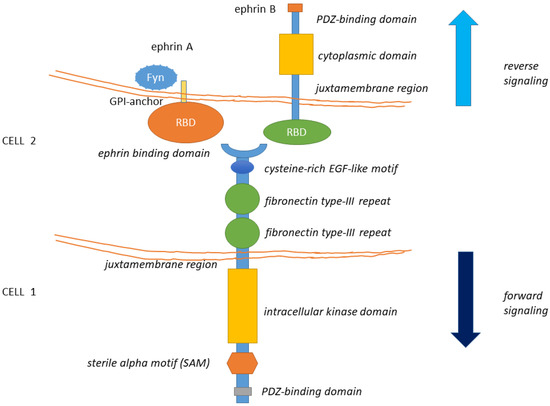
Eph receptor type A2 (EphA2) belongs to the Eph receptor subfamily of protein tyrosine kinases. Under normal circumstances, EphA2 interacts with Ephrin A1 on neighboring cells, participating in both forward and reverse signal transduction, a process also known as the Eph-EphA2 bidirectional signaling. In general, the EphA2-Ephrin A1 signaling regulates various cellular processes (proliferation, survival, migration, morphology, intercellular repulsion, and adhesion) during embryonic development, angiogenesis, and tumorigenesis, which can lead to repulsive cell contraction responses such as cell repulsion, separation, cell contraction, loss of focal adhesions, and cell rounding. EphA2 is mainly restrictedly expressed in the proliferating epithelial cells of adults. However, an increasing number of studies have demonstrated that EphA2 is highly expressed in different cancers and is associated with poor prognosis, metastasis, and low survival rates. The active involvement of EphA2 in the tumor process, along with its relatively low expression in most normal adult tissues, makes this protein another potential therapeutic target for cancer.
Characteristics of EphA2
Eph receptors, as an important branch of receptor tyrosine kinases (RTKs), currently consist of 14 known receptors and 8 related ligands. Among them, the EphA2 receptor is a transmembrane glycoprotein with a molecular weight of 130kDa, composed of 976 amino acids. It can interact with 8 ligands of the Ephrin A family and has a relatively high affinity for Ephrin A1. When EphA2 binds to Ephrin A1, it triggers a unique bidirectional signaling mechanism. The forward signal generated in cells expressing EphA2 promotes the oligomerization and phosphorylation of EphA2, enhancing its kinase activity, which in turn leads to a decrease in the attachment of cells to the extracellular matrix, affecting cell motility, viability, and proliferation. As for the reverse signal generated in cells expressing Ephrin A1, although it is less understood currently, it is generally believed to be adhesive and independent of kinase activity.
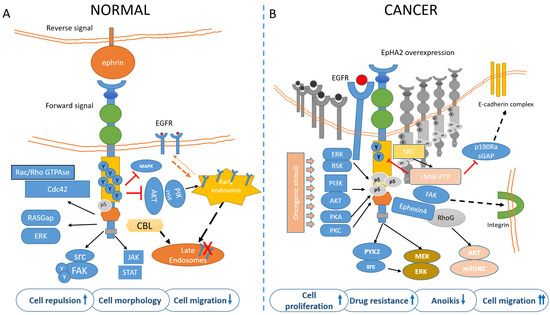
It is worth noting that EphA2 also exhibits ligand-independent kinase activity in cancer cells. It can dimerize with molecules such as E-cadherin, epidermal growth factor receptor (EGFR), human epidermal growth factor receptor 2 (HER2), and integrins, altering downstream signaling pathways in a non-classical manner. Even in a non-phosphorylated state, it can exert malignant effects and participate in the occurrence and development of tumors. In normal physiological processes such as embryonic development and angiogenesis, the EphA2-Ephrin A1 signaling pathway plays an important regulatory role, ensuring the normal formation and development of tissues and organs. However, in the pathological environment of tumors, this signaling pathway is exploited by cancer cells and becomes an accomplice in promoting tumor progression.
Abnormal Expression and Influence of EphA2 in Tumors
Numerous studies have shown that EphA2 is highly expressed in a variety of malignant tumors, such as prostate cancer, lung cancer, esophageal cancer, colorectal cancer, cervical cancer, ovarian cancer, breast cancer, and skin cancer. Its high expression is closely associated with poor prognosis in tumor patients, indicating a higher potential for metastasis and a shorter survival period. EphA2 is not only a biomarker of tumor malignancy but also directly involved in the malignant progression of tumors. It can promote the proliferation of cancer cells, assist cancer cells in breaking through the basement membrane, enabling invasion into surrounding tissues and distant metastasis. Additionally, it can regulate tumor angiogenesis, providing sufficient nutrients for tumor growth.
Exploration of Therapeutic Strategies Targeting EphA2
Given the crucial role of EphA2 in tumors, cancer treatment strategies targeting it have become a research hotspot. Currently, there are mainly two treatment approaches for the EphA2/Ephrin A1 system. On the one hand, cancer can be treated by inhibiting the oncogenic functions of EphA2, with specific measures including reducing the expression level of EphA2, promoting its degradation, or blocking its activation process. On the other hand, the EphA2 receptor can be utilized to precisely deliver therapeutic drugs or immune cells to cancer cells and their associated blood vessels, achieving targeted therapy.
In clinical trials, various treatment methods targeting EphA2 have been carried out. For example, EphA2-targeted antibody-drug conjugates (ADCs) and peptide-drug conjugates (PDCs) can precisely deliver cytotoxic drugs to cancer cells, enabling targeted killing of cancer cells. Tyrosine kinase inhibitors (TKIs), such as dasatinib which has been approved for marketing, can inhibit the kinase activity of EphA2, thereby blocking the related signaling pathways and suppressing the growth of tumor cells. Chimeric antigen receptor T-cell (CAR-T) therapy that recognizes and targets the EphA2 antigen can use genetically modified immune cells to precisely identify and attack cancer cells expressing EphA2. Nanocarriers can transport small interfering RNAs (siRNAs) targeting EphA2 to tumor cells, reducing the level of EphA2 by interfering with gene expression. In addition, in the future, it may be possible to use EphA2 agonists, such as the soluble EphA2 agonist (A1-Fc), or other small molecule inhibitors to block the phosphorylation of EphA2 at position S897, thereby inhibiting non-canonical signaling and providing more options for cancer treatment.
Challenges Faced by EphA2-targeted Therapy
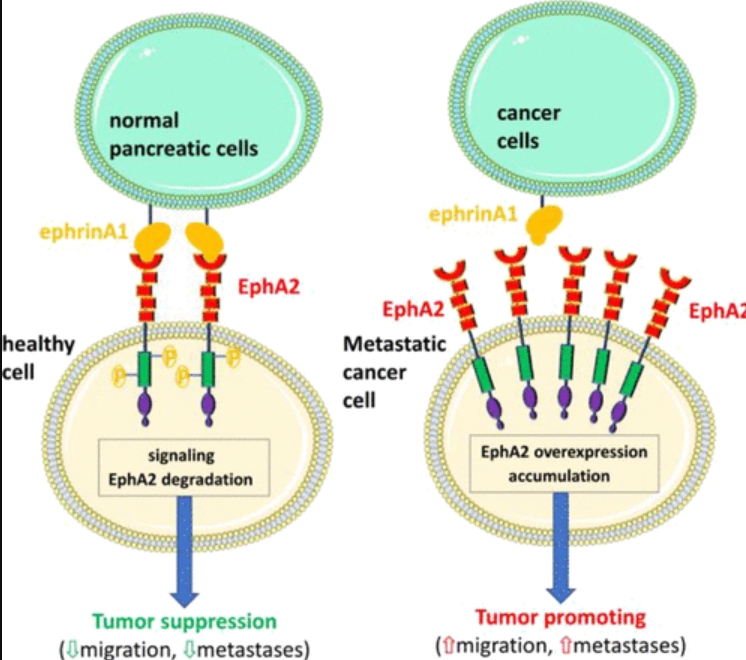
Although EphA2-targeted therapy has shown great potential, it still faces many challenges in practical applications. Since EphA2 is also expressed to some extent in normal tissues, treatments targeting it may have toxic and side effects on normal tissues. At the same time, the complex signaling pattern of the EphA2 receptor makes the formulation of targeted strategies difficult, and different tumor types and individual patients may require different treatment regimens. Moreover, EphA2 has a kinase-independent oncogenic effect, and traditional small-molecule inhibitors of RTKs may not be able to completely inhibit its oncogenic function.
Future Prospects
The repurposing research of marketed drugs such as dasatinib and the development of a new generation of peptide-toxin conjugates and other targeted treatment methods are steadily advancing. With the continuous in-depth study of the EphA2-Ephrin A1 signaling pathway, it is expected that in the future, the interaction mechanism between it and other oncogenic pathways can be more accurately revealed, thereby improving the efficacy and selectivity of treatment and reducing off-target side effects. Meanwhile, combining EphA2-targeted therapy with other treatment methods may also produce a synergistic effect, bringing better treatment outcomes for cancer patients.
This article is reviewed and published by the technical expert team of UA
Disclaimer: This article partially utilizes artificial intelligence assistance in its creation. If any content involves copyright or intellectual property issues, please let us know and we promise to verify and remove it as soon as possible.
Purchase recombinant protein, choose Nanjing UA-Bio
UA protein focuses on providing various protein reagents, raw materials, and services required for drug research and development, cell therapy, gene therapy, and basic scientific research, including drug target proteins, immune checkpoint proteins, cytokines, tool enzymes, customized protein expression, and full-length transmembrane protein development. Youai is committed to providing customers with high-quality products and professional services, and building a High-tech Biological Enterprise with International Competitiveness.

1.Eph receptor signalling: from catalytic to non-catalytic functions.
2.Emerging strategies for EphA2 receptor targeting for cancer therapeutics.






 Business license (three certificates in one)