IL-4Rα: The Janus Receptor Underlying Contrasting Fates in Allergy and Cancer

In Type 2 immune response-mediated allergic diseases, IL-4Rα serves as the shared subunit of interleukin-4 (IL-4) and interleukin-13 (IL-13) receptors, emerging as one of the most sought-after targets in the global biopharmaceutical sector. Through dual inhibition of IL-4/IL-13 signaling pathways, it has not only revolutionized therapeutic paradigms for conventional conditions like atopic dermatitis and asthma but also demonstrated remarkable potential across interdisciplinary fields including tumor immunology and viral infections.

  • Recent Advances
  • Product Information
  • Reference
Recent Advances
IL-4Rα
In type 2 immune responses driving allergic diseases, IL-4Rα, a shared subunit of IL-4 and IL-13 receptors, is a key global biopharmaceutical target. By blocking IL-4/IL-13 signaling, it has revolutionized treating atopic dermatitis and asthma and shows great potential in oncology and virology.
I. Molecular Mechanism: The "Double Lock" of Type 2 Inflammation Signaling
IL-4Rα signals through two receptor complexes:
Type I (IL-4Rα/γc): Expressed on hematopoietic cells, binds only IL-4, activating JAK1/JAK3 to drive Th2 cell differentiation.
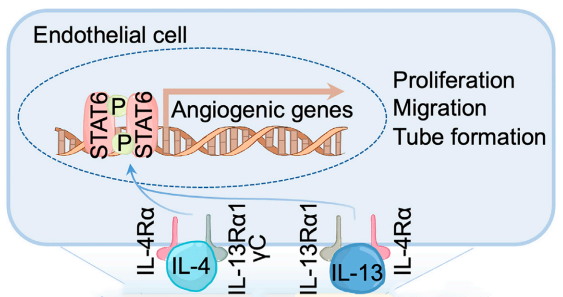
Type II (IL-4Rα/IL-13Rα1): Widespread in non-hematopoietic cells, binds IL-4/IL-13, and activates STAT6 via JAK1/TYK2, regulating IgE class switching, eosinophil chemotaxis, and airway remodeling.
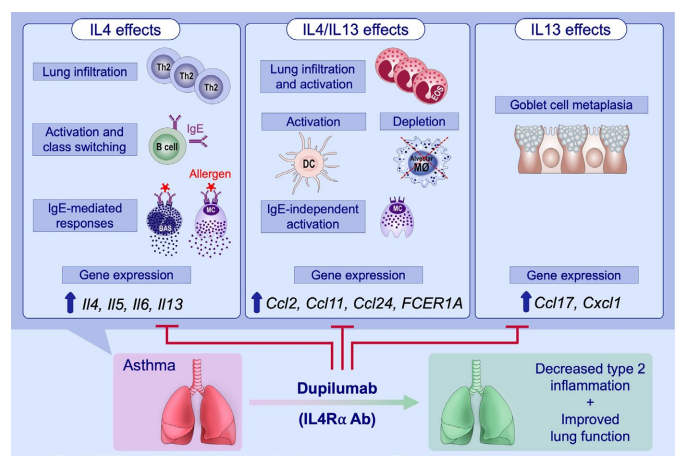
This dual receptor-ligand network makes IL-4Rα a "core valve" for type 2 inflammation. For example, in asthma, IL-4Rα overexpression in airway epithelial cells leads to IL-13-driven STAT6 activation, causing goblet cell hyperplasia and mucus overproduction.
II. Clinical Breakthroughs: Precision Therapy from Skin to Lungs
Atopic Dermatitis: Restoring the Skin Immune Barrier
Sanofi/Regeneron's dupilumab, the first IL-4Rα monoclonal antibody, showed remarkable efficacy in phase III trials:
After 16 weeks, 52.3% of patients achieved EASI-75 response (vs. 14.9% on placebo);
Pruritus NRS scores decreased by 60.4%, significantly improving quality of life.
Mechanistically, blocking IL-4Rα inhibits Th2-derived IL-4/IL-13 and reduces IL-33 expression in keratinocytes, repairing the skin barrier.
Chronic Rhinosinusitis with Nasal Polyps: Overcoming Post-surgical Recurrence
China's's CM310 achieved breakthrough results:
At week 24, 81% of patients had a ≥2-point improvement in nasal polyp score (NPS), with 42% achieving "medical polypectomy" (NPS ≤1);
Olfactory function recovery was significantly higher than placebo, with long-term efficacy lasting up to 52 weeks.
The mechanism involves inhibiting eosinophilic infiltration and IL-5 secretion induced by IL-4/IL-13, blocking polyp regeneration.
Asthma: Breaking the Hormone Dependence "Ceiling"
In the LIBERTY ASTHMA QUEST study, dupilumab reduced annual acute exacerbation rates by 47.7% in moderate-to-severe asthma patients, improved FEV1 by 260-330mL, and was especially effective in eosinophilic phenotypes (≥150 cells/μL). This makes IL-4Rα antibodies a crucial option in asthma step-care management.
III. Cross-disciplinary Expansion: From Inflammation to Oncology
Oncology: A New Target to Overcome Immune Evasion
IL-4Rα is highly expressed in various solid tumors:
In breast cancer, 78% of tumor tissues are IL-4Rα-positive, correlating with STAT6 phosphorylation;
In meningiomas, IL-4Rα expression is 3.2 times higher than in normal brain tissue and correlates with tumor grading.
Mechanistically, tumor microenvironmental IL-4/IL-13 activates STAT6 via IL-4Rα, inducing M2 macrophage polarization, angiogenesis, and immunosuppression. Anti-IL-4Rα antibodies can enhance anti-PD-1/PD-L1 therapy by blocking this process.
Virology: The "Hidden Driver" of HIV Replication
In HIV infection, IL-4 upregulates DC-SIGN via IL-4Rα, promoting viral transfer to CD4+ T cells. Clinical data shows increased IL-4 secretion in Th2-type T cell clones of HIV patients, correlating with viral load. Blocking IL-4Rα may offer a new strategy for "functional HIV cure."
IV. Evolution from "Target" to "Ecosystem"
The development of IL-4Rα-targeted therapies exemplifies the expansion from a single target to a disease ecosystem. The emergence of bispecific antibodies (e.g., IL-4Rα/IL-33), ADCs (e.g., IL-4Rα-targeted toxin conjugates), and single-cell sequencing-based precision profiling positions IL-4Rα as a "super hub" connecting inflammation, oncology, and infection, heralding a new era of precision medicine.
Target Protein Data Sharing:
Featured Product
IL-4R alpha/CD124 His Tag Protein, Human, Cat. No.: UA010382
Purity >95% by SDS-PAGE, 1μg (R: reducing conditions, N: non-reducing conditions).
Immobilized IL-4R alpha/CD124 His Tag Protein, Human (Cat. No. UA010382) at 2.0μg/mL (100μL/well) can bind Anti-CD124 Monoclonal Antibody (Dupilumab) (Cat. No. S0B0560) with an EC50 of 2.41-2.98ng/mL.
Related Products Recommendation:

Catalog Number

 Product Name

Expression System

UA010382

IL-4R alpha/CD124 His Tag Protein, Human

HEK293

UA010671

Biotinylated IL-4R alpha/CD124 Avi&His Tag Protein, Human

HEK293

UA010387

IL-4R alpha/CD124 Fc Chimera Protein, Cynomolgus

HEK293

UA010379

IL-4R alpha/CD124 His Tag Protein, Cynomolgus

HEK293

UA010385

IL-4R alpha/CD124 His Tag Protein, Mouse

HEK293

UA040026

IL-4 Protein, Human

E.coli

UA040192

IL-4 Protein, Mouse

CHO

UA040158

IL-13 Protein, Mouse

E.coli

UA040112

IL-13 Protein, Cynomolgus

HEK293

UA040113

IL-13 Protein, Human

HEK293

UA040224

IL-13 Protein, Human

HEK293

UA040117

IL-13 Protein, Mouse

HEK293


References

  1. Huixian Li; Chufeng He; Ruiwen Zhu; Francis M. Chen; Lin Wang; et al. Type 2 cytokines promote angiogenesis in ischemicmuscle via endothelial IL-4Ra signaling. Cell Reports. 2023.
  2. Yannis Hara; Mithilesh Kumar Jha; Jeremy Huang; Yingnan Han; Ingeborg M. Langohr; et al. The IL‐4–IL‐4Rα axis modulates olfactory neuroimmune signaling to induce loss of smell. Allergy. 2024.
  3. Audrey Le Floc’h; Jeanne Allinne; Kirsten Nagashima; George Scott; Dylan Birchard; et al.  Dual blockade of IL‐4 and IL‐13 with dupilumab, an IL‐4Rα antibody, is required to broadly inhibit type 2 inflammation. Allergy. 2019.
  4. Toshiyuki Matsuyama; Mizuki Sakurai; Kazuaki Chikamatsu. Dupilumab-related late adverse events in patients with chronic rhinosinusitis with nasal polyps. Acta Oto-Laryngologica. 2024.

This article is reviewed and published by the technical expert team of UA

Disclaimer: This article partially utilizes artificial intelligence assistance in its creation. If any content involves copyright or intellectual property issues, please let us know and we promise to verify and remove it as soon as possible.

Purchase recombinant protein, choose Nanjing UA-Bio

UA protein focuses on providing various protein reagents, raw materials, and services required for drug research and development, cell therapy, gene therapy, and basic scientific research, including drug target proteins, immune checkpoint proteins, cytokines, tool enzymes, customized protein expression, and full-length transmembrane protein development. Youai is committed to providing customers with high-quality products and professional services, and building a High-tech Biological Enterprise with International Competitiveness.

Target proteins | membrane proteins | cytokines | enzymes | viral antigens | protein customization
Buy antibodiesFind UA www.ua-bio.com | 15 years of protein development experience
Nanjing UA Biotechnology Co., Ltd. Email:order@ua-bio.com Phone:+86-25-56221161
公众号
Product Information
Reference
  1. Huixian Li; Chufeng He; Ruiwen Zhu; Francis M. Chen; Lin Wang; et al. Type 2 cytokines promote angiogenesis in ischemicmuscle via endothelial IL-4Ra signaling. Cell Reports. 2023.
  2. Yannis Hara; Mithilesh Kumar Jha; Jeremy Huang; Yingnan Han; Ingeborg M. Langohr; et al. The IL‐4–IL‐4Rα axis modulates olfactory neuroimmune signaling to induce loss of smell. Allergy. 2024.
  3. Audrey Le Floc’h; Jeanne Allinne; Kirsten Nagashima; George Scott; Dylan Birchard; et al.  Dual blockade of IL‐4 and IL‐13 with dupilumab, an IL‐4Rα antibody, is required to broadly inhibit type 2 inflammation. Allergy. 2019.
  4. Toshiyuki Matsuyama; Mizuki Sakurai; Kazuaki Chikamatsu. Dupilumab-related late adverse events in patients with chronic rhinosinusitis with nasal polyps. Acta Oto-Laryngologica. 2024.

The Last The Next