




Tfh Polarization Challenges? UA BIOSCIENCE Holds the Key with Its Expert Protocol!


T follicular helper (Tfh) cells are a functionally distinct subset of CD4+ T cells, named for their primary localization within lymphoid follicles. They serve as "master regulators" of humoral immunity, with their core function being to provide help to B cells.
- Recent Advances
On the intricate stage of humoral immunity, follicular helper T cells (Tfh) are undoubtedly the ultimate "dance partner" and "coach" for B cells. From germinal center reactions and antibody class switching to the generation of high-affinity antibodies, all depend on the core regulation by Tfh cells. Whether studying vaccine immunology, autoantibody-related diseases, or lymphomas, successfully inducing Tfh cell differentiation in vitro has become the key to unlocking the mysteries of humoral immunity.
Faced with complex cytokine cocktails and unique co-stimulatory signals, have you ever felt at a loss? Worry not! This "Tfh Polarization Guide" will simplify the complex, breaking it down layer by layer, taking you from theory to practice to comprehensively conquer the technical challenges of human and mouse Tfh polarization!
Part 1: Theoretical Foundation – The Unique Mission of Tfh Cells
1. What are Tfh cells?
Tfh cells are a functionally distinct subset of CD4+ T cells, named for their primary localization within lymphoid follicles. They are the "Master Regulators" of humoral immunity, with their core function being to provide help to B cells. Their hallmark characteristics include:
-
Key Transcription Factor: Bcl-6
-
Characteristic Surface Molecules: CXCR5 (enabling homing to follicles), PD-1, ICOS
-
Core Effector Cytokine: IL-21 (drives B cell proliferation and differentiation), while also capable of producing IL-4, IFN-γ, etc.
2. Why perform in vitro Tfh polarization?
-
Mechanistic Exploration: Deeply investigate how signaling pathways, metabolic reprogramming, or drugs affect Tfh differentiation and function.
-
Disease Modeling: Obtain functional Tfh cells for building models of autoimmune diseases (e.g., lupus, rheumatoid arthritis) or immunodeficiencies.
-
Vaccine & Therapy Development: Optimize vaccine adjuvant strategies or provide T cells capable of enhancing humoral immunity for adoptive cell therapy.
Part 2: Core Arsenal – Detailed Explanation of Tfh Polarizing Factor
Compared to Th1/Th2/Th17 pathways, Tfh differentiation relies on a more refined and unique combination of signals.
"Classic Combination" Signaling Pathways:
-
TCR Signal (Signal 1): Provided by anti-CD3/CD28 antibodies, delivering the initial activation signal fundamental to all T cell differentiation.
-
ICOS Signal (Enhanced Co-stimulation): The ICOS signal is the core co-stimulatory signal driving Tfh differentiation! Providing signal via an agonistic anti-ICOS antibody potently induces Bcl-6 expression and is an indispensable component of in vitro polarization protocols.
-
Cytokine Milieu (Directional Driving):
-
IL-6/STAT3 Pathway: IL-6 is an early key cytokine inducing naïve T cells to express Bcl-6 and CXCR5.
-
IL-21/STAT3 Pathway: IL-21 is a key autocrine cytokine for Tfh cells, further strengthening and stabilizing the Tfh cell phenotype, creating a positive feedback loop. Exogenous addition of IL-21 in polarization systems is highly effective.
-
TGF-β and IL-12: In certain contexts, combinations of low-concentration TGF-β with IL-12 or IL-6 have also been shown to synergistically promote the differentiation of Tfh-like cells.
-
Part 3: Practical Operation – Human and Mouse Tfh Polarization Protocols
A. Human Tfh Polarization Protocol
1. Cell Culture
-
Coat a 96-well cell culture plate overnight with 5 µg/ml anti-human CD3 mAb.
-
The next day, after washing and blocking the plate, add CD4+ T cells sorted using CD4 Nanobeads, human (SOB5740).
-
Use RPMI-1640 medium supplemented with 100 ng/ml IL-6, 50 ng/ml IL-21, 10 µg/ml anti-IFN-γ, 10 µg/ml anti-IL-4, 10 ng/mL TGF-β, 55 µM β-mercaptoethanol, 1 µg/ml anti-human CD28 mAb, and 10% FBS for culture.
-
Starting at 48 hours, monitor cell concentration every 12 hours. If the cell density is high, split the cells into new wells and add the above culture medium for stimulation (without adding CD3 and CD28 antibodies for re-stimulation).
-
After 5 days of culture, collect the cells, adjust the density to 10⁶/ml, and treat with 10 ng/ml PMA, 1 µg/ml Ionomycin, and 10 µg/ml Brefeldin A for 5 hours.
Negative Control Group (Th0 cells):
-
Coat a 96-well cell culture plate overnight with 5 µg/ml anti-human CD3 mAb.
-
The next day, after washing and blocking the plate, add sorted CD4+ T cells.
-
Use RPMI-1640 medium supplemented with 10% FBS, 55 µM β-mercaptoethanol, 10 µg/mL Anti-human IL-4, 10 µg/mL Anti-Human IFN-γ, 200 U/ml IL-2, and 1 µg/ml anti-human CD28 mAb for culture.
-
Starting at 48 hours, monitor cell concentration every 12 hours. If the cell density is high, split the cells into new wells and add the above culture medium (without adding CD3 and CD28 antibodies for re-stimulation). Culture for 5 days.
2. Flow Cytometry Analysis
-
After collecting the cells, stain with flow cytometry antibodies and run on the flow cytometer.
-
Suggested Antibody: Starter SOB5348 Alexa Fluor® 647 Mouse Anti-Human CD279 (PD-1) Antibody
-
Reference Kit: Tfh Polarization Kit, Human (UA090023) - UA BIOSCIENCE Official Website
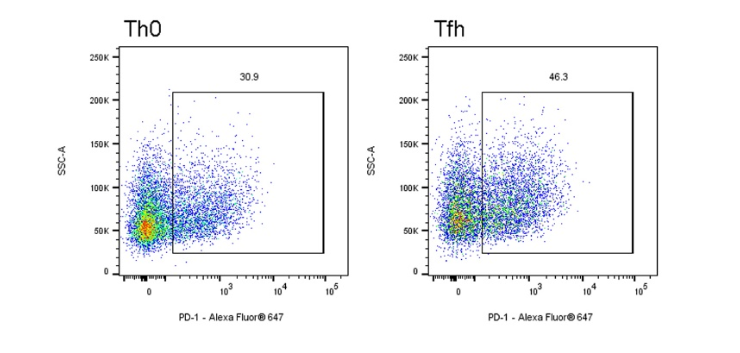
Tfh Polarization Kit, Human /人Tfh极化套装_UA090023_优爱(UA BIOSCIENCE)官网
B. Mouse Tfh Polarization Protocol
1. Cell Culture
-
Coat a 48-well cell culture plate overnight with 10 µg/ml anti-mouse CD3ε mAb and 2 µg/ml anti-mouse CD28 mAb.
-
The next day, after washing and blocking the plate, add sorted CD4+ T cells.
-
Use RPMI-1640 medium supplemented with 100 ng/ml IL-6, 50 ng/ml IL-21, 30 ng/mL TGF-β1, 10 µg/ml anti-IL-2, 10 µg/ml anti-IFN-γ, 10 µg/ml anti-IL-4, 55 µM β-mercaptoethanol, and 10% FBS for culture.
-
Starting at 48 hours, monitor cell concentration every 12 hours. If the cell density is high, split the cells into new wells and add the above culture medium for stimulation (without adding anti-mouse CD3ε and anti-mouse CD28 mAb for re-stimulation).
-
After 5 days of culture, collect the cells, adjust the density to 10⁶/ml, and treat with 10 ng/ml PMA, 1 µg/ml Ionomycin, and 10 µg/ml Brefeldin A for 5 hours.
Negative Control Group (Th0 cells):
-
Coat a 48-well cell culture plate overnight with 10 µg/ml anti-mouse CD3ε mAb and 2 µg/ml anti-mouse CD28 mAb.
-
The next day, after washing and blocking the plate, add sorted CD4+ T cells.
-
Maintain the cells in RPMI-1640 medium supplemented with 10% FBS, 55 µM β-mercaptoethanol, 10 µg/mL anti-mouse IFN-γ, and 10 µg/mL anti-mouse IL-4.
-
Starting at 48 hours, monitor cell concentration every 12 hours. If the cell density is high, split the cells into new wells and add the above culture medium (without adding anti-mouse CD3ε and anti-mouse CD28 mAb). Culture for 5 days.
2. Flow Cytometry Analysis
-
After collecting the cells, stain with flow cytometry antibodies and run on the flow cytometer.
-
Suggested Antibody: SOB5654 Starter APC Rat Anti-Mouse PD-1 Antibody
-
Reference Kit: Tfh Polarization Kit, Mouse (UA090024) - UA BIOSCIENCE Official Website
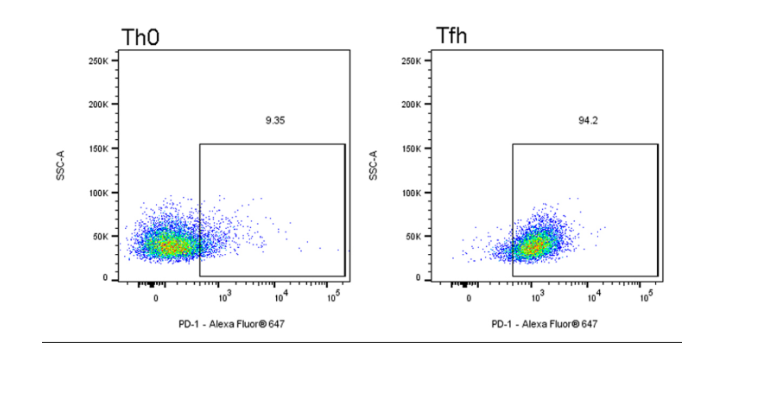
Tfh Polarization Kit, Mouse/小鼠Tfh 极化套装_UA090024_优爱(UA BIOSCIENCE)官网
Disclaimer: The protocols provided are general reference guides. Specific experimental conditions should be optimized based on your own experimental system.
This article is reviewed and published by the technical expert team of UA
Disclaimer: This article partially utilizes artificial intelligence assistance in its creation. If any content involves copyright or intellectual property issues, please let us know and we promise to verify and remove it as soon as possible.
Purchase recombinant protein, choose Nanjing UA-Bio
UA protein focuses on providing various protein reagents, raw materials, and services required for drug research and development, cell therapy, gene therapy, and basic scientific research, including drug target proteins, immune checkpoint proteins, cytokines, tool enzymes, customized protein expression, and full-length transmembrane protein development. Youai is committed to providing customers with high-quality products and professional services, and building a High-tech Biological Enterprise with International Competitiveness.







 Business license (three certificates in one)