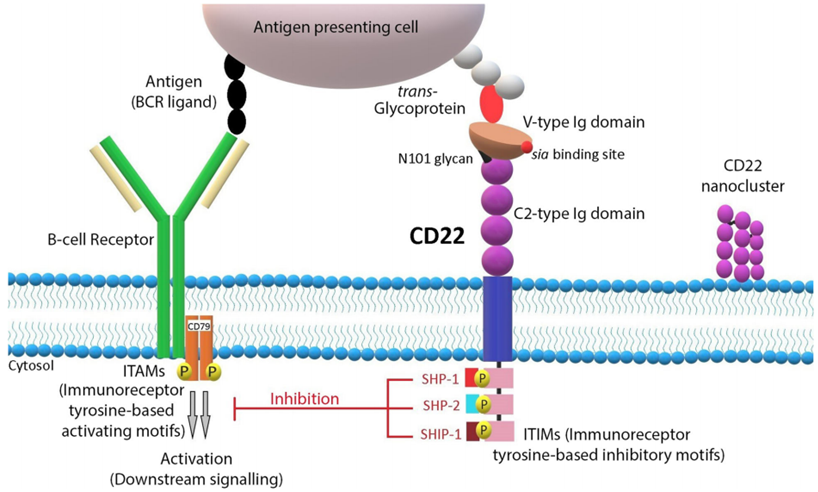
Figure. Structure and signaling pathway of Siglec-2/CD22
Siglec-2/CD22 has a molecular weight of 135 kDa, with its extracellular domain composed of seven immunoglobulin-like domains that specifically bind α2,6-linked sialic acid (α2,6Sia) ligands. This binding regulates B-cell functions through two modes:
- Cis-interaction: Siglec-2/CD22 binds to self-sialylated ligands on B-cell surfaces, forming nanoscale clustered structures sequestered in clathrin-rich membrane microdomains to inhibit B-cell receptor (BCR) signaling.
- Trans-interaction: Siglec-2/CD22 binds to sialylated ligands on other cells, regulating B-cell migration and BCR signaling thresholds. When crosslinked with BCR, its intracellular immunoreceptor tyrosine-based inhibitory motifs (ITIMs) are phosphorylated, recruiting tyrosine phosphatase SHP-1 to dephosphorylate downstream signaling proteins, ultimately suppressing B-cell activation.
This dual regulatory mechanism establishes Siglec-2/CD22 as a key molecule for maintaining humoral immune homeostasis. Siglec-2/CD22-deficient mice exhibit excessive B-cell activation, increased autoantibody production, and systemic autoimmune symptoms, confirming its core role in preventing autoimmune diseases.
Siglec-2/CD22 is highly expressed on the surface of over 90% of acute lymphoblastic leukemia (B-ALL), non-Hodgkin lymphoma (NHL), and hairy cell leukemia (HCL) cells, while lost in plasma cells. Its expression pattern correlates with disease progression:
- Drug resistance mechanism: Approximately 30% of relapsed patients after CD19 CAR-T therapy show CD19 loss, while Siglec-2/CD22 CAR-T overcomes this resistance. However, some patients escape treatment through downregulated Siglec-2/CD22 expression (Siglec-2/CD22−/dim disease).
- Prognostic marker: The endocytic property of Siglec-2/CD22 makes it an ideal target for antibody-drug conjugates (ADCs). Tumor cells with high Siglec-2/CD22 expression efficiently internalize ADCs, releasing cytotoxic drugs (e.g., ozogamicin) for precise tumor cell killing.
Siglec-2/CD22 functional deficiency is linked to the pathogenesis of systemic lupus erythematosus (SLE), rheumatoid arthritis (RA), and other autoimmune diseases:
- Signaling pathway dysregulation: Siglec-2/CD22 suppresses BCR signaling to prevent autoreactive B-cell activation. Siglec-2/CD22 deficiency leads to excessive B-cell responses to self-antigens, producing autoantibodies like antinuclear antibodies.
- Microglia regulation: In Alzheimer’s disease (AD), Siglec-2/CD22 is expressed on microglia, and its binding to sialylated ligands inhibits microglial phagocytosis of β-amyloid (Aβ). Elevated plasma soluble Siglec-2/CD22 (sSiglec-2/CD22) levels positively correlate with brain Aβ deposition and cognitive decline in AD patients, suggesting Siglec-2/CD22 as a potential biomarker and therapeutic target for AD.
ADCs deliver cytotoxic drugs to tumor cells via antibody-specific binding to Siglec-2/CD22:
- Inotuzumab ozogamicin: The first global ADC approved for relapsed/refractory B-ALL, achieving a complete response rate (CR) of 58% and a median overall survival (OS) of 7.7 months.
- Moxetumomab pasudotox: A Siglec-2/CD22 ADC for hairy cell leukemia, inhibiting protein synthesis through catalytic pseudotoxin, with a CR rate of 41% and good tolerability.
Siglec-2/CD22 CAR-T modifies T cells to express chimeric antigen receptors targeting Siglec-2/CD22, demonstrating significant efficacy:
- Clinical data: In a phase I trial, 58 Siglec-2/CD22+ B-cell malignancy patients received Siglec-2/CD22 CAR-T therapy, achieving a CR rate of 70% and median OS of 13.4 months. However, two grade 5 adverse events (related to cytokine release syndrome) occurred in the high-dose group (3×10⁶/kg), indicating the need to optimize dosing regimens.
- Combination strategy: Combining Siglec-2/CD22 CAR-T with CD19 CAR-T overcomes antigen escape, achieving a 93% CR rate in relapsed/refractory B-ALL.
- Suciraslimab: The world’s first Siglec-2/CD22 monoclonal antibody (mAb) filed for 上市 (marketing), used to treat rheumatoid arthritis. It restores B-cell signaling regulation by blocking Siglec-2/CD22 binding to sialylated ligands, reducing autoantibody production.
- Epratuzumab: An immunomodulatory Siglec-2/CD22 mAb that induces Siglec-2/CD22 phosphorylation and downregulates BCR expression, significantly reducing disease activity scores (SLEDAI) in SLE patients.
Research on Siglec-2/CD22 not only deepens our understanding of B-cell immune regulation but also provides innovative solutions for treating malignant and autoimmune diseases. With continuous advancements in targeting technologies, Siglec-2/CD22 is poised to become a key therapeutic target in more disease areas.
|
Product Number
|
Product name
|
Expression System
|
|
UA011196
|
Alexa Fluor 647-Labeled Siglec-2/CD22 His Tag Protein, Human
|
HEK293
|
|
UA011227
|
PE-Labeled Siglec-2/CD22 Fc&Avi Tag Protein, Human
|
HEK293
|
|
UA011228
|
PE-Labeled Siglec-2/CD22 His&Avi Tag Protein, Human
|
HEK293
|
|
UA010426
|
Biotinylated Siglec-2 Fc&Avi Tag Protein, Human
|
HEK293
|
|
UA011007
|
Biotinylated Siglec-2 His&Avi Tag Protein, Human
|
HEK293
|
|
UA010679
|
Siglec-2/CD22 His Tag Protein, Human
|
HEK293
|
|
UA010025
|
Siglec-2/CD22 Fc Chimera Protein, Human
|
HEK293
|
|
UA010359
|
Siglec-2/CD22 His Tag Protein, Mouse
|
HEK293
|
|
UA010979
|
Siglec-2/CD22 His Tag Protein, Rat
|
HEK293
|
Alexa Fluor 647-Labeled Siglec-2/CD22 His Tag Protein, Human Product Number: UA011196
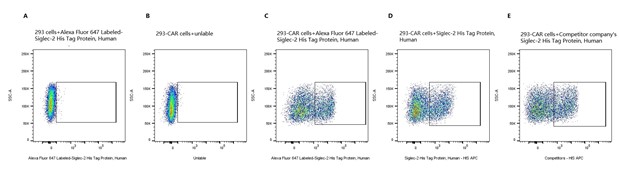
5e5 of transient transfected anti-Siglec-2 ScFv CAR-293 cells were stained with 0.1ug Alexa Fluor 647 Labeled-Siglec-2 His Tag Protein, Human, (Cat. No. UA011196) and unlable respectively (Fig. C and B), and non-transfected 293 cells were used as a control (Fig. A). Alexa Fluor 647 signal was used to evaluate the binding activity.
5e5 of transient transfected anti-Siglec-2 ScFv CAR-293 cells were stained with 0.1ug Siglec-2 His Tag Protein, Human (Cat. No. UA010679) and competitor respectively (Fig. D and E). APC signal was used to evaluate the binding activity.
Biotinylated Siglec-2 Fc&Avi Tag Protein, Human Product Number:UA010426
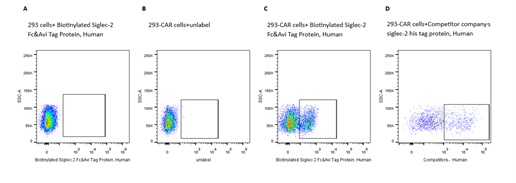
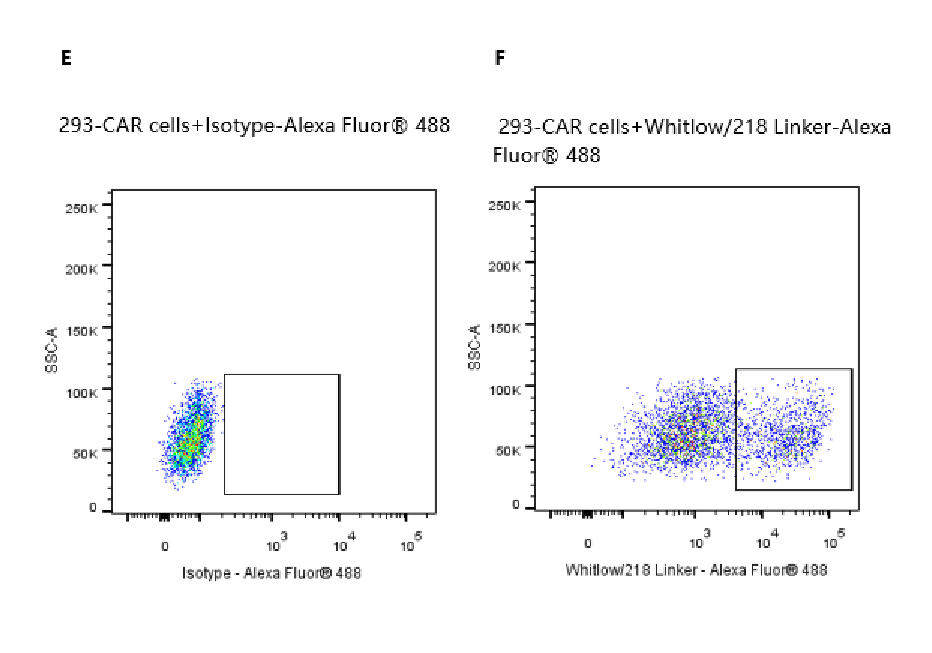
2e5 of transient transfected anti-Siglec-2 ScFv CAR-293 cells were stained with 0.1ug Biotinylated Siglec-2 Fc&Avi Tag Protein, Human, (Cat. No. UA010426) and unlabel respectively (Fig. C and B), and non-transfected 293 cells were used as a control (Fig. A). PE signal was used to evaluate the binding activity. 2e5 of transient transfected anti-Siglec-2 ScFv CAR-293 cells were stained with competitor respectively (Fig. D). APC signal was used to evaluate the binding activity. 2e5 of transient transfected anti-Siglec-2 ScFv CAR-293 cells were stained with isotype and Whitlow/218 Linker-Alexa Fluor® 488 (Fig. E and F). Alexa Fluor® 488 signal was used to evaluate the binding activity.
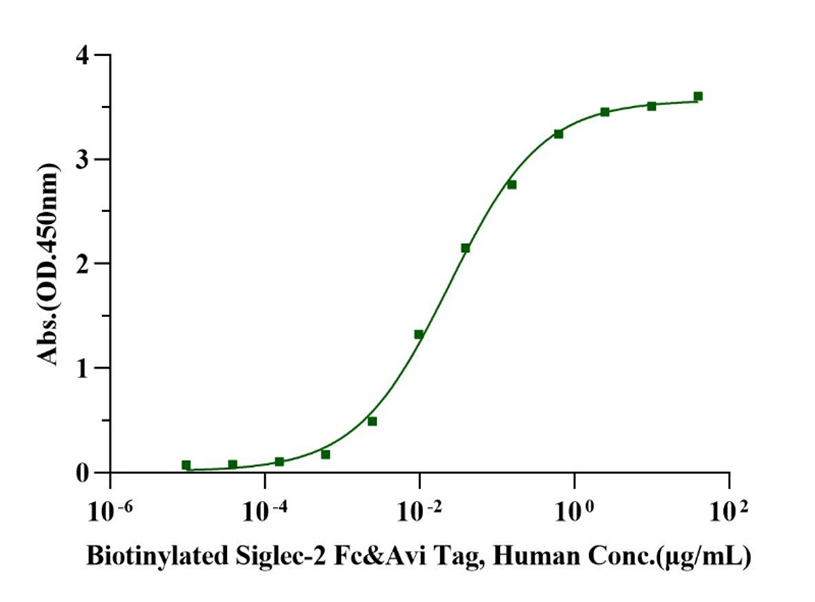
Immobilized Anti-Human CD22 Monoclonal Antibody(Pinbio) at 1.0μg/mL (100μL/well) can bind Biotinylated Siglec-2 Fc&Avi Tag Protein, Human (Cat. No. UA010426) with EC50 of 1.92-2.95ng/mL.
Click on the product catalog numbers below to access detailed information on our official website.
This article is reviewed and published by the technical expert team of UA
Disclaimer: This article partially utilizes artificial intelligence assistance in its creation. If any content involves copyright or intellectual property issues, please let us know and we promise to verify and remove it as soon as possible.
Purchase recombinant protein, choose 
UA protein focuses on providing various protein reagents, raw materials, and services required for drug research and development, cell therapy, gene therapy, and basic scientific research, including drug target proteins, immune checkpoint proteins, cytokines, tool enzymes, customized protein expression, and full-length transmembrane protein development. Nanjing Univ is committed to providing customers with high-quality products and professional services, and building a High-tech Biological Enterprise with International Competitiveness.
Target proteins | membrane proteins | cytokines | enzymes | viral antigens | protein customization
Buy antibodiesFind UA www.ua-bio.com | 15 years of protein development experience 












 Business license (three certificates in one)